

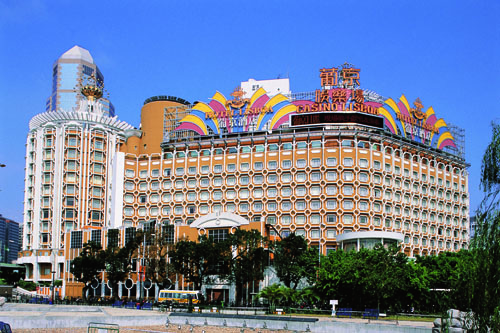
Prior to the current Covid-19 lockdown, casinos in Macao were already engaged in a $600 million/month cash burn, thanks to the China‘s zero-tolerance policy on the disease. That will only get worse now that access to customers has been shut off entirely, needless to say. Given the former and potential money-making puissance of Macao, the six operators have no chance but to hunker down and absorb the punishment, especially as they wait the six months before their licenses are renewed, as appears inevitable. (And why not?) “The sad part is that it’s going to be years until business comes back to where it used to be,” observed gaming pundit Alidad Tash. How many years remains to be seen but the smart money is on later rather than sooner.
To demonstrate their good corporate citizenship, the concessionaires are keeping their payrolls (laudably) intact. Also, after some hemming and hawing, they are also maintaining salary payments to said workforces. In the meantime, U.S.-owned operators are looking to their corporate parents for loans to stay in business. But that’s nothing compared to the predicament of SJM, which is unlikely to remain a going concern if the shutdown continues a month longer. Stanley Ho‘s erstwhile monopoly has fallen on sorry days. The American companies are solvent but have to worry about talk that Peking views them as “an unacceptable national security risk.” After all, casinos get to know their customers very well. Right now, Macanese casinos would be happy to have some customers, period.

Caesars Entertainment says it plans to apply for sports betting in Ohio. But the Roman Empire is leaving it pretty late: Applications are due tomorrow. Also missing in action are Rush Street Interactive, Bally’s Corp. and Hard Rock International. If they don’t make the deadline they’re not shut out of the Buckeye State but it’s a cinch they’ll miss the Jan. 1, 2023, launch date. And, as we have seen, the race in sports betting goes to the hare, not the tortoise. Already in the derby are FanDuel, Fanatics and a Betfred/Cincinnati Bengals partnership, as well as DraftKings, BetMGM, Barstool Sports and PointsBet. Fanatics lacks a terrestrial partner, so it will have a tougher row to hoe toward licensure. Putting the cart before the horse, Caesars struck a deal with the Cleveland Cavaliers to have an in-stadium sports book—but can’t manage to file its paperwork. Look for first-filers BetMGM and Barstool to eat its lunch.
FanDuel CEO Amy Howe has never been afraid to swim against the flow of conventional wisdom, as she did yesterday in an interview with CNBC‘s Contessa Brewer. “There’s no doubt that the market is not working right now,” Howe told Brewer. “The way we look at it, even if the market was working, there was going to be some form of consolidation.” She thinks that 15 operators are too many and 12 may be, too. Since Howe plans on growing her company, look for FanDuel to be a consolidator rather than one of the consolidated. (A former COO of Ticketmaster, Howe is no novice at separating consumers from their money.) In related observations, Howe is guardedly optimistic about the passage of Proposition 27 in California, thinks the sports betting industry could do more to promote female athletes but draws the line at getting involved with college athletics. We were skeptical of Howe when she took over FanDuel but she’s proven us wrong, happy to report.
May sports betting numbers have crept over the transom from Illinois. Despite robust hold, revenue was down to $67.5 million on handle of $764.5 million. FanDuel had the highest hold percentage of the majors (12%) and DraftKings the loosest (7%). Revenue leader was FanDuel with $35 million, then came DraftKings’ $14 million and BetRivers‘ $9 million. Also in the picture was Barstool Sports with $3 million, as was PointsBet with $4 million, while Caesars Sportsbook got almost completely blanked. Time to bring DJ Smoove back.
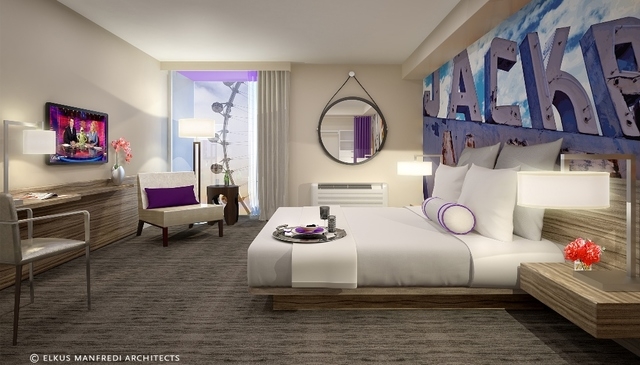
Jottings: Paying more for hotel rooms? Then you’ll be getting more service, right? Wrong! The 17% increase in hotel prices over 2019 is driven by hoteliers exploiting increased demand. Customer satisfaction, meanwhile, has declined by 11 points, according to J.D. Power … If you’re nostalgic for the days of the Rat Pack (who isn’t?), Esquire has a treasure trove of anecdotes and old photographs … Not to be outdone, Atlas Obscura busts out 15 iconographic sites in the life of Elvis Presley. Alas, the much-rubbed statue at Westgate Las Vegas is the only one in Sin City … Tonight’s episode of Restaurant: Impossible, starring Robert Irvine, alights in Boulder City, the only town in the Silver State that prohibits gambling … Affirmative action has gone by the boards in Maryland. In order to issue 60 sports betting licenses in a timely manner, minority and female ownership will no longer be criteria, at least for now … Washington, D.C.‘s clumsy, dysfunctional—and thoroughly juiced in—GameBet sports betting operation is coming under fire from the City Council. The money-losing application is also losing support in the corridors of power, which should be very bad news for Intralot, maker of GameBet. Office of Lottery & Gaming Executive Director Frank Suarez, however, seems determined to go down with the Intralot ship.
Quote of the Day: “The blizzard doesn’t last forever; it just seems so.”—author Ray Bradbury

Those Prop 27 TV commercials Ms. Howe is running are absurd, they have a Native American doing a testimonial about how Prop 27 is going to be great for Native Americans, when in fact the Native American tribes are against Prop 27, and have their own proposition. I favor Prop 27 on the merits, so to see this kind of advertising and what FanDuel thinks of Californians is depressing. It’s only July and the mudslinging and deception are already disgustingly thick, and because I watch local sports programming, I am in the target range, gonna be a long time waiting for this to be over…