


After a somnolent Tuesday, all heck has erupted in the gaming universe and we’ll try to cram at least some of it into today’s dispatch. Gaming revenues continue to flicker here and there, while remaining high heavens above 2019’s outstanding numbers. Missouri casinos grossed $169.5 million last month, 1% higher than last year, as gambling fever continues to level off, albeit at an elevated level. A nice problem to have. Gamblers visited 5% less but spent 7% more in Show-Me State casinos. Starting in Kansas City for a change, Ameristar Kansas City (above) led the market with $18 million (flat). Rebranded Bally’s Kansas City continues to devour market share, up 11.5% to $10.5 million. One of its victims was Harrah’s North Kansas City, down 7% to $15 million, while Argosy Riverside was flat at $16 million.
Statewide leader, as ever, was Ameristar St. Charles, up 1.5% to $27 million. In a Penn Entertainment-vs.-Penn contest, River City climbed 11% to $22.5 million while Hollywood St. Louis hopped 11% to $21.5 million, a win-win if ever there was one. Unfortunately Horseshoe St. Louis couldn’t stop its slide, dropping 11% to $13 million. Century Casinos dipped 3% ($6 million) in Cape Girardeau and 18% ($4 million) at construction-disrupted Century Caruthersville. Strongest of the boondock casinos was Isle of Capri Boonville, up 4% to $8.5 million.
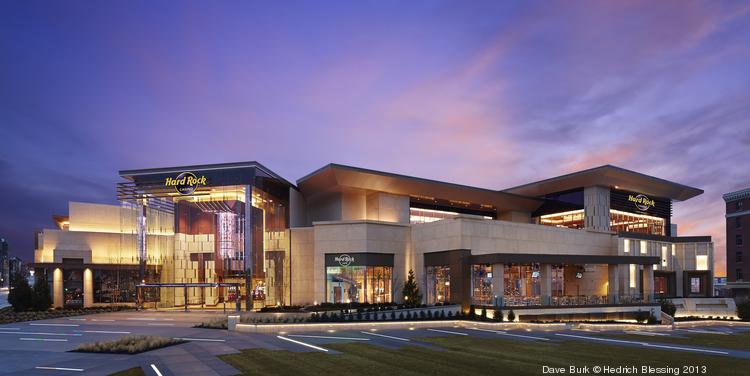
In a month when perennially struggling Illinois was up 2%, perpetually strong Ohio had a mild, 2% swoon-let. The statewide gross was $207 million, 27.5% better than it was three years ago. Not everybody had an adverse July. MGM Northfield Park was up 2% to $25 million, best in the Buckeye State (we never cease to marvel that this is done without table games). Hard Rock Cincinnati (above) continued to climb, up 3% to $22 million, Scioto Downs rose 1.5% to $21 million and Miami Valley Gaming hopped 5.5% to $20.5 million. Hard to complain about numbers like those. There was a fierce struggle for second place, ultimately won by Hollywood Columbus with $23 million (-3%), closely followed by Jack Cleveland, a hair under $23 million (-3%). Hollywood Toledo banked $20.5 million (-4%). The worst month was had by Jack Thistledown, down 13.5% to $16 million. Belterra Park slipped 6% to $8 million, Hollywood Dayton took in $13 million (-6%) and Hollywood Mahoning Valley rounded things out with $14 million (-6%).

For Wynn Resorts, 2Q22 was all about record numbers in Las Vegas and Boston (and never you mind Macao). Shooting 40% past its 2014 peak, Wynncore posted $227 million in cash flow, hitting best-evers in everything except baccarat. (No surprise there.) 91% hotel occupancy augurs well for the third quarter, says CEO Craig Billings. “While we haven’t seen any noticeable sign of weakness in our current operations or outlook, we’re watching this closely,” he hedged. As for Encore Boston Harbor, its $64 million cash flow was also a record. Macanese casino revenue was all but nonexistent, -98% from 2019. A fortnight’s closure didn’t help, costing Wynn $1 million a day. Billings whistled a happy tune about pent-up demand in China. We don’t doubt that it exists but it’s a huge uncertainty, thanks to Peking‘s inscrutability with regard to anti-Covid policy, to say nothing of who can come to Macao and in what numbers. It’s big government at its worst.
The company was aggressive in stock buybacks, spending $137.5 million to repurchase 2.4 million shares. Still that wasn’t enough to placate some analysts. JP Morgan‘s Joseph Greff sped over the Las Vegas and Massachusetts numbers to zero in on an $82 million loss in China. He did allow that the stock repurchase was unexpected and “a nice surprise.” Like Billings, Greff was upbeat about the prospects for sports betting in the Bay State, although Gov. Charlie Baker (R) is keeping everyone on pins and needles. “[D]ialing in a recession scenario,” Greff is modeling a domestic 10% decline in gambling revenue next year. “As for Macau, we see no improvement until the 2023 at the earliest (not that we, or anyone, has a crystal ball for when that market starts to improve) and, quite honestly, it’s hard to have much conviction in 2023 Macau estimates.”

Saying that Wynn was “attractive for patient (dare we say brave) value oriented investors,” Greff remained neutral on the stock, saying better values were to be found elsewhere. Thanks to Macao, Wynn came in well short of Wall Street‘s consensus for 2Q22 cash flow, even though it far overshot projections in Las Vegas ($561 million vs. $503 million) and Boston ($210 million vs. $201 million). Wynncore room rates averaged a stratospheric $460/night, while highs in slot handle (+19%) and table play (+32%) were achieved with little international participation. Room rates at Encore Boston Harbor were 22% higher than anticipated. WynnBet continues to curb losses, generating a $20 million negative ROI, thanks in part to curtailed broadcast advertising.
Deutsche Bank analyst Carlo Santarelli was more bullish, despite shaving his price target on WYNN all the way from $92/share to $85. Macao, he wrote, “was an afterthought in the discussion as the market remains a story of cash preservation more so than operational performance.” The domestic results he found unsurprising (in a good way), noting that Las Vegas Strip customers appear “indifferent to costs.” (We’ll say!) Unlike others, Santarelli didn’t find Massachusetts sports betting “overly meaningful/relevant, but we do believe the opening of the retail sportsbook at the property could provide ancillary benefits to the asset, and we believe the database sign-ups could also add to the broader domestic ecosystem.” He also foresees a dimmer 2023 (and 2024) but because of Macao, not stateside concerns. Vegas convention booking are said to be “quite strong” next and already “ahead of pace” for 2022.
Billings tried to make whoopee about the company’s United Arab Emirates casino-to-be but Wall Street ignored him, preferring to focus—positively—on $200 million or more capex happening at Encore Boston Harbor. With Wynncore revenues shooting 58% past 2Q21 and Bostonian ones up 27%, who needs the UAE … for now?

Executives at Station Casinos showed why they get paid the big bucks and we don’t. They said they are “fielding a lot of calls from parties interested in the [sites of] three closed properties” they’re planning to demolish. We’ll freely admit to having been skeptical about the level of interest in empty acreage, even in this economy, but Station is proving us wrong. The company is looking aggressively to the future, with CFO Stephen Cootey stressing the new, 128-acre site on Cactus Lane, hard by South Point. “We are excited about the potential of this site as a local and regional destination casino resort and look forward to setting our plans for this parcel in the future,” remarked the CFO.
The company is also exploring the viability of its 67-acre “Losee Station” land on the north Beltway. “These two acquisitions are a continuation of our 46-year history of growth through the purchase of gaming sites located in high-growth areas with superior ingress and egress among major beltways in the Las Vegas Valley,” remarked Cootey. Station has also has at least three other projects incubating, to say nothing of in-progress Durango Station. “We expect to double the size of the portfolio by 2030 and continue to roll out new properties one after the other,” said CEO Frank Fertitta III, adding that Station will use the Durango property’s performance as a harbinger for what to do next and when.
Compared to its reckless expansionism prior to the Great Recession, Station is now (per its leadership) watching demand/supply dynamics and population demographics, a change we applaud—although it’s hard to square more talk of 100% expansion by 2030 with verbiage about risk/reward strategies. Station is sending a very mixed message, at least for now. As for budgets, watch the results at Durango closely, because execs have committed themselves to a goal of 20% ROI on all future projects, aggressive but not unachievable.
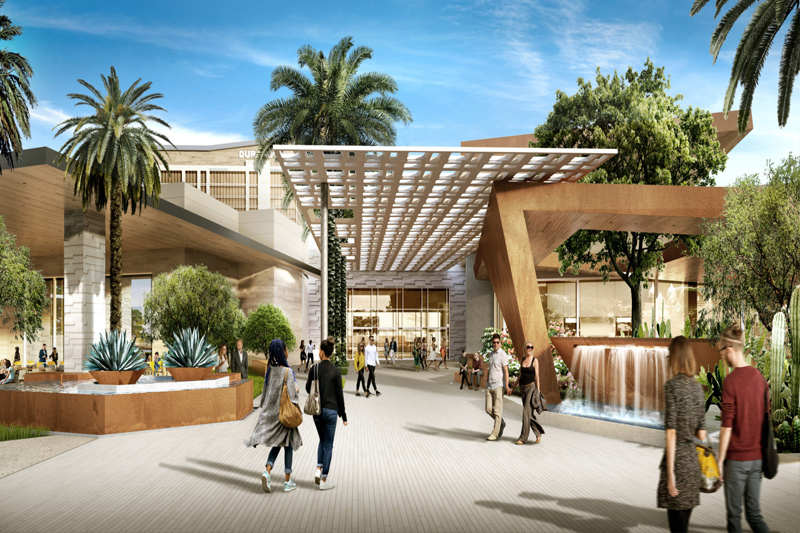
Profit was way down, however, $32.5 million against 2Q21’s $143.5 million. Revenues also inched down 1% to $422 million. Still, per Truist Securities analyst Barry Jonas, Station beat estimates and had a “solid” second quarter, calling the numbers “a near-record.” Regarding Station’s stated desire to double its Vegas presence in eight short years, Jonas opined that “We can see some investor resistance to a large development strategy in the macro environment, but also think [management] is planning for the longer-term.” His enthusiasm can be attributed to a best-ever quarterly cash flow ($189 million) and to beating what look like some rather cautious revenue estimates—for instance, Santarelli expected 16% less cash flow and Station delivered -8%.
In other Jonas news, the Wildfire planned for part of the former Castaways site (finally getting gentrified) has been redubbed Fremont, another upscale move. Modestly budgeted at $24 million, it will hold 200 slots, table games and two restaurants. Greff dared to venture that Station would realize $1 million per acre (pretty good) for each of its three demolition sites, a $107 million payday should it happen. Unlike some of its competitors, Station is also seeing an improvement in low-end play, another positive augury. While still predicting a 10% falloff in locals gaming revenue next, Greff—who likes the supply/demand picture—ratcheted up his cash-flow forecast for the remainder of 2022. Looking ahead to 2024, he predicts a “more normalized” growth rate and (contra the Fertittas), a 15% or lower ROI on Durango Station. Given the $750 million price tag, that’s a sensible forecast. On the whole, however, he was quite positive on Station’s long-term prospects.
Santarelli applauded the potential removal of $8 million in carrying costs for the three casino derelicts and raised his cash flow projections through 2024. He raised his price target on Station from $45/share to $50, saying “we continue to believe the balance sheet, growth pipeline, real estate ownership, relative valuation, and LV locals market strength, differentiate RRR from regional peers.” If you scrolled down to the fine print, one discovers that the Wild Wild West acreage (considerable) is “held for sale,” perhaps for a potential sports stadium and that two key Station parcels, the Losee Road one and another on Las Vegas Boulevard are still “seeking gaming entitlement.” That may be a formality but it could slow Station’s doubled-by-2030 timeline. Don’t worry: Station has at least five other sites it could develop in the meantime, so the Fertitta Brothers will be kept busy, we don’t doubt.
In other details, management spent $114 million on stock buybacks. Per Santarelli, “visitation and spend per visit were up across portfolio properties during the quarter and that database trends in the 2Q22, across all segments, were similar to those in the 1Q22 and this has continued into the 3Q22.” Regional and out-of-town visitation continues on the upswing. Execs noted “wage inflation” but expect it to subside for unspecified reasons by year’s end, presumably an allusion to recessionary trends in the larger economy.
Jottings: Not today, we’re knackered. See you tomorrow.

[…] Source link […]