

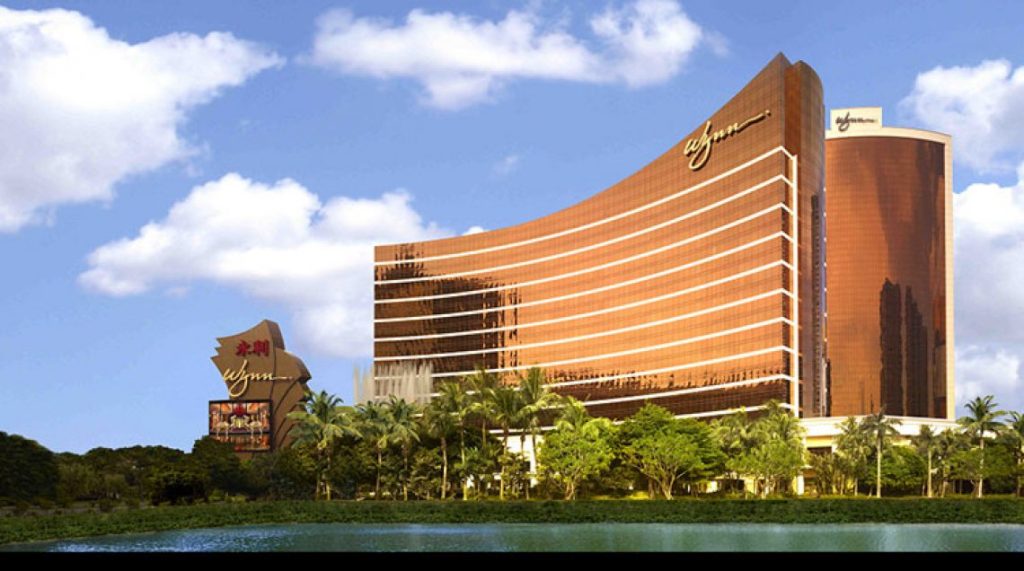
Wall Street analysts were across-the-board upbeat on Wynn Resorts‘ 3Q22 performance, as high-end casinos in Las Vegas continue to flourish. Although he categorized himself as “neutral,” given the evolving situation in Macao, analyst Joseph Greff of J.P. Morgan encapsulated third-quarter sentiment with “Upside in Las Vegas and smaller than forecasted losses in Macau.” Sounds pretty good to us. More specifically, Wynn beat expectations, largely on the strength of Sin City, backstopped by Boston. Interestingly, as Greff said, in Macao the company’s casinos—absent the junket middlemen—picked up a solid amount of direct VIP play during Golden Week, better even than in 2019. (Its retail component recovered to three-fourths of pre-Covid business.)
Greff was dismissive of the significance of Tilman Fertitta‘s big buy-in of WYNN shares, writing, “we think this relates more to an industry person seeing value in the stock rather than eventually angling for a transaction or M&A.” Wynn CEO Craig Billings agreed, telling investors, “What I can say is kudos to him, because he’s done quite well since it appears he has started acquiring during the second quarter when the stock was excessively cheap. It’s actually right around when we were buying back stock as well. It’s a great recognition of the value of our equity.”
More surprisingly, Billings hedged on Wynn Resorts’ commitment to New York City, saying, “We’re always interested in locations like New York. The devil is in the details when it comes down to what the upfront license payment, taxes and regulation details end up being.” That’s a heck of a lot of wiggle room Billings is giving himself, and it should gladden the hearts of Empire City Yonkers and Resorts World New York City (as well as Caesars Entertainment). Billings was much more enthusiastic about the United Arab Emirates: “The more time we spend over there, the more we believe in the non-gaming elements for that market … Given it’s a man-made island without any existing development, it’s an incredibly flexible location on which to plan. For example, if you want to move a beach, you move a beach. The casino will be “slightly larger” than the initial Wynncore one, given that Wynn will have the market to itself.

Greff continues to model a recession for 2023, forecasting an 8% diminution in Wynncore revenues and 5% at Encore Boston Harbor (cushioned by the advent of sports betting, on which the company sets great store). “As for Macau, we see no improvement until 2023 at the earliest (not that we, or anyone, has a crystal ball for when that market starts to improve) and, quite honestly, it’s hard to have much conviction in 2023 Macau estimates,” he added. Wynn Palace brought a $44 million negative ROI and Wynn Macau was $22 million negative, of which the best that can be said was that The Street expected worse from both. The sole domestic blemish on 3Q22 results was a greater-than-anticipated loss ($18 million, hardly catastrophic) in the WynnBet division, always an Achilles Heel for the company.
Meanwhile back in Las Vegas, room bookings have returned to pre-pandemic levels and ADRs are significantly higher (think $426/night on 89% occupancy). Gamblers were enthusiastic, too, with 72% higher coin-in and 32% larger table wagering than in 3Q19. Wall Street expected $502 million in Wynncore revenue and the resort delivered $544 million. And if you ever wondered how much a day it costs to run that place, the magic number is $3.5 million. Wynn has over $4 billion cash on hand against a worrisome leverage of $10 billion.

According to Deutsche Bank analyst Carlo Santarelli, there were only “limited signs of cost creep” from utilities and labor, and October results were at record levels. He thought Macanese casino renewals could come as soon as next week and appeared that Wynn would be in the winners’ circle. Santarelli observed that WynnBet would take a $12 million body blow from John “Mattress Mack” McIngvale, so there goes the interactive 4Q. He added, “While we view the business as an afterthought for investors at present, the losses continue to curb, and we don’t expect material spending to resume, outside of incremental state launches. Management noted that it believes retail sports betting in Massachusetts will have a considerable head start, relative to mobile, thereby giving WYNN a nice opportunity to establish a customer database in a cost effective manner ahead of the mobile launch.”
Calling Wynn a “compelling setup,” Credit Suisse‘s Ben Chaiken characterized the Encore Boston Harbor numbers as “better than expected.” Still, “We think the largest takeaway is strength in Vegas, particularly on the hotel side and slots.” He dismissed Macao as a “non-factor,” adding that it should change for the better this month as e-visas continue to be issued. (At present it is slightly easier to get into Macao than Hong Kong.) Wynn stock, by the way, is no longer a bargain, having shot up approximately $20 per share since Tilman invested. Doubtless Billings would like the Texan to buy some more.
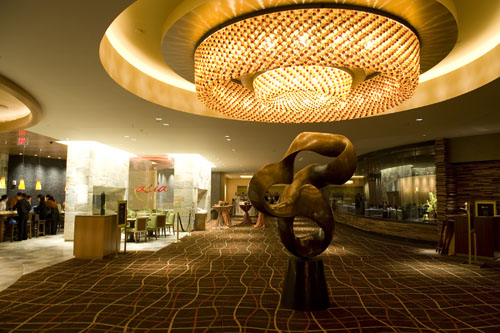
Missouri didn’t get the memo that gaming is recession-proof, as its numbers were down 5% last month, although still 9% higher than before the pandemic. We’ll not belabor you with 2019 comparisons but cut right to the near-term chase. Gamblers continued to spend more (+4%) but were 8.5% fewer in number. Horseshoe St. Louis (above), of all unlikely places, gained a point to close the month at $13 million. Flat year/year were River City ($21 million), Hollywood St. Louis ($19 million) and Bally’s Kansas City ($10.5 million). Everyone else lost traction. Ameristar St. Charles banked $24.5 million, good for top-dog status but a 7.5% decline. Argosy Riverside‘s $14.5 million represented a 4% dip, while Harrah’s North Kansas City did a 20% tumble to $12 million. Ameristar Kansas City ceded 2.5% but still led the market with $16 million. Construction-hampered Century Caruthersville dove 18% to $3.5 million but Century Cape Girardeau was down just 4% to hit $5.5 million.
Sports betting’s epochal wipeout in California is all over the headlines today. Former Cali casino regulator Richard Schuetz has a few thoughts on whether it ever had a chance in the first place. When he predicted the electoral result last May, Schuetz “seemed I had involved myself in some sacrilegious act.” Indeed he received profane verbal abuse about it. He responds, “Well, to all those folks who sent all of that cash to California for measure 27, welcome to the table. You have clearly been played, and you have been played hard.” He notes that Steve Wynn and Circus Circus Enterprises‘ Mike Sloan (two people nobody in gaming misses) tried to take out the California tribes in 1998 and got fed their asses. “It was obvious to me at the time that their main problem was arrogance and ignorance.” The basic problem is that Mighty Whiteys like Wynn simply underestimate California’s 110 tribes.
True, the tribes got clobbered on Proposition 26 but didn’t lose nearly as badly as Proposition 27 did. They did a better job of framing the debate: That Big Gaming would outsource the profits to Las Vegas and points east, and insource the social costs. This had the additional virtue of being accurate. (My assessment, not Richard’s.) They’re also, Schuetz resumes, much better-connected in Sacramento. As for the ‘solve homelessness’ ploy, “Californians were burned by this nonsense with the lottery and education, so that was a weak play.” What it comes down to, he concludes, is that Golden State citizens made Big Gaming for the carpetbaggers they were and treated them accordingly. Whatever keeps them up nights, it’s not “Where can I go to place a legitimate bet on the San Diego Padres?”
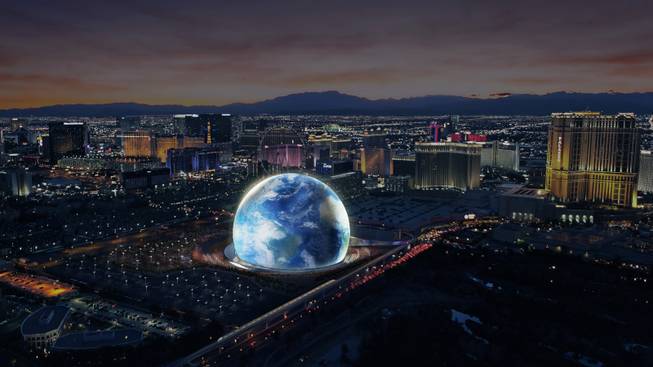
As for a sure thing that is starting to look iffy, how about the MSG Sphere, saddled with runaway costs that have taken it to $2.2 billion? (You could build a nice Las Vegas Strip casino for that much.) Once intended as a kind of King Tut’s Tomb for Sheldon Adelson‘s ego, its current purpose (now the province of Apollo Management) is unclear. As one perceptive Vegas observer tweeted, “It’s going to take a while to pay that one off no matter who plays there. I believe boondoggle is what it’s in danger of becoming.” Sort of like the off-again, sometimes-on-again All-Net Resort & Arena. According to MSG, the cost creep is “because of the ongoing impact of inflation, global supply chain pressures and the overall complexity of the project, MSGE officials said during the company’s fiscal first-quarter earnings call.” Ummmm, isn’t that why you do advance planning? Boyd execs built all of that into Sky River Casino, consequently opening under schedule and on budget.
Wall Street wasn’t fooled by the executive blather, with MSGE shares falling 8.5% on the news. CFO David Byrnes tried to divert investors with shiny objects: “We’re now in the midst of the seasonally strongest point of the fiscal year with our Christmas Spectacular [at Radio City Music Hall], the best months coming up for our bookings business and the impact of the Knicks and Rangers,” all of which are meant to pay for the Vegas cost overrun. Revealingly, however, “certain discretionary capital projects” will be cut back or deferred, sacrificed on the Strip altar. Byrnes says you have to see the finished Sphere to believe it. Will enough people do so? MSG is in so far it has no choice but to find out.

Although I’ve tweeted about this already, it bears repeating. The Culinary Union sent out an e-mail blast today touting the fact that it had knocked on over 1 million Nevada doors. But with Gov. Steve Sisolak (D) and Sen. Catherine Cortez Masto (D) both seemingly headed for defeat (and a snail-powered electoral system could delay the final tally by weeks), and Rep. Dina Titus (D) and Rep. Susie Lee (D) sweating out narrow leads, doesn’t the magnitude of the Culinary’s GOTV effort also amplify its failure to deliver, unlike previous election cycles?

[…] Source link […]
The Las Vegas Review Journal had a newspaper article entitled “MSG Sphere at The Venetian to cost $1.2 billion plus” from August of 2019 and the first sentence is interesting: “The MSG at The Venetian will cost between $1.2 billion and $1.7 billion, and the venue, once complete, is expected to be busier than Madison Square Garden in New York.”
Considering the New York Knicks (NBA) and New York Rangers (NHL) each play 41 home games a year in Madison Square Garden I doubt that the MSG Sphere will be busier than Madison Square Garden. Construction started on the MSG Sphere in late 2018.
According to the article back in 2019 MSG estimated the project cost at $1.2 billion while the general contractor AECOM estimates $1.7 billion. Talks are underway to resolve the difference.
“We think the general contractor’s estimate is too high and, as part of the contractual process, are reviewing and challenging our contractors estimates and assumptions,” Madison Square Garden Company CFO Victoria Mink said during a conference call with investors. “We believe, as a result of this process, that we will be successful in achieving significant cost reductions.”
WTF, the cost four years later is $2.2 billion dollars.