

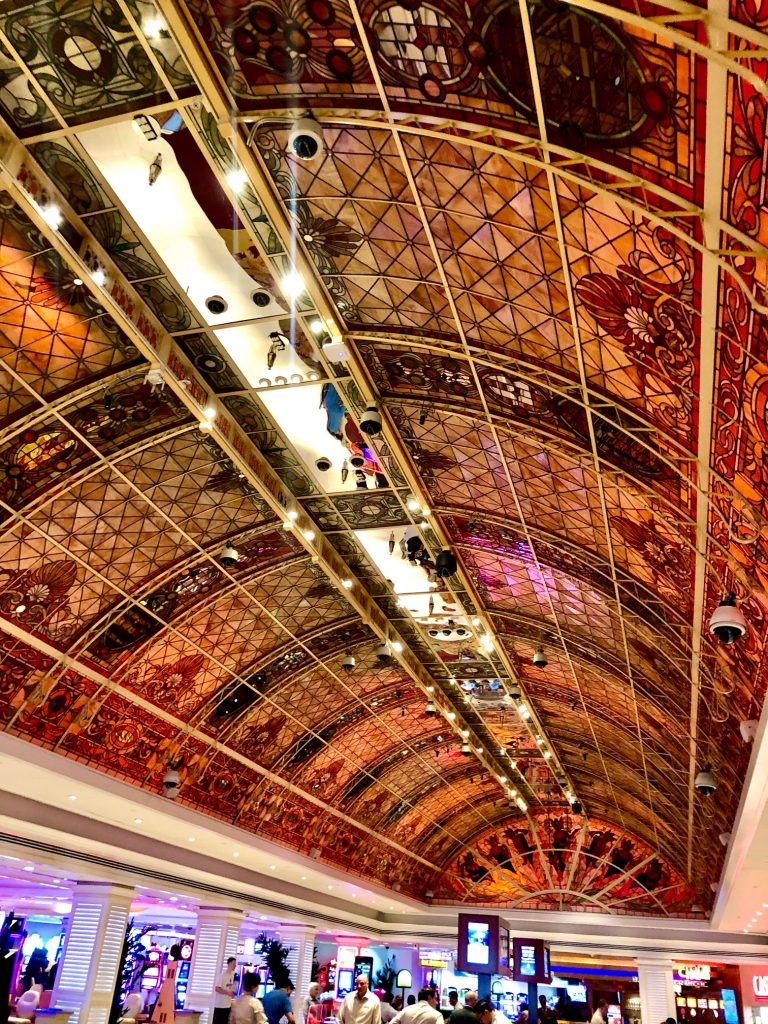
Now that the fix is in for the Oakland Athletics to get a vanity stadium in Las Vegas, the bosses of the Tropicana Las Vegas are losing no time in getting what’s really important: Imploding the old girl. Of course, they could be jumping the gun. Not a word has been breathed about how the A’s, who have consistently pled poverty to excuse their craptastic product, intend to come up with their share of the stadium money, which totals $1.1 billion. We expect some tin-cup rattling to occur once the state, Clark County and Vici Properties are too fully committed to back out. If Nevada gets off with a $380 million subsidy, it will be lucky.
In the meantime, the A’s must “negotiate” with the Las Vegas Stadium Authority to “establish a development agreement, lease agreement and non-relocation agreement, as well as a community benefits agreement.” The part about a non-relocation agreement is rich, considering that Las Vegas is poaching the abysmal A’s from Oakland. Anyway, since the Stadium Authority is chaired by Las Vegas Convention & Visitors Authority CEO Steve Hill, who’s already been up to Carson City shilling for the A’s, expect the talks to be little more than a charade. Having already carried water for the vagabond team, Hill is hardly in a position to drive a hard bargain from them.
As Oakland public information officer Julie Edwards told the press, “The reality is the A’s ownership had insisted on a multibillion-dollar, 55-acre project that included a ballpark, residential, commercial and retail space. In Las Vegas, for whatever reason, they seem satisfied with a nine-acre leased ballpark on leased land. If they had proposed a similar project in Oakland, we feel confident a new ballpark would already be under construction.”
Regarding the demolition of the Trop, Bally’s Chairman Soo Kim could hardly conceal his frustration at not getting to push the TNT plunger yesterday, telling the Las Vegas Review-Journal, “We don’t have specific times yet.” Boasting that he’d given the A’s $180 million worth of land for nothing, Kim effused, “Look we put up as much money as the county or the state and we did that because the economic benefits, to us, were clear. I think that the risk to all the talk of ‘what if the revenues fall short,’ I just think that is overblown. I think this is going to be a great success.”
Having drunk the A’s Kool-Aid to the dregs, Kim dismissed concerns about the wretched team they field: “the A’s are doing badly now, so this is not the team they want. That doesn’t make any sense. Sometimes teams have losing seasons, but I think a move is going to energize the team … I can’t imagine it not doing well.” Didn’t they say that about the then-Oakland Raiders? Also rubbing its hands with glee is MGM Resorts International, which has 20,000 fungible parking spaces, for which it plans to (over)charge long-suffering A’s fans. Play ball.

Speaking of politically expedient deals involving Bally’s, Illinois gaming regulators looked the other way and provisionally approved the temporary casino slated for Medinah Temple, enabling it to open by late July or early August, depending on how fast Kim’s company can move (and it seems to have been moving as fast as it can). Indeed, Kim bragged that Illinois Gaming Board staffers couldn’t “keep up with us.” It’s a casino, Soo, not a footrace and it’s still not staffed nor its games approved. He has reason to be smug, though. The application was so juiced it got green-lit in record Illinois time and will open less than a year after being awarded—lightning speed.
The Chicago Sun-Times noted how juiced-in the casino was, reminding readers than then-mayor Lori Lightfoot chose Bally’s “without any substantial input from a City Council committee,” that Lightfoot steered Bally’s to Medinah Temple, owned by one of her campaign backers also that “Lightfoot also backed Bally’s traffic and public safety plans, while touting the $40 million up-front payment the company made to the city after receiving City Council approval.” If the Bally’s/Lightfoot accord wasn’t crooked on the face of it, it doesn’t entirely pass the smell test, something that Land of Lincoln regulators ought to have considered.

Not all casino states are experiencing a cool-down in revenues. Massachusetts gambling receipts shot up to $99 million last month, an 8.5% improvement. As expected, Encore Boston Harbor led the pack, its $62.5 million representing an 8% jump from last year at this time. MGM Springfield must finally be doing something right, vaulting 10.5% to exceed $23 million, while Plainridge Park was also up, jumping 9% to $13 million. When it came to sports betting, punters did well with a 1.3% win rate on handle of $444 million. That left $60.5 million for operators, of whom Fanatics entered too late (May 25) to be fairly evaluated. Only Betr ate dust. DraftKings led with $30.5 million. Then came FanDuel ($20 million) and BetMGM ($5.5 million). There was no home-field advantage for retail-based Barstool Sports ($2 million) or WynnBet ($1 million), who helped bring up the rear along with Caesars Sportsbook ($1.5 million).
Fanatics may have counted its PointsBet chickens before they hatched. Today DraftKings waded into the fight, offering $195 million cash on the barrelhead for the U.S. operations of the Australian company, which is calling it quits in North America. It’s now Fanatics’ move, having been outbid by $45 million. J.P. Morgan analyst Joseph Greff noted the obvious points—that the deal would allow DraftKings to gain market share by buying out a competitor, while elbowing aside a potential rival. He added that DraftKings management had been quick to assure investors that this sudden outlay of moolah would not impact positive-ROI projections for next year or for 2025, thanks to over $1 billion cash on hand.

As Greff explained, “Rationale for the offer … includes synergies from (1) new product offerings (i.e. pointsbetting) with increased user engagement, (2) more in-house technology development (eliminating external suppliers can lift gross margin), (3) marketing scale efficiencies, and (4) improved fixed cost structure with overlapping functions.”
Barry Jonas at Truist Securities was more circumspect than Greff, saying that although DraftKings will gain “some valuable in-play technology, there is sizable overlap with the money-losing PointsBet operation.” He also generously called Fanatics “large and credible.” He hinted that the offer was timed to throw a wrench into PointsBet’s sale vote, set for June 30. Jonas opined that, having failed to purchase Entain, DraftKings’ real target might not be Fanatics but rival BetMGM. He added that DraftKings was closer to profitability than is PointsBet.
Fanatics CEO Michael Rubin shrugged off a development he should take seriously, accusing DraftKings of raining on his company’s parade and saying he was “highly skeptical” of the offer. We see nothing amusing in it. As Susquehanna Investment Group analyst Joseph Stauff wrote, the $195 million offer “seems to suggest there’s likely to be some bidding competition. We think this is smart.” “It’s a move to delay our ability to enter the market,” Rubin pouted. “I guess they are more concerned about us than I would have thought.” He sulked that DraftKings would be expending significant dough “just to try to block us.” Don’t you just hate it when the free market functions as intended?
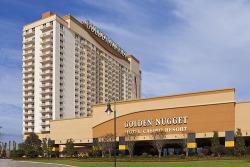
Louisiana gambling revenue dipped 2% last month to $203 million and, you guessed it, would have been significantly worse (-6.5%) had it not been for the contribution of Horseshoe Lake Charles. Let’s start there. The aforementioned casino took in $9 million, which put a serious hurt on the competition, particularly L’Auberge du Lac, which fell 11.5% to $27 million, while Delta Downs was bruised -7% to $14 million. Relatively unaffected was the Golden Nugget (above), off 3% but leading the region with $28 million. Horseshoe may still be in last place but she’s making her presence felt.
In similar fashion, Harrah’s New Orleans drubbed the competition, armed with $22 million and a 4.5% gain. Dropping 12%, Boomtown New Orleans managed $10.5 million while Treasure Chest tumbled 15.5% to $7 million and Fair Grounds racino managed $3.5 million, an 11% decline. Nearby Amelia Belle plunged 16% to $3 million but Evangeline Downs was flat to secure $6 million.

In Baton Rouge, the competition was far outpaced by L’Auberge Baton Rouge with its $16 million and 2.5% uptick. Hollywood Baton Rouge did $5 million, an 11.5% tumble, while Belle of Baton Rouge scraped together 1% as it faded 13%. Shreveport/Bossier City casinos were led by Margaritaville ($16 million) despite a 12.5% decline. Horseshoe Bossier City had it worse, plunging 18% to $13 million, while Sam’s Town sank to last place, flat at $3 million. Even Louisiana Downs did better, securing $3.5 million (-12%). Somewhere in between Margaritaville and Sam’s Town were Boomtown Bossier ($5 million, -7%) and the only gainer in the market, Bally’s Shreveport. It jumped 8% to $9 million. It’s Bally’s world. We just live in it.
