

Thanks for linking this article in your blog; it was interesting reading. But as I was finishing the article, the question that kept popping up in my head was: Does it make sense to spend billions and billions for a single rail-line between Vegas and (somewhere in) SoCal?
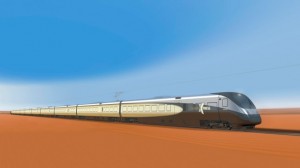 Wouldn’t it be just as effective to just add more airline flights? SoCal has more than a dozen airports located from Santa Barbara in the north to San Diego in the south (including LAX, John Wayne [Orange County], Burbank, Palm Springs, etc.), thus eliminating a very major issue with BOTH train proposals (single-point terminuses at either Victorville or Anaheim).
Even if Vegas needed a second new airport (isn’t one already proposed/started/etc.?)* to handle the extra flights, the total cost would be a FRACTION of the billions and billions to build and operate a rail line.
[* — A second airport is indeed planned for the Jean area but appears very, very far off now, especially with fewer flights coming into McCarran International Airport for the foreseeable future.]
And how many passengers could such a rail-line handle if everyone was trying to travel to Vegas on a Friday afternoon/evening (or trying to return on a Sunday)? There is a real limit as to how many passengers could be handled on a single-line during any 4-8 hour window — a limitation that airline flights are MUCH less affected by (especially if a 2nd airport was built in Vegas).
I still don’t understand the “obsession” with building a passenger rail line from a single-point terminus in SoCal. Is someone who lives in Thousand Oaks on the north side of the L.A. area (not to even mention Santa Barbara further north) really going to drive down to Anaheim on a Friday afternoon to catch a train to Vegas? That drive from Thousand Oaks during traffic can take an hour and a half (or even longer).
Maybe I’m missing some factor, but it just doesn’t seem like a very good way to spend billions and billions when we are already running out of money. I’m not against attempts to relieve the travel congestion in and out of Vegas on the weekends, just not sure why a multi-billion railroad is the best answer (especially with the single-point terminus issue for such a spread-out location as SoCal).
Readers, I’m stumped on this one. Anybody care to be attorney for the defense?

I guess people forgot how much it sucked to have $4+ gas.
Well, let’s go over the ways:
* Convenience Factor: Train stations are typically located in the downtown core of cities, and the airports are usually located far off due to the whole takeoff/landing thing. Unfortunately, even the most idealistic plan for Vegas connected not to LA Union Station, but the Anaheim station presently located near Angel Stadium (although apparently a refurbishment would come with the CA HSR line). Point is, in most cities, just getting between the airport and where you actually want to be is a hassle.
* Environmental Factor: Planes put out a lot of carbon. We can’t replace cross-country travel with trains, even high speed trains, for any but the most patient long distance traveler, and it’s not very cost effective. On the other hand, we could eliminate these regional routes operated by small contracted out services like Mesa Airlines, running as US Airways Express in McCarran; or Colgan Air, running as Continental Express). These regional airlines have a much sketchier safety record [see the episode of PBS’ Frontline the “Flying Cheap” on pbs.org]
These small planes doing hop and skip and jump flights spend quite a bit of fuel just going into the air to go back down again, and many of their routes would be greener if replaced with rail. The feasibility of LA to Vegas is a bit questionable due to the mountains involved, but would be easier in the case of other regional routes like NYC to Buffalo.
* Future-proof: There’s no way to Las Vegas to any other city that doesn’t involve fossil fuels. Airplane fuel goes up and down and the price of tickets go with it. Ditto car/bus fuel. There could be a time when flying an airplane becomes an expensive luxury thanks to depleting fossil fuels or lessened use of it (given the disaster in the Gulf, we could only hope), and Vegas’ economy first requires that people be transported out to a city that is virtually in the middle of nowhere, hours away from the next nearest metropolis. When it comes to metro areas, we’re practically like Hawaii.
* The Ugly Truth: Air fare is cheap because the air travel industry is heavily subsidized and bailed out constantly, while rail routes were privatized and Amtrak is more or less hobbled along thanks to some amnesty by a few congressmen (VP Biden is supposedly an Amtrak fan.) Meanwhile, all Amtrak rails aside from the “Northeast Corridor” (which runs a DesertXpress style not-really-high-speed route called Accela between a lot off close together New England cities) is owned by the freight industry. Trains take forever to travel even small distances since passenger trains are forced to wait on the side whenever a freight train goes by.
The reality is that no form of transportation, even the road system, is paid for entirely out of use taxes. That’s why Rogich’s plan to have DXP pay for itself entirely without public funding shouldn’t be taken too seriously.
Basically, we have been badly planning transportation grids since the war ended, and our rail system is in the same shape. Free-market conservatives talk about how the market has chosen air travel over flight, but they are ignoring all the subsidized assistance for the air industry, as well as that one Icelandic Volcano Incident could ground us all and leave us with our rail system. Europe’s system was practically overloaded while air was down, and their system may not be as good as Japan’s but is a dreamlike utopia compared to the state of our rails.
I live five minutes away from the Fullerton train station, and 15 minutes from the Anaheim stop – 🙂
I don’t have to fight traffic to get to an airport two hours before takeoff, then wait in long “security” lines – 🙁
And when I get to the train station I can board right away, then walk to the lounge car and order a beer(s). 🙂 😉 ;-}
Agree with most of what mike_ch says, except for his comment that passenger trains take forever because they “are forced to wait on the side whenever a freight train goes by.” Not true. Freight trains have to wait on Amtrak. It’s a requirement of the freight railroads’ contract with Amtrak. If freight holds up an Amtrak without a really good reason, the railroad gets fined.
“Point is, in most cities, just getting between the airport and where you actually want to be is a hassle.” But not so much in SoCal with a dozen or so airports located all over, from the north to the south. As spread out as SoCal is (stretching from the Mexican border up to Santa Barbara or more — a distance of well more than 200 miles), there simply is no single point that is really that close to the vast majority of the population. And the airport in San Diego is right smack in the middle of the city (as well as Phoenix and a number of others).