

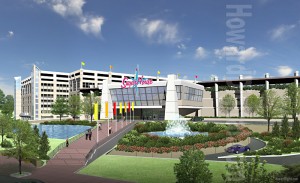
 Returning to yesterday’s theme of exaggerated expectations of gaming revenues (decanted by casino operators, quaffed uncritically by politicians) we have a glass half-full/half-empty report from Pennsylvania. The salient statistic is that, once five-month-old SugarHouse (left) is factored out, slot revenues in the Keystone State were -9% from January 2010. Some of that money may have migrated to table games, whose $43 million enabled the state to post a 20% revenue increase from a year ago (an apples-to-oranges comparison, admittedly).
The revenue pecking order remained pretty much the same, with Parx Casino ($38 million, +4%) way out front, Harrah’s Chester Downs ($27 million, +1%) and Sands Bethlehem ($27 million, +26%) jostling for runner-up status, and The Rivers ($25 million, +38.5%) finally pulling its weight. Only Penn National Gaming‘s eponymous racino was revenue-negative for January, while Mohegan Sun, Mount Airy and Presque Isle all reported double-digit gains.
 Barely edging the last two properties with a relatively meager $14.5 million was SugarHouse, in the heart of Philadelphia. Add that to the modest increases posted at Harrah’s and Parx (as opposed to much larger ones outstate), and it’s crystal clear that SugarHouse isn’t growing the Philly market so much as rearranging it. These numbers are all the argument the Pennsylvania Gaming Control Board needs for reassigning Ed Snider‘s old license somewhere else in the state.
Heck, even Caesars Entertainment CEO Gary Loveman may be looking at SugarHouse’s anemic revenue (worse even that The Rivers’ early going) and thinking he caught a break when Horseshoe Philadelphia never got off the drawing board. It would have been fortunate to eke out a fraction of what Chester Downs makes already. Steve Wynn‘s speedy exit from the Snider debacle now looks as prescient as it was precipitous.
In the full half of the glass, table games have provided a better-late-than-never boost to both The Rivers and Sands Bethlehem, two victims of their own cost overruns. Unfortunately for Sheldon Adelson‘s place, table revenue is no longer lifting slot revenue (-7% last month), too, as it did when tables were introduced back in midsummer. As was mentioned en passant during Sands’ most recent investor call, the megaresort-in-progress is producing its best numbers to date, which include table win far in excess (as in +27%) of Wall Street‘s expectations.
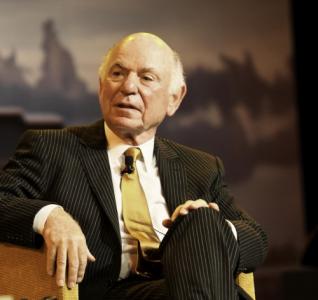 Both Adelson and Wall Street alike are pinning much hope on the May opening of a 300-room hotel. Had it been up to COO Michael Leven (left), Sands would still be mulling whether or not to finish that part of the project. Fortunately, Adelson overruled $2 Million Mike and has a shot at obtaining the stay-and-play customers who could push Sands Bethlehem up to the 17% ROI that Sheldon predicted when the project opened. As for the remainder of Sands’ obligation to the City of Bethlehem (event center, mall, meeting space), Adelson told gaming analysts he was “also making significant progress on other pieces of our development plans for Bethlehem, and we’ll be sharing additional detail in the weeks to come.” Since Sands has admitted it needs a joint-venture partner to finish the project, that’s presumably the “significant progress” to which Adelson alludes. Let’s hope for Bethlehem’s sake it’s not like the long-ballyhooed sale of Sands’ Macao shopping malls, an oft-promised consummation that turned out to be quarter after quarter of coitus interruptus.
 Since Penn National is gaining a reputation for running its casinos on the cheap, that leaves the quite profitable company with plenty of revenue with which to bigfoot the political process in various states. Penn’s habit of sticking its snout into other people’s business is now generating some pushback in Maryland. The company’s role in helping to fund an (unsuccessful) anti-Cordish Gaming campaign last fall has helped get it slapped with a lawsuit.
 That’s not all. Several Maryland legislators are pushing a bill to forbid casino operators in the state from “directly or indirectly interfering with hindering, obstructing, impeding or taking any action to delay the implementation or establishment of a video lottery facility.” That’s language aimed clearly at Penn and its recent hijinks in Anne Arundel County. “It seems evident to [Wells Fargo] that management intends to continue its fight with the folks in Maryland,” analyst Carlo Santarelli recently opined of Penn. By a remarkable coincidence, a lobbyist for Penn subsidiary Maryland Jockey Club filed multiple gripes with Anne Arundel County that have temporarily (?) brought Cordish’s huge project to a halt.
You’ve gotta hand it to Penn: It doesn’t just stick a knife in its rivals; it twists it around few times for good measure.
Architectural afterthought: When you look at SugarHouse, Arundel Mills and Horseshoe Cincinnati, isn’t it a bit depressing that the next wave of new casinos looks like a bunch of suburban shopping malls? Are we going there to play craps or buy sneakers?

Hmmm. Yup. Sugar House is a disgrace of a casino. I can not believe that the PA GCB approved the place! I have not yet been to Bethlehem; however, I hear Sands is fine. I just can not figure out who would want to spend a night there.
On the other note, I think Penn is getting into dangerous territory of over-expanding and over-reaching into other companies business. I believe what Maryland is looking to do in terms of law may already be on the books in NJ. Very interesting.
Well, in defense of the Maryland project, that is a shopping mall, literally.
[…] This post was mentioned on Twitter by Scott Raymond, 89835. 89835 said: Philadelphia’s cup runneth under http://bit.ly/gjblNr via http://outside.in/89835 […]