

 This just in … the Massachusetts state Senate voted 24-14 to send casino legalization on to a conference committee, where the House’s version — passed with a crushing majority — already reposes. Differences between the two versions, obviously, will have to be reconciled but analyst Joseph Greff characterizes those as a “small hurdle” to eventual passage, though an immigration-status provision could prove thorny … as might dipping a Puritan toe into Internet poker. Since the two bills were made in the likeness of Gov. Deval Patrick, so to speak, it looks like we have a done deal. Break out the champagne (One ambiguity in the Boston Globe‘s reporting and that of other sources, such as Greff and Carlo Santarelli, is whether the tax rate is on gross receipts or profits. The former is standard practice. Taxing profits is practically an invitation to cook the books, just as Hollywood studios do when they want to screw actors out of their ‘points.’)
 As Santarelli puts it, today’s news will “further extrapolate the likely domino effect in surrounding states.” Action in Massachusetts will particularly force the hand of New Hampshire lawmakers, who are already considering two racinos in lieu of the previously contemplated single location. In the face of growing voter support in the Bay State, casino opponents are trotting old the old Sharron Angle (right) meme that gaming-industry employment doesn’t constitute “real jobs.” As opposed to what? Grubbing for day labor?
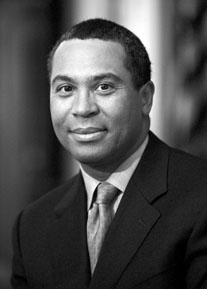 The particulars of the bill are: three resort casinos and a slot parlor with 1,250 one-armed bandits. (Expect Caesars Entertainment to make a racino/joint-venture pitch for the latter.) Compared to Florida, the price of entry to Massachusetts is a bargain: $85 million upfront plus $500 million for the physical plant. Only the slot parlor is a rotten deal: a special 40% tax rate (against a $150 million mandatory investment) that jumps to 49% — perhaps even as high as 55% — when you include a subsidy for the horsey set. Spending patterns by New England punters (less gambling, more dining, etc.) also make a resort property the more attractive investment. Senators quickly quashed an amendment that would have put a slot route into Logan Airport … a provision sure to have drawn gubernatorial ire. Don’t make Patrick (right) angry. You wouldn’t like him when he’s angry — as pro-casino lawmakers discovered last year.
There is no limit on the hours of operation … but smoking is verboten. (That sigh you just heard was a ‘thank you’ from Foxwoods Resort Casino and, to a lesser degree, Mohegan Sun.) But there will be free drinks. Also, one federally recognized tribe will be juiced into a casino license. That’ll really ramp up the pressure on Capitol Hill to circumvent the Carcieri v. Salazar decision and fast-track some tribes into eligibility, lest Mohegan Sun’s $600 million Palmer project beat everyone else to the starting line. The Mashpee Wampanoags are shopping a rival casino proposal around the state, although their gaming-entitlement status isn’t crystal-clear.
 We’re looking at as many as 10,250 slots in the Bay State, max. Greff estimates that International Game Technology will benefit most, garnering more market share (45%) than Bally Technologies and WMS Industries combined. Still, it’s a good day to be in the manufacturing sector. Casino revenues are projected in the $1.2 billion-$1.8 billion range. Given casino proponents’ propensity to highball their projections by 25%-40% (and, in this case, their use of antiquated statistics), I expect something closer to $1 billion.
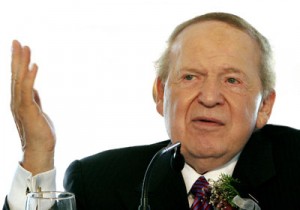 Via Twitter, the Review-Journal‘s Howard Stutz tips Caesars and Las Vegas Sands as frontrunners for the plum Boston-area concession … although Sands CEO Sheldon Adelson has been waffling of late. He’d have to be convinced “Venetian Boston,” “Palazzo Plymouth,” “Sands Dorchester,” “Marina Bay Framingham” or whatever could achieve $120 million a year in cash flow … so his company says. Penn National Gaming craves one of the outlying licenses and bullish Genting Berhad has shown interest as well. With so many heavyweights already in the ring, even cash-rich Wynn Resorts appears to have shied away from the fight. Let’s hope Massachusetts learns from Pennsylvania‘s mistakes and steers clear of inexperienced, ‘favorite son’ casino developers. Also-rans will probably include David Nunes, who’s probably wishing he hadn’t just blown a big wad of cash on a ballot initiative to give himself a casino. (Among other things.)
 Loveman’s revenge? Minority owner of the Boston Celtics and sometime CEO of Caesars Entertainment Gary Loveman has to be enjoying the NBA lockout. Caesars’ sportsbooks have been at a disadvantage ever since the company’s (previous) pet-rock board allowed Loveman to put his interests ahead of the stockholders and buy a piece of the Celtics. That meant no Boston action at Caesars’ books. Now, nobody in the casino industry is making money from NBA bets — unless they involve how long the labor impasse will last. Regardless of where Loveman stands in the latest squabble between millionaires and billionaires, his fellow NBA owners have leveled the playing field between Caesars and every other sportsbook in Nevada. So there!
