

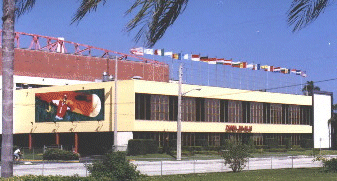
 This is a good time to be in Florida, right? Not if you’re Boyd Gaming and have been trying to unload Dania Jai-alai, souvenir of a half-assed venture into the Sunshine State’s racino market. The company has scrapped an $80 million sale of its Dania asset after the would-be buyer couldn’t scrape the cash together in time. With megaresort casinos looming over the horizon, bankers might have been reluctant to underwrite Dania Entertainment LLC’s decidedly underdog endeavor. Then again, Dania Entertainment might have had its own second thoughts; the odds in this particular David-and-Goliath bout favor the big boys.
Dania’s aspiring owners might also have looked with despair on the load-in of 1,050 slot machines at nearby Casino Miami Jai-alai. Against so much firepower, they may well have thought, “Why bother?” Boyd’s 47 Dania acres are theoretically still a fungible asset, with so few aspiring megaresort owners having secured land … but it’s a long shot. Boyd only made two mistakes during the bubble years and, compared to Echelon, Dania Jai-alai is a bagatelle.
 The vice tightens. In a chilling development, the government of Singapore has informed Resorts World Sentosa (right) and Marina Bay Sands that any press releases and interviews will have to be cleared with Big Brother first. The latter got its shorts in a wad after a big jackpot at Sentosa was blurbed to the media and “made gambling more attractive.” Horrors! The hypocrisy is so thick you can slice it. Singapore got itself hitched to the casino industry but keeps sending the subtextual message that it would prefer the casinos themselves to fail … or at least remain very, very quietly in the background.
 Good vibrations. Although casinos in Macao continue to outperform at a staggering pace, fears remain that either the central government in Peking will clamp down on access to the gambling enclave or that players’ equity will dry up. J.P. Morgan analyst Joseph Greff, back from a recce of the Pacific Rim, returned “feeling positive about the overall health of the VIP and mass gaming segments,” particularly as applied to Wynn Macau. Execs at the casino expect a 10% to 15% growth in market size and are “not seeing any slowdown in credit or repayments.” Secretary for the Economy & Finance Francis Tam has promised that all six concessionaires will be represented on the Cotai Strip. This must come as a relief to Sociedade de Jogos de Macau, MGM Resorts International and Wynn, all of whom have — with varying degrees of patience — been waiting for their parcels to be stamped “Approved.” However, Tam’s reiteration of an increase of no more than 2,000 gaming tables over the next 12 years makes it as clear as could be that no new concessions will be forthcoming anytime in this decade. (In other words, it’s time for Caesars Entertainment to write down that Macao golf course.)
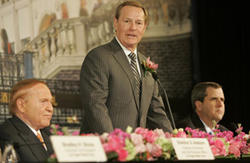 The government seems to have given up hope of diversifying Macao into a vacation destination and pinned its hopes on adjacent Hengqin Island — slated for a 3,500% population increase by 2020 — instead. As one Macanese gloomily observes, Hengqin is “condemned to be a success.” Both MGM and Galaxy Entertainment are looking casting their eyes toward it, even though gambling will be prohibited. Las Vegas Sands had big plans for Hengqin once upon a time but hasn’t said “boo” about the place in years, not since William Weidner (above) was calling the shots. (Incidentally, the Fairmont Raffles financial problems that Sands waved away in ’06 were yet another bungled investment by — you guessed it — Colony Capital, whose ineptitude spans the globe.)
