

Desperation has well and truly hit the fan at MGM Mirage. The company’s Strip casinos may not be priced to move … but it’s said to be quite a different story where MGM Grand Detroit and Beau Rivage are concerned. (A Bloomberg report implies that Gold Strike in Tunica may be on the table, too.)
How desperate? We’re talking about sacrificing $231 million in cash flow (in a down year) to keep CityCenter alive. Outside of Vegas, all the company would retain would be “halfsies” of Borgata, MGM Grand Macau and the Grand Victoria riverboat in Elgin, Il. We’d by definition be talking about considerably increasing MGM’s Vegas exposure, especially since CityCenter would — one hopes — be mostly open for business by the time these potential sales cleared the regulatory process.
Strategically, it stinks. MGM would be putting nearly every chip it has on the Strip. At a time when regional markets are outperforming Las Vegas, MGM would be removing two of the most vital bet-hedges it has and doubling down on the Strip. With a $7 billion debt payment hitting shore in 2011 and MGM about to go into competition with its existing Strip properties on an undreamt-of scale, if CityCenter doesn’t lift all MGM boats, it’ll be curtains for the company.
True, that $7 billion balloon payment could be — has to be — restructured. That may have been MGM’s thinking all along: Confronted with reality, lenders would become more flexible with the deadline. Or perhaps the company expected CityCenter to throw off sick amounts of cash flow, solving the problem at one fell swoop.
Time is of the essence. MGM still has three financing hurdles, at least, to surmount. A) It has to dig under the sofa cushions for as much as $800 million [assuming Dubai World continues to sulk and welsh on its financial commitments] to keep the project going; and to get to B) $1.8 billion in additional debt financing; which still leaves it short of C) $1.2 billion in completion money … the capital that not even the combined efforts of Sens. Harry Reid and John Ensign could jawbone loose from a suddenly risk-averse banking industry.
By selling Treasure Island to Phil Ruffin for 7.75X cash flow — and if we discount the theoretical premium that comes with being on the Strip — MGM has put itself in a spot where the logical price for MGM Grand Detroit is $917 million and Beau Rivage fetches $700 million. If it could realize that $1.6 billion (or more), MGM would have its back-end costs on CityCenter covered. But that still leaves a short-term need for $800 million, which is where …
Colony Capital comes in. Seems that the private-equity firm is thinking in terms of a secured loan rather than a piece of the action. Worst-case scenario, Colony walks away with one of MGM’s better Strip casinos in lieu of repayment (or more than one). It makes a helluva lot more sense than the prospect being floated last week whereby Colony would take Dubai World out of the project — an expensive proposition that would get MGM no closer to having the money it needs to finish what will be either its crown or its masoleum.
Stranger still was the here-today, gone-tomorrow story that James Packer would be teaming up with Colony to help rescue CityCenter. This popped up online in the wee hours of Saturday and was kiboshed on Sunday evening. Crown Ltd., for its part, helped keep the story alive through some semantic footsie. It said it wasn’t in talks with MGM or Dubai World — which left open the possibility it was dickering with Colony instead. A less-equivocal denial was several more hours in coming.
Having a flutter on CityCenter would provide a convenient explanation for Crown’s drawdown of its acquisition of Cannery Casino Resorts. However, one can but imagine the displeasure that would have erupted up the street at Fontainebleau if it emerged that a key investor (Packer) was flirting with an arch-rival project. Besides, it’s not as though Packer doesn’t have other problems with which to deal.
MGM could really use some good news but it’s not going to come from Macao. Shun Tak Holdings, steered by MGM Grand Macau partner Pansy Ho, saw its profits wither by 90%. With Pansy and father Stanley Ho going through hard times, if MGM entertains any hope of flipping its Macanese subconcession back to them, it’ll surely be a good ways off.
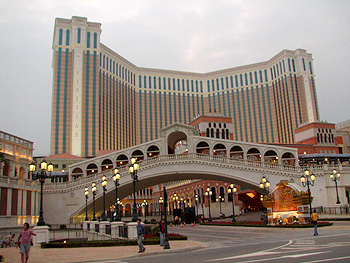
Bridge of Sighs. It was across aforesaid Venice landmark that the condemned passed on their way to execution. Outsted Venetian Macao executives don’t have to traipse over a replica Bridge of Sighs but there’s been quite a doleful procession of late.
Last week, President Mark Brown made the trek, according to the Macau Daily Times. It also reports that casino boss Vince Mascio and international marketing director Ming Lien were close on Brown’s heels. Thanks to his recent stock purchase, Las Vegas Sands CEO Sheldon Adelson is more in control than ever. Is this Macanese purge a sample of Adelson Unleashed?
