

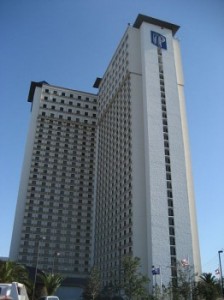
 It was a thankless day for Boyd Gaming: It exceeded Wall Street‘s expectations for 1Q12 and stock analysts yawned in the company’s face. Wrote Deutsche Bank‘s Carlo Santarelli, “the fundamental setup … remains tough,” due to a highly competitive locals market in Las Vegas, where Boyd has lost market share, and the incoming impact of Revel in Atlantic City. Despite “largely encouraging” results, particularly “prudent” acquisition IP Biloxi (which accounted for almost 10% of first-quarter cash flow), at Delta Downs and aboard Treasure Chest, Santarelli thought the stock fairly valued at $8/share. Management believes if run rates at IP can be maintained, its purchase price will fall below 7X cash flow, making it a relative bargain.
If Santarelli played Good Cop, J.P. Morgan‘s Joseph Greff was definitely Bad Cop, damning Boyd’s profitability as “modestly disappointing,” shaving a couple of points off his cash-flow projections and predicting a big drop-off in share price by year’s end — even though the earnings report surpassed his own forecasts! He put much of the blame on Boyd’s lack of new-revenue prospects and the fact that two-thirds of its properties are in glutted markets. “Over-valued,” he calls the company, although he did find a silver lining … for Pinnacle Entertainment: “continued stabilization of regional [gambling] trends” bodes well for Pinnacle’s Midwest and South portfolios, although apparently not for Boyd’s.
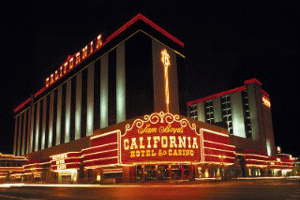 Poor table hold, higher marketing and operating expenses, and flat play all bedeviled Boyd’s Vegas operations. Its Downtown casinos continue to exponentially outperform Glitter Gulch as a whole. Smooth sailing is foreseen for Borgata‘s near term, as it continues to outpace Atlantic City overall by 50%, representing 29% of Boyd’s 1Q12 cash flow and largest single market. Only Caesars Atlantic City and Harrah’s Marina do comparably well, and Resorts Atlantic City is the worst underachiever. (At least Wall Street has finally shut the hell up about Boyd selling the biggest cash cow in its barn.) However, once Revel is fully operational, a 6%-8% decline in Borgata casino revenue is predicted by Santarelli, while Greff projects a 10% declivity. Long-term debt is expected to creep downward this year and next, going from $3.2 billion to $2.9 billion.
 Although the name “Al Gore” is a favored cheap shot (as though there were something inherently hilarious about the man) for intellectually moribund Las Vegas Review-Journal editorial-page yokels, Boyd’s grim reception on Wall Street would strike a chord with the former vice president. He’s been talking up “sustainable capitalism,” which — contrary to what one might immediately think — promotes long-term investment strategies. Generation Investment Management General Partner David Blood (left), late of casino owner Goldman Sachs, is Gore’s esquire in this new crusade. “Today the average mutual fund in the U.S. turns over its entire portfolio every 7 months; 20 years ago it was every 7 years,” Blood asserts.
Decrying “short-termism,” which focuses on instant profitability and leads to unsound investment strategies, the duo is putting forward a five-point plan. Its main tenet would be to phase out quarterly earnings guidance — the sort of thing that often leads to companies getting thumped when the actual numbers don’t jibe with the guidance.
 The Gore/Bloom proposal would certainly find a friendly reception among Boyd executives feeling bloodied by this morning’s earnings call. Also, quarterly reporting requirements and a short-term-results fixation on Wall Street were prominent — nay, predominant — reasons that both then-Harrah’s Entertainment and Station Casinos used to rationalize their LBOs, ill-fated and grotesquely ill-timed though they were. The only aspect in which Gore and Blood sound naive is suggesting that bonus awards are excessively year-to-year oriented. My experience with the gaming sector has been that any relationship between bonuses and actual performance, long- or short-term, is largely coincidental.
