
You can’t ask for a better diagnosis of what might be loosely called Caesars Entertainment‘s business plan than this anonymous comment from a Las Vegas Review-Journal reader: “Right now, their strategy for getting out of the hole appears to be to dig faster.”
And sometimes, if you don’t look where you’re digging, you hit a power cable or water main. Which is equivalent to what Caesars did last week. Leave it to Gary Loveman‘s administration to turn the opening of a new casino into an international incident. In a classic case of using direct-mail marketing as a blunderbuss rather than a rifle, Caesars blasted a promotional offer for Horseshoe Cleveland into the Total Rewards universe, scoring a “friendly fire” bullseye on … Caesars Windsor. It wasn’t Total Rewards so much as Total Dumbass.
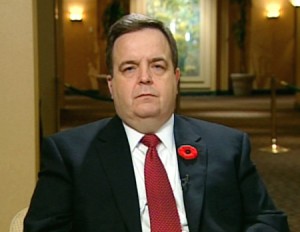 Not only was Windsor CEO Kevin Laforet ambushed by his own commanders, casino owner Ontario Lottery & Gaming Corp. was singularly unamused and Ontario Minister of Finance Dwight Duncan (right) summarized the escapade as “boneheaded.” It was like the Ohio branch of Caesars kicking sand in their Ontario counterparts’ faces, since the latter are bracing for the debut of Penn National Gaming‘s Toledo casino on May 29. That’s bad enough without Horseshoe unwittingly attempting to plunder your marketing pool — and adding insult to injury by offering a measly $5 in free slot play. (Translation: “We think your customers are comp whores whose loyalty can be had for five bucks.”)
 This was a screwup of sufficient magnitude that both Loveman and COO Tom Jenkin had to personally apologize to the provincial government. Caesars also issued a groveling public statement in which it swore it was “very proud to operate Caesars Windsor in Canada.” (P.S.: Please don’t try to revoke our management contract!) Furthermore, Loveman and Jenkin must now abide by an OLG-imposed policy that no Caesars casino will market via mail to active Windsor customers without the latter’s express permission.
If this doesn’t write fin to Loveman’s attempt to seize a beachhead in Toronto, in order to shore up his rapidly crumbling Canadian flank, a few additional provocations might do the trick. How about giving 27 Casino Windsor employees the chop on the eve of Horseshoe Cleveland’s opening? (A human sacrifice to the gods of table-game hold?) It was curious payback for the province’s shutdown of a racino at Windsor Raceway last month. As you can imagine, it didn’t play well with the horsey set either.
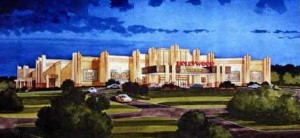 The sackings are about all we’ve seen of Laforet’s much-bruited “defense plan.” Weak on particulars, its Prime Directive is “accept the fact [customers] will try other places,” which is about the most supine “strategy” imaginable. Laforet is pinning his hopes on customers maybe having a fling with Hollywood Casino Toledo (right) or maybe Horseshoe Cleveland, then deciding that it’s nicer at Windsor, eh? He would also have you believe that Toronto is not a serious competitive threat to Windsor. And that money grows on trees. OK, I totally made up that last one.
 City officials in Windsor weren’t thrilled when top Caesars lobbyist Jan Jones openly coveted a Toronto casino (and, compared to Loveman, she’s the essence of tact). While MGM Resorts International was probing the Canadian front with the help of Sussex Strategy Group, Caesars went off in typically half-cocked fashion, declaring itself “absolutely” interested, without sounding out anyone in provincial or local government beforehand. It doesn’t look as though the Windsor city fathers were consulted either. Casino spokeswoman Jhoan Baluyot-Lucier quickly went mum when the question of revenue impact was broached.
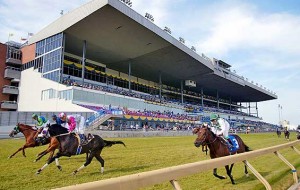 One advantage Caesars holds: Public support for casino gambling in Toronto is tepid but there might just enough to eke out a racino at Woodbine Racetrack (right). That would drive off MGM, which wants to do something very big and very grand along the waterfront. But Loveman has a few successful racinos under his belt already and, with his company on its uppers, converting an existing facility has the not-inconsiderable advantage of affordability. Besides, opines casino consultant Jake Miklojcik, multi-billion-dollar megaresorts are a risky bet in that neck of the maple woods. “It’s a number you would use in an underserved market … That’s not true with the Toronto area. I can think of less than five places in the entire North America where that could work,” he told the Windsor Star. “I don’t think Toronto would be one of them.”
(We’ve certainly not heard from Sheldon “Tex” Adelson and it’s not like him to let anybody else steal a march on a lucrative new market. Perhaps paying to build a megaresort that the provincial government would own offends his concept of free-market capitalism.)
Look familar? While we’re on the subject of Total Rewards, it’s been pimping a new-look logo these last few months:
 For the life of me, I couldn’t figure why it looked so familiar — and I saw the light:
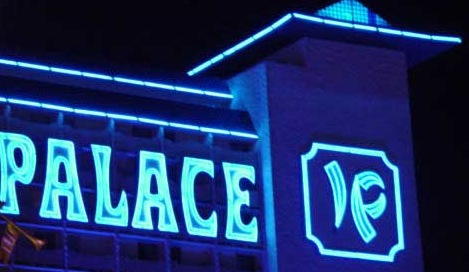 I guess, what with the rights to Ralph Engelstad‘s old trademark on the verge of expiration, somebody thought, “Hey, why waste it?” Add a few curlicues, change the “I” to a “T,” tilt the “R” leftwards and — Banzai! — you’ve got yourself and brand-spanking, new Total Rewards logo. Whoever thought that up deserves a bonus. Besides, it will keep all those fond, warm, cherished Imperial Palace memories subliminally alive within us.

You know…while I don’t blame OLG for being pissed off at Loveman, and CZR’s as usual passive/aggressive left hand doesn’t know what the right is doing…the real elephant in the room is CBP on the US side. They’re just brutal, especially at the Tunnel. I think CBP personally have made going to Windsor such an unpleasant experience, and exponentially so when they secondary search just about every traveller who says they visited CW, looking for undeclared >$10K in cash they can seize (giving new meaning to the phrase “treasure hunt”), it’s really hurt business to the point that CW is more or less a locals Windsor casino now. Don’t get me wrong, they still get US play, but the voices in the high limit rooms are definitely Canadian accented.
It’s really a shame that no one has pitched a bitch with provincial or national pols on this matter, which only reinforces the perception of many that Canada is just a puppet for the US.
I don’t see why OLG would have a real problem with the mailers. This is how you grow the business, this is how CZR has always done it. As if US CBP is going to let Canadians come into the US with any amount of cash on them to gamble without accusing them of being drug dealers/money launderers/terrorists/any excuse we can use to seize your dough.
The problem is with the management contract perhaps…only so much money to go around, and maybe not enough for both OLG and CZR.
While I can understand Windsor’s uproar at this, I have to call it a bit ridiculous. I guess I’m not following, should the Cleveland property get upset since it’s a split venture, if Caesars markets to other markets? At some point Cleveland jobs are going to be dependent on the market too, what then. Perhaps if Caesars and the Canadian government focused on trying to fix the issues plaguing Caesars Windsor rather then infighting, they wouldn’t care about who they are marketing too.
Perhaps I’m biased as a former Clevelander, (I actually don’t think I am, because I’m relatively sure I’d feel the same if it was any other property) but to me if you are going to take advantage of a large database such as TR to try and drive traffic to your joint venture, then you need to recognize that it’s a bit of a double edged sword at times.
While I agree that mass emailers are essentially stupid, especially for a whole $5 freeplay, it’s what marketing is nowadays. I can’t fault Caesars for that, although I would fault them for not including in their contract with the Canadian government that if they get access to total TR users, then Caesars gets reciprocal access. That is the true failure.
Seventy Stars….I can not agree more. I went over to Windsor from Detroit to check out Caesars about 2 years ago. Never again!
In regards to the total rewards campaign, I like your observation Dave. Here in NYC, the TR logo is on top of many yellow taxis, but guess what? No one knows what the heck it is! I guess loyal Caesars followers do, but not regular tourists. The whole campaign seems wasteful; in NYC anyway.