

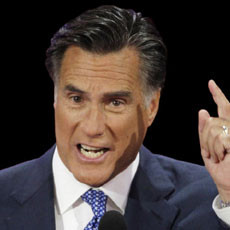
 You might say Mitt Romney was for gambling before he was against it. Both as a 1994 Senate candidate and later as governor, he advocated slot parlors and later VLTs in Massachusetts. (He also proposed to extort $75 million apiece in ‘protection money‘ from gambling facilities in adjoining states.) But, beginning in November 2004, there was an “evolution,” as he’s described it, in Gov. Romney’s views. Gambling was A-OK when the Bay State was running a $3 billion budget deficit but, after booking surpluses, “the social costs associated with gambling are too great,” he sniffed.
This is a concern that was conveniently swept under the rug when Massachusetts was in the red — and theoretically even less able to bear aforementioned “social costs.” Romney’s relatively newfound scruples certainly postdate his Bain Capital tenure. His wholly owned subsidiary, Brookside Capital Investors, took a $29 million flier in stock of Gtech, the world’s leading lottery-system purveyor. At the time, Gtech was dipping a toe into Internet gambling, which Romney now opposes. So the man’s certainly been a “playa” in gaming expansion, but …
In the end, this may be a distinction without a difference. Romney’s rival job candidate, Barack Obama has sent what could be very, very charitably called mixed signals. While the Justice Department has scaled back its previously expansive interpretation of the Wire Act, it has also been on the warpath against Internet casinos and currently has mobile-gambling operator Cantor Gaming under its microscope, too. Legislation to legitimize online poker continues to languish on Capitol Hill, despite a federal judge’s ruling that it is a game of skill, not chance.
Whichever man wins next Tuesday, the gaming industry loses.
A generally favorable climate in D.C. toward tribal interests lulled some of us (well, me) into thinking the Mashpee Wampanoags were a slam-dunk for one of those Massachusetts  casino licenses. Not so! But it was not the tribe which was faulted; rather, it was the Bay State’s 21.5% tax rate, which the Department of the Interior deemed usurious. The levy was contrary to the bootstrapping intent of the Indian Gaming Regulatory Act, Interior decreed, and the compact also yielded too much sovereignty to Gov. Deval Patrick (right) and on too many fronts. So it’s back to the drawing board for the Mashpee. City fathers of intended casino destination Taunton are making supportive noises — but they’re also hanging onto $1.5 million the tribe already paid Taunton.
Didn’t see that one coming.
By most accounts, casinos in Atlantic City emerged from Hurricane Sandy with only cosmetic damage, although Caesars Entertainment told rather a different story during its latest earnings call, but what about the Boardwalk itself? A goodly section of it was churned to kindling. In hopes of preventing a reprise, Atlantic Citizens and tourists may have to relinquish the romance of wood in favor of more durable, concrete-and-plastic replacements. Times change and we must needs change with them.

I can’t agree with your conclusion. Gambling thrives when the people have the money, both as vacations or at their local casino. Romney’s economic plan is to give the folks at the top even more breaks, in the absurd hope that the wealth will trickle down. This is nonsense, wealthy people tend to bank their wealth, or invest it offshore. Only demand creates jobs, and if regular people have no wealth, there is no demand. I am a medical marijuana patient/activist, so I am very aware of how the Justice Department is moving against a lot of caregivers/providers. Just like with internet gambling, it’s maddening to see assets used against victimless crimes. If you want to blame the guy at the very top, it’s your right, but you have thousands of career law enforcement people to wade through before you reach Obama. Romney is against alcohol; imagine a casino without cocktails. Who can predict if Romney will listen to Evangelicals who are morally against gambling? With Obama, at least we know where he stands on issues.