

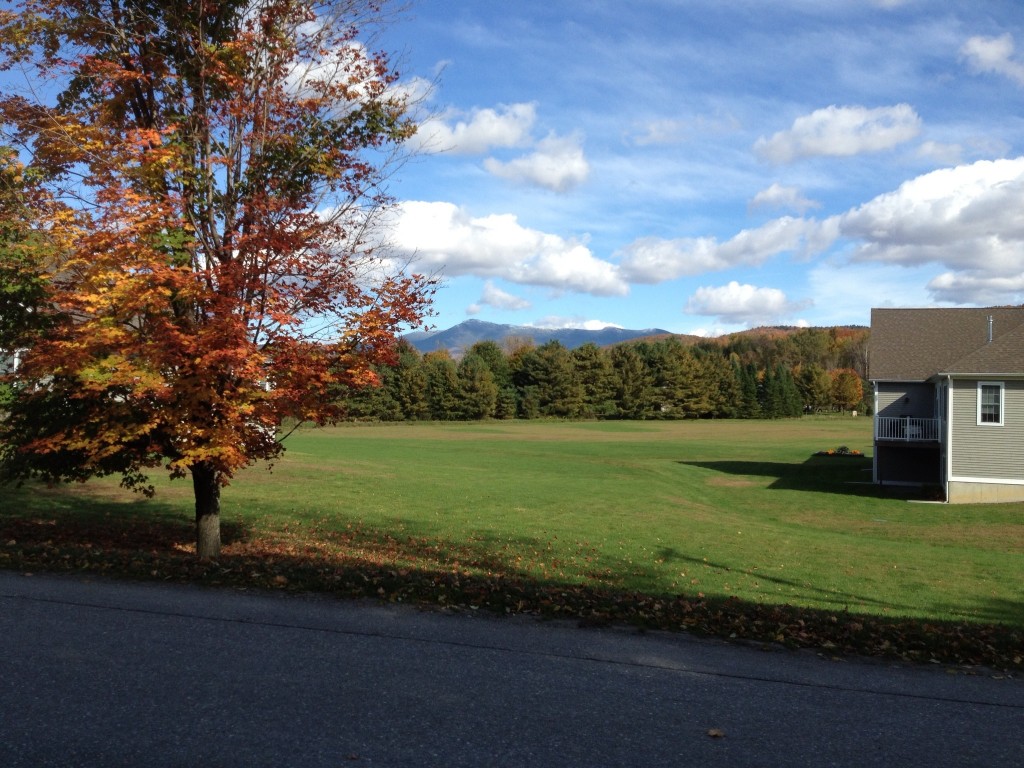
That idyllic scene above is not Massachusetts but Vermont. However, the Green Mountain State is not only shaped like a funnel, it is one, an untapped market just waiting to be drained by whichever casino lands the coveted western Massachusetts concession, even it might have to wait until 2016 or even 2018. (A couple of “dog ate my homework” applicants missed the deadline — which was hardly a recent development — and were last seen pleading for extensions.) We’ve come a long way from those summertime months when city officials were mulling whether a gambling palace might be a good thing or not …
CBS 3 Springfield – WSHM … to now, when earnest money has been collected from would-be developers. Steve Wynn and Caesars Entertainment have already ponied up for their Boston-area projects. Neil Bluhm crashed the party at the last minute. He might settle for the lightly contested slot-parlor license … but that’s not his style. The uncertain 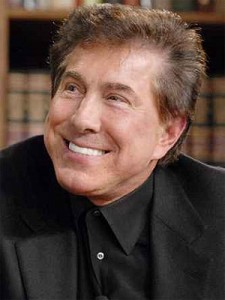 federal standing of the Mashpee Wampanoags (quietly backed by Genting Berhad) meanwhile, has thrown Bay State regulators into a state of paralysis whether or not to accept rival bids in the southeast corner of the state. However, the late-in-the day arrival of Wynn and Bluhm does much to allay fears of the Massachusetts Gaming Commission that had the latter rattling its tin cup in Wall Street‘s direction, clearly unsatisfied with a Caesars-or-nobody choice — and a half-hearted one at that — in Beantown. The real jockeying for advantage is taking place out west, where Mohegan Sun just squeaked under the wire with its entry fee, having just secured new financing. In terms of location, the Mohegans may be at something of a disadvantage: Springfield sits at the intersection of Massachusetts Turnpike and U.S. 91, while Palmer is a couple dozen miles off the north-south axis, east on the Turnpike, midway between U.S. 90 and U.S. 84. Its close proximity — 85 miles distance — to the Mohegan Sun parent property in Connecticut does little to diminish the stalking-horse nature of the Mohegan bid. In addition to having a direct pipeline to Vermont, Springfield also sits athwart the route to Albany and is a short drive from Hartford. So even if Ameristar Casinos is out of the picture (and a good thing too, as its project budget had gotten wildly out of control), Springfield is still the no-brainer location … even if voters might toss the
 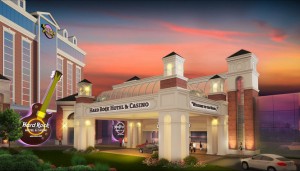 MGM Resorts International, late of Brimfield, and Penn National Gaming proposals in a summer referendum. Hard Rock International also waited until late in the game to weigh in with an $800 million proposal (left), targeted for a fairground in West Springfield. The CEO of Seminole Gaming, Jim Allen, had said Hard Rock wasn’t finished in Massachusetts after it quit Holyoke and he certainly made a dramatic re-entry. Former Donald Trump sycophant Richard Bronson has also been lurking about the fringes. Sibling rivalry spurred two rival proposals by the Picknelly Brothers but neither got anywhere. One of their sites was subsumed into the Penn National project, currently designated for the same acreage, accompanied by some snapping by Penn’s resident attack dog, Eric Schippers. At least two currently homeless projects that are flirting with Chicopee and Holyoke could pick up 41 acres in Springfield from Ameristar, which won’t be needing them any longer.
And, thanks to Mayor Alex Morse, Holyoke is a lost cause. However, since Springfield Mayor Domenic Sarno has missed his mid-December deadline for tapping projects that would be forwarded to voters, rival cities might still have a chance to get into the game. Sarno’s also made an ethical face-plant, hiring a consultant who lobbies for both the main rivals, Penn and MGM. Good thinking, Your Honor! That gaffe alone has retarded the selection process.
Even before that bump in the road, Sarno had set a selection timeline that failed to synch with that of the Massachusetts Gaming Commission. Meaning that Springfield voters could choose Penn in June — or maybe October — but the state might go with MGM. (Since diversity is a major criterion, MGM has a leg up on Penn already and the ardent degree of its wooing is likely to sway voters, as well as elected officials. Penn talks vaguely of “positive ripple benefits.” And, most importantly, Doug Flutie.) Regardless of its missteps, Springfield is to be commended for the transparency of its bidding process.
 Although Massachusetts solons only required a reasonable $500 in casino investment from prospective developers, all the visiting Las Vegans have been eager to overbid, while local businessmen have their own set of demands. MGM pitched a project (left) whose cost — including residential development! — could reach $850 million, part of a “george” community-relations push. It’s already paid thrice the assessed value for one parcel — a former rectory! (People seem to have short memories regarding the early struggles of overbudgeted Sands Bethlehem down in outstate Pennsylvania. You can find the proposals here and here.) The MGM bid does have the virtue of being subsumed into existing downtown buildings.
To call Penn’s video pitch “underwhelming” would be charitable.
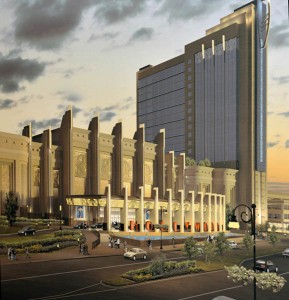 As in Brimfield, Jim Murren‘s concept would be “of the hill, not on the hill,” to paraphrase a Frank Lloyd Wright aphorism. The Mohegan project would be literally atop a hill, by the way. Realizing that they would have to up their game for Springfield, Penn rejected its cookie-cutter Hollywood Casino look in favor of a stunning, Art Deco design (left) that will incorporate the existing Paramount Theater. It might be supersized “Hollywood” but it’s an improvement. Failing to pass the laugh test is Charles J. Petitti‘s “nonprofit casino” proposal for Holyoke. Petitti’s only willing to put up $300 million, plaintively telling newsmen “laws can be amended.” Not likely, bub. He subsequently raised his budget, but in a two-phase proposal that’s a non-starter. (The other Holyoke projects look pretty rinky-dink, too.) But, given Mayor Morse’s hapless flip-flopping, it’s ultimately moot.
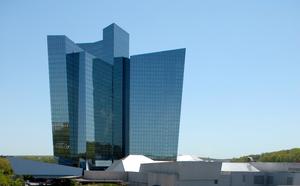 Palmer officials, meanwhile have been down to Mohegan Sun proper in Uncasville, Connecticut, and liked what they saw. Although some of the resort (right) is 16 years old, “It didn’t like old and … tired,” said one visitor. At $650 million, the Mohegan proposal has the best chance of making a strong return on investment. However, as in Springfield, Palmer’s electorate gets the final say. However, companies “with poor balance sheets” will be looked upon unfavorably by the Gaming Commission, which puts a black mark next to Mohegan Sun, MGM and (in the east) Caesars. Advantage: Hard Rock and Penn. One body has already hit the floor, that of Ameristar Casinos, whose $910 million proposal was scrapped, ostensibly because the company felt The Fix Was In for MGM or Penn. However, since Ameristar was dickering to sell out to Pinnacle Entertainment, a high-cost megaresort wasn’t in the cards.
Ultimately, Springfield’s fate will repose in the ballot box. If residents blow their chance to cash in on Vegas’ largesse, those in competing cities will be less inclined to look this gift horse in the mouth.
