

As the contentious racino contract for Aqueduct Racetrack is rebid, the field has narrowed to three suitors, all of whom are in enviable cash positions. Penn National Gaming‘s bankroll has taken on Holy Grail status, Genting Bhd has a money-spinner in the form of Resorts World Sentosa and Hard Rock International is a fancy name for “Seminole Tribe,” which dominates the Florida casino market.
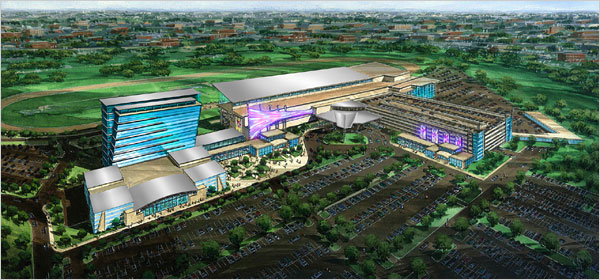
A discarded plan for revamping Aqueduct Racetrack, one of several to bite the dust.
Penn’s relative ubiquity in the Mid-Atlantic region will probably be used as a club for beating up on CEO Peter Carlino‘s bid. However, if Harrah’s Entertainment can have four casinos in Atlantic City, a racino in Pennsylvania, and possibly a racino and two management deals in Ohio, Penn’s smaller string of East Coast properties shouldn’t be held against it. It’s also (still) the only track operator in the hunt, experience which ought to count for something.
The Seminoles are under a regulatory cloud at the moment (and could, worst-case scenario, have their casino licenses revoked by Washington, D.C.). Familiar as a casino financier in New England tribal circles, Genting has been hinting at a direct operational role in the U.S. recently and Aqueduct makes a lot more sense than, say, bargain hunting in Atlantic City or Las Vegas right now. Still, Penn should be the #1 choice.
Silly season on Beacon Hill. As the chances for keeping the tribal-casino genie in the bottle slip away, Massachusetts solons continue to — pardon my French — dick around with enabling legislation, letting the clock run down. In a move that casinos in neighboring states (and potential Class II tribal venues in the Bay State) will welcome, state Sen. James Eldridge (D) gummed up the works in order to ensure that absolutely no smoking whatsoever occurs in a Massachusetts gambling hall. Perish the thought!
Not to be left out of the silliness was Minority Leader Sen. Richard Tisei (R), who proposed using 100% of casino levies* as a one-size-fits-all-form of property-tax rebate. Leaving aside the fact that not everybody pays the same amount of property tax, if the State of Massachusetts simply wanted to run in place, revenue-wise, casinos wouldn’t even be on the legislative docket. Tisei’s amendment could have killed pro-casino momentum stone dead … and maybe that was the idea. Which is not to say that this Christmas tree of a bill couldn’t use some pruning — like the allocation of new revenues to prop up racetracks. That’s money that could be better spent treating disordered gamblers, for one.
* — Massachusetts’ proposed tax rate of 25% for casinos is, by usurious East Coast standards (New Jersey excepted), surprisingly reasonable.
One less in Reno? Tribal casinos have taken an irrevocable bite out of the Reno gaming economy and one of the prime casualties has been the Siena Hotel Spa & Casino. This place has struggled right out of the gate and tax arrears could spell its doom. It’s difficult to see how much longer the Nevada Gaming Control Board can justify keeping it on life support. As with Lake Tahoe, the Reno marketplace is going to have to winnow out its stragglers in order to counterbalance business lost to California rivals.
 O’Malley steps in it. It’s been nigh upon two years since Maryland voters approved slot houses for their state (at a staggering 67% tax rate). Only one of them will be open by Election Day 2010. As though to give challenger — and former governor — Robert Ehrlich ammunition, Gov. Martin O’Malley (D) has thrown in his lot with a coalition of Ann Arundel County grumblers who want to strip a casino concession awarded — after near-incessant procrastination — to Cordish Gaming, basically so that it can be re-awarded to a nearby racetrack. While Ehrlich’s own attempt to bring racinos to Maryland was an ignominious flop, his supporters have been arguing that O’Malley’s done no better and the governor’s bigfooting of the Ann Arundel case is a gift-wrapped box of grenades.
Gettysburg refought. The controversy surrounding the proposed Mason-Dixon Resort & Casino near the battlefield of Gettysburg is one that creates a painful conflict between S&G‘s respect for free-market principles and my reverence for American history. To put gambling in close proximity to “these honored dead” (as Abraham Lincoln called the fallen Union soldiers) may be one’s Yankee prerogative but it’s also in very questionable taste.
When historians like Gary Wills and James McPherson weigh in on the issue, they deserve a more thoughtful response than the snide one they received from Mason-Dixon shill David La Torre, who “wondered how the historians would come up with hundreds of jobs and pump millions into the local economy. He also questioned why the letter contains only 272 signatures. ‘I think it’s fair to point out [the letter] cites organizations with memberships in the tens of thousands,'” La Torre sneered. Yeah, and if it contained hundreds of thousands of signatures, he’d find some comparably obnoxious way of blowing them off. Putting this jerk out as your company squawk box does the Mason-Dixon project no favors.
ColSux Watch: Yet another Columbia Sussex hotel is being picketed. It’s too bad this crummy company is still allowed to linger in the casino industry (thanks, Nevada Gaming Control Board) but perhaps its assiduous sowing of bad karma will soon be reaped.

“proposed Mason-Dixon Resort & Casino”
– Add that to the list of private property owners who want/wanted to build near the cemetery: A huge shopping center & condo development, and a tall observation tower for paying tourists – plus the usual gaggle of souvenir shops and chain restaurants.
‘I think it’s fair to point out [the letter] cites organizations with memberships in the tens of thousands,’
– I wonder if those organizations will now mount an Internet petition drive to collect those tens of thousands of signatures for presentation to local/state/federal officials in opposition to Mason-Dixon’s plans – with prominent thanks to Mr. La Torre for his inspiration.