

 Considering that table games were up and running in Delaware and gradually rolling out in Pennsylvania, it comes as a pleasant surprise to see that Atlantic City was only down 5% in July. Frankly, I was expecting much worse, especially after a massive power outage hit two casinos. As in much, much worse. As in, “Would the last person leaving Atlantic City please turn out the lights?” Since some of the 2008-09 comparisons for July and August were apocalyptic, single-digit declines in 2010 may even be construed as a form of moral victory. The $364 million haul was the year’s best and would have sufficed for third-best last year.
Actually, compared to some really dreadful table-game numbers in June (-16%), last month’s -4% gross revenue decline is not so bad. The casinos played lucky, too, as drop was -6%. Looser slots, however, couldn’t stem lower play and even lower revenues (-5%). S&G wasn’t the only one pleasantly surprised by a July that was merely disappointing rather than outright awful. J.P. Morgan expected a 10% revenue fall at Borgata but that resort was off last year’s pace only by -1%. A bad month at the tables (-13%) was ameliorated by a really good one at the slots (+6%). You could tally the revenues of the potentially confiscated Atlantic City Hilton (+2%; $19 million), Resorts International (-19%, $16 million), Trump Plaza (-17%, $15 million), and Biggest Loser Trump Marina (-13%, $14 million) and come out only $100K ahead of Borgata solamente.
The good news is that the new marketing and programming approach at the A.C. Hilton seems to be yielding early dividends. But if Resorts keeps sinking at the present rate, it’s going to hit “crush depth” before Dennis Gomes can close a purchase. Caesars Atlantic City tightened its grip on fifth place, falling -10% (to $40 million), while refreshed Trump Taj Mahal was the only other gainer in the market (7%, $47 million), vaulting past three Harrah’s Entertainment-owned properties into second place.
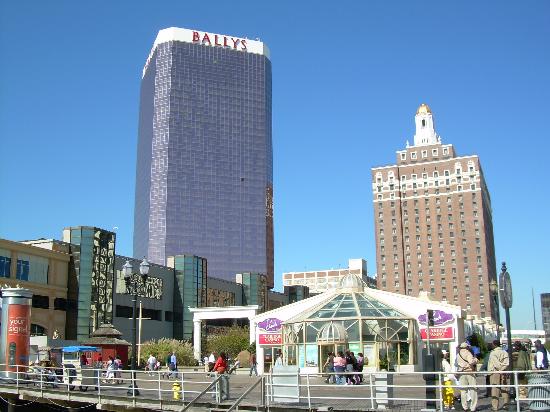
This might be the time for Harrah’s to start worrying about losing market share in Atlantic City were it not for the fact that all of its casinos except Bally’s Wild Wild West (which should be renamed “Bally’s Way Too Big”) are outperforming most of the competition. Their “fair share” of play — if you have X gaming positions you should get Y% of the action — is consistently in the “plus” column.
 Having proclaimed the CEO of Boyd Gaming, Keith Smith, one of gaming’s most underrated executives, it is my unfortunate duty to turn around and retroactively award him the Whistling Past the Graveyard prize for 2006. Smith earned this albatross when he said of Pennsylvania racinos and slot parlors, “Slots barns will never have what Atlantic City has to offer. There’s no comparison.” Well, one thing they have is convenience and another is ready access to prime Atlantic City feeder markets, which is why they’re beating the Boardwalk’s britches.
Smith may be forgiven a certain amount of complacency. Atlantic City had survived racinos in Delaware and New York State. Perhaps he and his colleagues figured Pennsylvania would be no more effectual. But I know I was taking the Pennsylvania threat seriously back then, when I covered it for the Las Vegas Business Press, and most everyone not heavily invested in Atlantic City seemed to feel the same. What’s most amazing, in retrospect, is not so much the staggering level of denial that prevailed in Atlantic City executive suites four years ago but the fact that it’s only now just beginning to be shaken off.
Or is it? Combing through the lengthy report compiled for Gov. Chris Christie (R-N.J.) by the Hanson Commission, I was staggered to read the following: “… if the reality met customers’ expectations, there would be sufficient latent demand to more than double Atlantic City’s revenues in the medium term.”
Whoa! Whatever they’re smoking, I want some. Actually, market researchers McKinsey & Co. are responsible for that pie-in-the-sky projection. Atlantic City faces enough of a challenge clawing back from a 25% revenue loss in three years without being lumbered with these sorts of expectations. ($725 million or more per month in the summer? Unrealistic.)
 However, when the Boardwalk is credited with fully a third of all New Jersey tourism, clearly something has to be done to save Atlantic City. To simply abandon it to its fate risks wider damage to the state as a whole. The commission’s nostrums for changing New Jersey‘s system of casino regulation is to cut $15 million-$25 million from the budget, partly achieved through less on-site manpower and more automation/computerization. The Hanson Commission’s criticism of an “unnecessarily adversarial” regulator/casino relationship sounds a lot like, “Gee, we were overly hard on MGM Mirage” or “Let’s not ask too many questions if Harrah’s goes into Macao.”
One of the goals of laissez-faire regulation would be “attracting other world class operators to ownership of the eleven existing facilities as well as any new ones.” (Emphasis added.) That sounds like an unsubtle hint that Colony Capital and Trump International Resorts — the main bottom-feeders — need to hit the bricks in favor of “world class [sic] operators.” Easier said than done, of course. Given how completely the New Jersey Casino Control Commission bungled the sale of the Tropicana Atlantic City, the Hanson Commission’s concern about scaring off buyers is understandable.
The unintentional downside to the proposal is that a relaxed enforcement regime could lead to more slippages and corner-cutting at the low-end property … much in the way that Columbia Sussex turned the Trop from a leader into a laggard. That would the complete opposite of the upgraded Atlantic City envisioned by the Hanson Commission. Some may deride the commission’s proposal of “Boardwalk rids, a NASCAR track, a drive-in theater, etc.,” but I say it sounds like it’s worth trying.
Companies pay lip service to making Atlantic City a destination resort but destination-style amenities are still in comparatively short supply. And the notion of making it more like Pennsylvania by dotting Atlantic City with small-hotel “boutique” casinos seems downright dingbatty. There’s a great deal of good thinking in the Hanson report; let’s hope it’s not heavily diluted in Trenton by juiced-in special interests (read: the horsey set).

[…] This post was mentioned on Twitter by Marc L – ECG, David McKee. David McKee said: New entry: Atlantic City, July 2010 — it could have been worse https://www.lasvegasadvisor.com/stiffs-and-georges/?p=4313 […]
I really like this piece on AC. Without naming names, other LV based gaming writers can never look at that market objectively and take as many slaps at the market as they can; warranted or not. Anyway, I love what the AC Hilton is doing and hope they can survive under Colony or not. I have always believed Boyd to have incredible (“underrated”) leadership in both the financial and civic communities where they operate. They have good and honest values regardless of rather rare lofty quotes made by their CEO. Also glad the Taj is doing well (Trump actually did a very nice job upgrading this property) and ecstatic the voters of NJ finally elected a leader with the brass to do or try something about AC rather than sitting back and watching it rot! Here’s hoping for some meaningful recovery.
Undoubtedly I’ve blathered on about this before on this blog but, the question I keep asking is, why doesn’t AC just *give up* on getting the blue hairs down from Philly, and start marketing itself very aggressively in Europe, as “Las Vegas Style Action without the extra 6 hours of flying” or something similar. Pay BA or some other overseas airline guarantees to run at least one flight a day into ACY, or just run charters.
It was on my first visit, and has been on subsequent visits, my abiding impression that Atlantic City COULD NOT POSSIBLY be worse. I have never been in a more wretched place, and I’ve been in forty-one countries on five continents.
I do have an idea for AC casinos to recapture lost market share, though–rent out free body armor and weapons, and give people the “two blocks inland” tour, where LIVE zombie movies are going on EVERY DAY.