

Withered baccarat numbers meant that the Las Vegas Strip had a muted February, only a percentage point above 2019. Players dropped $599 million (-44.5%) of which the house won just $62 million (-52%). That offset a bonny month at the slots, where Strip casinos kept $336.5 million (+26.5%) on coin-in of $4.3 billion (up 32%). Non-baccarat table games gained only modestly (3.5%) to $200.5 million on 25% more wagering. By contrast with this near-stagnation, albeit at high levels of play, on the Strip, locals casinos shot 19.5% past their 2019 mark to $223 million. Downtown hopped 19% to $69 million (remember, this is a comparison to a pre-Circa era) and Reno leapt 37% to $62 million. Passenger loads into and out of Las Vegas, by the way, finally caught up with pre-Covid demand, hitting 107% of last year’s mark. While barely 100,000 of them were international travelers, that latter metric was an exponential increase.
On a year-over-year basis, the Strip’s haul was a 72% improvement over February 2021, while Downtown grew 34%. The Boulder Strip ($73 million) expanded 14%, Laughlin ($43 million) jumped 31% and North Las Vegas ($23 million) was 18.5% to the good. Miscellaneous Clark County ($127.5 million) grew 24%. The only extent to which revenues ‘normalized’ was in Laughlin (-4% vs. 2019) and North Las Vegas (-.5.5% against 2019). Statewide win of $1.1 billion included contributions of $15.5 million from Mesquite (21% over last year) and economic bellwether Wendover ($21.5 million), up 23%. The lone cloud on a very bright sky was Lake Tahoe, down 4% to $19.5 million.
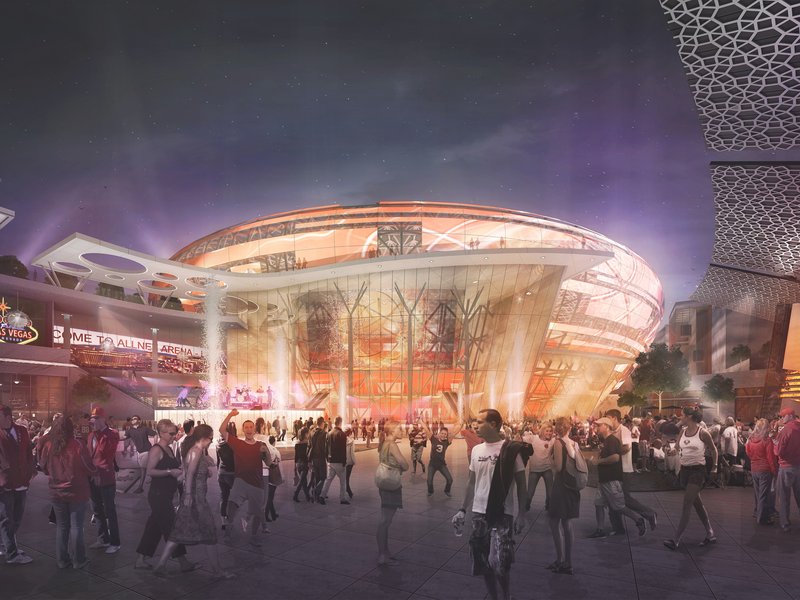
Entrepreneur Jackie Robinson can probably stick a(nother) fork in his All-Net Arena Resort concept (pictured). His North Strip project is being beaten to the punch—and to the south—by Oak View Group, which has purchased 25 acres at Las Vegas Boulevard and Blue Diamond Road with a view to building a $3 billion, 20,000-seat sports arena and entertainment complex (including, yes, a casino). It would be one-half-mile north of the Silverton and two-and-a-half from South Point. It would also be just south of the Brightline train station, assuming that ever gets built. As traffic locations go, this would be a killer. Oak View, “focused on being a positive disruption to business as usual,” has a track record—unlike Robinson—of getting such things done. It manages Seattle‘s Climate Pledge Arena and UBS Arena in Belmont, New York. It also has three arena projects in progress, with four more on the drawing board.
Jilted Las Vegas Raiders prexy Marc Badain is acting as liason between Oak View and the Vegas community, along with President of Business Development Francesca Bodie. The exact purpose of the arena is exquisitely vague at this point. 20,000 seats seems far too small for baseball, so cross off the Oakland A’s. But Major League Soccer is a possibility, ditto minor-league sports, along with the inevitable large-scale music events. “South of the Las Vegas strip [sic] represents one of the few areas of potential future growth of the gaming and entertainment corridor,” wrote Oak View CEO Tim Leiweke and he’s right about that, even if the company isn’t totally au courant with Vegas Valley events, assuming that “Stations’s [sic]” Cactus Lane project is still on when it’s very much defunct. Oak View’s goals, which include being carbon-neutral and zero-waste, are to be commended.

Nevada Gov. Steve Sisolak (D) was quick to give the project his blessing, saying, “We are proud Oak View Group has chosen Nevada for its next and largest project. This newly proposed entertainment district in Las Vegas will help continue the state’s economic momentum and create thousands of jobs and greater prosperity for Nevadans. I look forward to seeing the many opportunities this creates in Las Vegas.” Yes, and let’s hope it can be done without governmental subsidies, which are of dubious necessities. “Sports teams are among the biggest extortionists when it comes to peeling public dollars from public hand,” Steve Sebelius presciently wrote last weekend. “Meanwhile, critical needs in Las Vegas — in education, housing, police services and foster care, just to name a few — go wanting.” Had he heard something we hadn’t? Probably.

Could legalization of sports betting in California have a seismic impact that breaks legislative logjams in other states, from Massachusetts to Alabama? Some political experts think so. The tricky part is still ahead. At least two dueling referenda are sure to be on November’s Cali ballot. The frontrunner is a tribally funded effort that would make sports betting the sole (on-property—province of Native Americans. Not to be outdone, DraftKings, FanDuel and a spate of Las Vegas interests are escalating a rival campaign that would permit sports wagering statewide (although this would put tribes at a disadvantage, since IGRA confines their gambling to “tribal lands,” which don’t extend into cyberspace). Still, tribes are pushing back with a $100 million ad blitz that says non-tribal sports betting breaks the sacred trust between California and its aboriginals, who are supposed to have exclusive rights to operate gambling.
We’re talking at least 90% of the action, folks. Big Gaming’s version of online betting would see tribes getting a sop in the form of a guaranteed percentage. Mind you, if California is like New York or Pennsylvania, we’re still talking about a smidgen’s slice of a very small revenue pie. Also, “Our initiative is the only one that would raise hundreds of millions of dollars reach year in solutions to homelessness,” said Big Gaming spokesman Nathan Click, sounding a note that is sure to click (sorry) with voters and mayors alike. Wilton Rancheria Chairman Jesus Tarango concedes, “may get a piece of it, but it would not be the same piece as if it was controlled by us and ran by us.”
The only ‘win’ in this for the card room industry is if both ballot initiatives lose, as card rooms are likely to be shut out of sports wagering. But, with $24 million at their disposal, the clubs are lambasting the tribal initiative on the airwaves. “All these vital services cities provide for their residents depend on the revenue from these card rooms that these cities host,” California Cities for Self-Reliance Joint Powers Authority spokesman Juan Garza told Politico. Presuming that voters don’t react to a plethora of sports-betting initiatives by nixing them all, the Lege had better brace itself to regulate the oncoming wagering tsunami.
How big of an onslaught? Consider how sports betting is pervading our consciousness already. The high-water mark to date are TV ads featuring Gonzaga University basketball star Drew Timme shilling for Spokane‘s Northern Quest Resort & Casino. In one, he’s pictured at the roulette table, betting on number two (his jersey number), prompting another player to ask, “Isn’t that a little on the nose?” The convergence of Gonzaga and sports betting advertising has prompted to pearl-clutching but is the to-be-expected outcome of legalized wagering and the liberation of student athletes from non-compensated NCAA-serfdom status. In one predictable response, McGill University problem-gaming professor Jeffrey Derevensky proclaimed, “Here you have student-athletes that are endorsing or representing casinos where we’re trying to get student-athletes not to engage in gambling.”
That horse may have already fled the stable. A quarter of all NCAA athletes are already betting on sports, no doubt causing fainting spells at Gonzaga, where you ostensibly can’t “conflict with the University’s Catholic, Jesuit, and humanistic heritage and identity.” We don’t hold much with Jesuits and sports betting hardly seems un-humanistic. Even the school itself is in bed with tribal gaming. Said Timme, “Any time I walk into the gym I see a big Northern Quest logo, so I didn’t think too much of it, honestly.” (Northern Quest, in return, doesn’t take bets on Gonzaga games.) One person who doesn’t think l’affaire Timme is that big of a deal—and we agree—is LEAD1 President Tom McMillen, who “represents programs and athletic directors of the NCAA’s Football Bowl Subdivision,” according to the Wall Street Journal. He told the paper, “It reminds me, we went through the debate on alcohol at football games. And that kind of just went up in smoke, too, those bans. I’m saying I think you could see a sports book within five years on campus.” Only five?
Jottings: As we tweeted last weekend, Caesars Entertainment is making the sagacious move to rebrand Isle Black Hawk as a Horseshoe casino. It’s more than a name change; a redesigned gaming floor, refurbished hotel rooms, a redone sports book and a World Series of Poker-branded card room are among the goodies in store … We’re not such a fan of the Indiana Grand rebrand, which will result in cumbersome Horseshoe Indianapolis Racing & Casino. What a mouthful! … Having missed its original reopening date, Palms Casino Resort is now aiming to be on line by mid-June. Finding suitable labor seems to be at the heart of the problem. Once targeted for a 1,200-person workforce, Palms management is now willing to settle for as few as 500. Meanwhile, the Kaos fallout still continues, with DJ Kaskade (née Ryan Raddon) winning $8 million in court from a Station Casinos subsidiary.
