
Sens, Chuck Schumer (D) and Orrin Hatch (R), forever in search of bad ideas to espouse, it would seem, have introduced the Sports Wagering Market Integrity Act of 2018. There’s no mention of Hatch’s cockamamie notion of individual states having to get 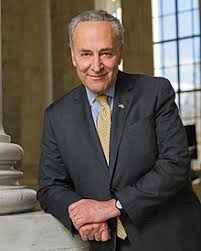 permission from the federal Attorney General to offer sports betting but the American Gaming Association‘s Sara Slane hit the nail on the head and drove it clean through the board when she called the legislation “the epitome of a solution in search of a problem.” She added, “Additional areas this bill seeks to address – including the mandatory use of official league data and the creation of a national sports wagering clearinghouse – can, and should, be decided by marketplace negotiations between private businesses and cooperative agreements among jurisdictions. In the mere six months since the U.S. Supreme Court paved the way for legal, regulated sports betting, significant developments on both of these fronts have already occurred without any federal involvement.”
It’s too early for incoming AGA President Bill Miller to have put his stamp on the association. However, it is continuing in the activist tradition established by Geoff Freeman. Can you imagine a 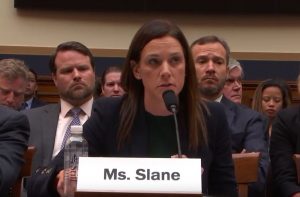 broadside like Slane’s being fired off during the top-hush, behind-the-scenes Frank Fahrenkopf era? As for Schumer and Hatch, perhaps they are spooked by the advent of sports betting in our nation’s capitol. Venues that are juiced in include FedEx Field, Nationals Park, Capital One Arena and Audi Field, while as many 60 D.C. Lottery outlets can apply for licensure. Slane applauded the low tax rate (10%) and said of the Lottery’s exclusive right to sports betting, “Predictably, this will result in less investment and innovation, to the detriment of consumers and the ability of a nascent legal marketplace to compete with the accessibility and convenience offered by many established illegal wagering operations. AGA urges District policymakers to reevaluate the merits of this key aspect of their framework and allow greater competition in the future,” views shared by Washington Capitals owner Ted Leonsis. (He also owns the Washington Wizards basketball franchise.) Sports wagering handle is expected to reach $30 million by 2022.
* “If the economy slips into recession, we strongly believe domestic gaming revenues are more defensive than many investors believe and that conditions in 2008 are very different to today,” writes Credit Suisse analyst Cameron McKnight. That being said, he  notes that restaurant covers are substantially up in Las Vegas in November. “This is a positive sign for the fourth quarter,” he notes. In another positive economic indicator, T-Mobile Arena is the third highest-performing venue of its scale in the U.S. “his is in spite of the fact that number of events held at has decreased y/y at T-Mobile Arena, driven by weakness in 2Q and 3Q 2018.” The 2020 NFL draft is expected to draw 200,000 tourists to Las Vegas, with a possible economic impact of $125 million or more. Finally, in a fact gleaned from VitalVegas, “A player at Red Rock Resort hit a sequential royal flush this weekend, turning a $5 bet into a nearly $218k jackpot; the odds of playing a sequential royal flush are 2.4 million to 1.” Bravo to the winner.
* In a move to diversify Atlantic City‘s economic base, the Casino Reinvestment Development Authority is putting its money where its mouth is via a commitment to invest up to $700K in promotion of sports wagering, with events to be held at Jim Whelan Boardwalk Hall and the Atlantic City Convention Center. “It may sound odd to many of us, but thousands of people sit around and watch people play 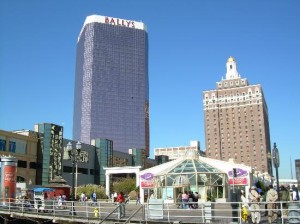 video games. This may be the future of spectator sports,” CRDA Executive Director Matthew Doherty told The Press of Atlantic City, vouchsafing a foretaste of the Apocalypse. If anybody remembers the old TV game show College Bowl, well, e-sports are the College Bowl of tomorrow.“These folks are paid as professional athletes just for pushing buttons. It’s something in my opinion that puts Atlantic City on the edge of something different,” argued Mayor Frank Gilliam. It’s also where Silicon Valley looks for the tech wizards of the future, so Atlantic City is definitely aiming for a new caliber of tourist.
In the realm of more-traditional sports wagering, Monmouth Park — in an effort to stave off oncoming Freehold Raceway — is partnering with Canadian firm theScore to offer mobile betting. The new offering is expected to be online by the middle of next year.
* MGM Resorts International has sold Park MGM to its REIT, MGM Growth Partners. The parent company gets $637.5 million richer (which we hope they will use to de-leverage) while MGP looks to make a good return on investment. As JP Morgan analyst Joseph Greff wrote, “To us, this transaction reflects MGM’s ability to monetize its real estate/get favorable returns for its prior investments at attractive values .”

That’s all we need in gaming..Federal Oversight. As if the Feds are doing just fine with their own affairs (pending shut-down, deficits etc).