

Last week, the great and powerful of the casino industry attended a show-and-tell at the J.P. Morgan Gaming, Lodging, Restaurant & Leisure Management Access Forum. Here’s what they had to say …
Wynn Resorts: The company is looking to make a big splash with Wynn Palace, taking significant market share from the competition. No doubt knowing that what gets said on  Wall Street is heard back in Macao, President Matt Maddox and CFO Stephen Cootey said they were confident of they’d get a “very fair” allocation of table games when the time comes for them to be doled out. They also plan to comp considerably more rooms to their mass-market customers.
“Real pricing power” was the description of conditions on the Las Vegas Strip, where Wynn Resorts is vocally supportive of the Genting Group and James Packer developments. Prospects for this year are seen as bright, with non-gaming spending way up and room rates higher. A new brand, Wynn America, was rolled out, with the Boston casino being its inaugural property. “Management hopes that Boston can be a “showpiece” for how to do regional gaming correctly, and it plans to pursue this in other major cities,” wrote analyst Joseph Greff.
MGM Resorts International: On the Las Vegas Strip, the lion is looking to make its biggest revenue growth in its core properties, such as Monte Carlo and New York-New York. Unlike the luxury hotels, these were hardest hit by the recession and have the farthest to come back. Therefore, they are to be the recipients of “targeted capital investments.” Management remains bullish on Japan, which it expects to become the world’s third-largest casino market. Although MGM brass are “fully engaged” with the political process in Nippon, they don’t expect a casino bill until autumn and peg its chances of passage at less than 50-50.
Las Vegas Sands: Broadened market appeal was the watchword for the company’s Macao plans, particularly in the non-gaming sector. Sands President Rob Goldstein admitted to  having little visibility on new table-game allocations but thinks that if they are correlative to past ones and to non-gaming investment Sands will be in the catbird seat. He anticipates no movement on the issue until late this year. He was, however, confident that strong focus on the mass market and a giant inventory of hotel rooms position it well for future economic events. Sands is sanguine about promotional wars, believing they will play out in the VIP market, not among mass players.
In Singapore, room rates are on their way up and the restaurant mix continues to improve. Despite the importance of high-end play, Goldstein deems the mass-market margins attractive. Sands is still chafing at the limit on its hotel rooms, although the government has given no signals on whether it is receptive or not.
Penn National Gaming: According to Greff, “management was very encouraged by the trends it saw in December and January, where it experienced growth in visitation and spend per trip  across every segment of its database.” COO Jay Snowden and CFO Saul Reibstein dismissed the idea of gas-price fluctuations having a material impact on business, although they conceded that “definitely” helped in recent months, even if favorable tailwinds “are more than just gas prices.”
Penn is optimistically that it can generate $250 million in Year One of Plainridge Park and may have the Massachusetts market all to itself for as many as three years. It helps that labor costs will be kept down by the racino’s restriction to slots and electronic table games. (Cyber dealers work for free.) Unlike the Columbus, Ohio, market the gambling consumer won’t have to be “educated” and Massachusettans’ inclination to wager is indicated by “the highest spend per capita lottery in the country, by a wide margin.” A focus on blue-collar gamblers, closeness to Providence and greater proximity to Boston than Twin River all give Penn confidence.
Boyd Gaming: Continued improvement in the underlying Las Vegas economy is seen by CFO Josh Hirsberg, even if most of Boyd’s revenue growth is of the non-gaming ilk. Considering 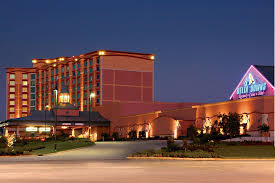 Nevada’s low tax rate, Boyd foresees a stronger comeback in its Nevada assets than its outlying ones. “While management is encouraged by many of the signs it is seeing in the regional markets, most notably in December and January, it stopped short of calling a bottom for the regional gaming consumer.” The company described itself as “cautiously optimistic.” Although it is unclear if improvement at Delta Downs (buoyed by the current boom in Lake Charles) is temporary or permanent, Hirsberg said is exceeded expectations.
Borgata is — no surprise — benefiting from casino closures in Atlantic City, particular at mid-week. Boyd is waiting on an $88 million tax refund from the city and going through the appeals process for an additional $50 million (plus interest) that it won. Management believes that neither of these sums is crucial to deleveraging the Borgata balance sheet. After all, those property-tax refunds will have to be shared with former and current partner MGM.
