

No further obstacles should remain to a Carl Icahn takeover of ailing Trump Taj Mahal after an appeals court found in favor of wage- and health-care rollbacks at the Atlantic City casino. Unite-Here Local 54 and the workers it represents were dealt a stinging setback, and have 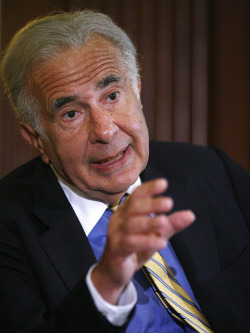 to be wondering what other economy measures Icahn may implement. The latter has, however, promised a substantial infusion of capital into the Taj which “performs at the bottom of the Atlantic City market.” Icahn lost in one respect, namely the time it took to get a court ruling. His representatives contended the resort couldn’t withstand “another lost summer.” However, that may be just what it’s looking at after the long legal battle.
While Local 54 ponders its next move — possibly including a strike — it faces a lose-lose situation, its now workers now having to live on limited means but faced with an Icahn closure of the Taj had the appeals court gone against him. (Unite-Here wanted the dispute heard by the National Labor Relations Board.) In the meantime, it has to grit its teeth and prepare itself for life under Icahn, who could scarcely be worse than his inept Trump Entertainment Resorts predecessors.
The Taj and all of its Boardwalk brethren could take little comfort in the revised version of the PILOT Program that emerged from the New Jersey Legislature. They’ll have to pay $50 million more in taxes and the “floor” of their annual payments to the state can never fall below $120 million. Atlantic City gets a few crumbs, such as $10 million a year for the Casino Reinvestment Development Authority and $8 million for marketing. A delay in implementing the program from last year to this one will also bring some relief to the gaming industry, if not to Atlantic City’s beleaguered city government.
* Reports of casino saturation in Pennsylvania have been exaggerated. Last year’s gross revenue eked out a very slight margin over 2012’s previous record, on the strength of a 3% revenue increase. Lacking a casino-by-casino breakdown, we’d attribute the record result to outlying casinos like Sands Bethlehem, because the Philadelphia market really is swamped and will be further challenged when Cordish Gaming opens its stadium-area casino.
* Once again, a gaming executive has resigned “to pursue other opportunities,” namely that of updating his resume. Parq Vancouver President Michael Graydon was found to be in a conflict of interest 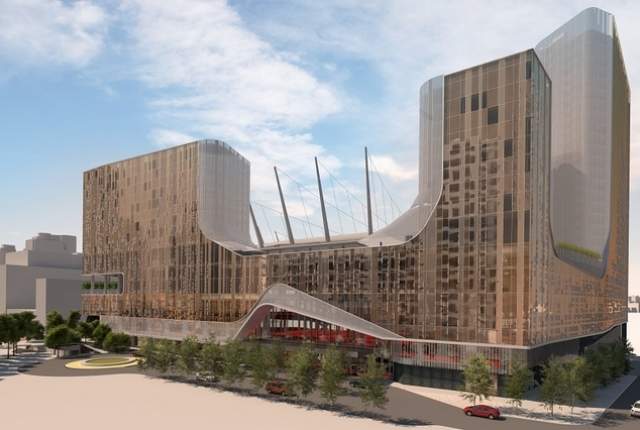 when details of his hiring emerged. Seems that Graydon was still CEO of the British Columbia Lottery Corp. — on whose services Parq Vancouver will rely — when negotiating the details of his new job with Paragon Gaming, Parq Vancouver’s developer. In a butt-covering statement, Paragon CEO Scott Menke said Graydon “concluded that the president position needs to be more hotel and casino operations-focused and that his background and experience are not aligned with the evolving needs of Parq Vancouver.” Don’t weep for Graydon: He’ll have to refund $55,171.20 of his salary but gets to retain $30,960 in vacation. See you at the beach, Mr. G.
* The Nevada Gaming Control Board — along with the indifference of casinos — effectively killed daily fantasy sports when it said that DFS sites would need Nevada gaming licenses. Gov. Brian Sandoval (R) is trying to breathe some life back into DFS, reconvening the dormant Gaming Policy Committee to craft rules for this particular form of Internet gambling. What nobody really seems able to address is that Nevada’s population is so small that it’s not worth pursuing for DFS revenue.
