
Gaming revenue in Louisiana was flat last month, with strength in Shreveport and New Orleans making up for weakness in (mainly) Baton Rouge and Lake Charles. It’s difficult to account for the 3% dip in Lake Charles, aside from the fact that Golden 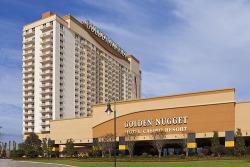 Nugget had a bad month, declining 12% to $22 million. L’Auberge Lake Charles shot past it, grossing $24 million, a 6% increase. Isle Grand Palais was down 10.5% to $7.5 million while Delta Downs cantered 3.5% faster to $14.5 million. The Baton Rouge problem is no mystery: the smoking ban. Gaming & Leisure Properties‘ Casino Rouge seems to have fallen as far as it can: flat at $4.5 million. Belle of Baton Rouge careened 39% down to $2.5 million, raising existential questions about its ability to continue as a going concern, while L’Auberge Baton Rouge plummeted 13% to $10.5 million.
Harrah’s New Orleans showed impressive growth, rising 11.5% to $23 million. Mopping up were Penn National Gaming‘s Boomtown New Orleans, up 6.5% to $9.5 million, Boyd’s Treasure Chest ($8 million, +2%) and Amelia 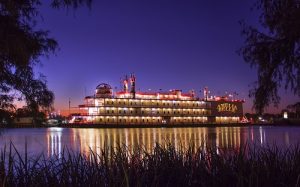 Belle ($3.5 million, +5%), and Churchill Downs‘ Fair Grounds racino ($3.5 million, +5%). Happily, no one was revenue-negative. In the Shreveport/Bossier City area, Penn’s newest asset, Margaritaville, continues to give Horseshoe Bossier City stiff competition. (How ironic that Margaritaville is a Caesars Entertainment brand in Las Vegas and almost was one in Biloxi.) Horseshoe grossed $13 million, up 6.5%, while Margaritaville was just over $12 million, a 10.5% gain. Penn’s Boomtown Bossier was up 10%, for a $4 million gross while Eldorado Shreveport slipped 2.5% to $8 million. Harrah’s Louisiana Downs was up 4% to $3.5 million while Sam’s Town Shreveport gained 3% to pass $5 million. Diamond Jack’s wants to be rid of Shreveport and customers returned the sentiment. Business was down 12% for a $2.5 million gross.
* Paving the way to sanction Wynn Resorts, the Massachusetts Gaming Commission has voted to settle Steve Wynn‘s lawsuit against the MGC. The latter  tried to spin this cave-in as a win, saying that it would “receive an investigative report and move forward,” that the settlement permits “a robust, public review of its investigatory findings.” MGC members huddled with their legal team for five hours before waving the surrender flag. (Presumably minus the sensitive bits Steve Wynn wanted redacted.) Wynn Resorts, a co-defendant in the lawsuit, can now brace itself for whatever fine it has to pay in order to get Encore Boston Harbor up and running.
* Bucking the Trump administration’s interpretation of the Federal Wire Act, lawmakers have voted an Internet-gambling bill out of West Virginia‘s House Judiciary Committee. Although the bill has bipartisan support it has to beat the clock, as the Lege adjourns on March 9. Under the proposed enabling legislation, the West Virginia Lottery would administer the online industry, issuing licenses at $250,000 a pop. The tax on revenue was initially set at 10%, then pushed to 15%, although some lawmakers wanted 35%. Delegate Tom Fast (R) had the sauce to call the 35% rate a “bare-bones minimum.” Delegate Shawn Fluharty (D) responded that “the intent here is not about raising a tax that doesn’t exist. This would have the effect of killing the legislation if we went to a 35% tax rate.” A moral-turpitude clause inserted into the bill would have the effect of keeping PokerStars and similar miscreants out of the state. Now we will see whether–should the bill pass–supine Gov. Jim Justice (R) will let it become law without his signature, as happed with sports betting.
