
JP Morgan‘s Daniel Politzer ran the numbers on an Eldorado Resorts buyout of Caesars Entertainment and finds it doable. His model is predicated on a $10.50/share purchase of CZR stock, currently trading  at $8.56. That’s a pretty good deal for a junk stock that has always traded below its IPO price because Gary Loveman had put Caesars into a world of hurt before deciding to go public. Under Politzer’s scenario, each CZR share would be traded for 0.09 of an ERI one. Let’s face it: Caesars shareholders would be getting a much better stock in this deal and should consider themselves lucky to have it. Eldorado would assume $10.9 billion in Caesars debt and could achieve up to $300 million in synergies, whether from merged marketing, labor cutbacks or “culled corporate expenses” (read: deadwood).
Two billion-plus in asset sales also figure in Politzer’s calculus. “We think the company gets the most bang for its buck selling a wholly-owned Strip asset as opposed to regional assets reliant on Caesars Rewards,” he writes. However, he is somewhat contradicted by the massive exposure a combined Caesars/Eldorado would run up in non- Vegas markets: 41% in Atlantic City (four casinos), 33% of Missouri and 6 of 13 casinos, 27% market share in Iowa and four of 16 private-sector casinos, 30% in Illinois (three of 10 casinos), plus “modest” overlap in Reno, Lake Tahoe and Laughlin. Depending on the inclination of the Federal Trade Commission as well as Eldorado’s appetite for risk, there might be a number of one-off acquisitions to be had by smaller companies (are you reading this, Churchill Downs?). Politzer estimates a Caesars/Eldorado hookup could generate almost $1.25 billion in cash flow, which would seem to say that the deal pays for itself. Let’s hope it does.
* “for the entirely reasonable price of $450K for 4 nights,” Venetian will hook you up with the Presidential Suite experience. What does your $450,000 (more money than I’ll ever see in my life) buy you? A cake, a salsa dancing lesson, butler service and transportation to from Las Vegas on the company jet. A few of us can live large, the rest can only dream about it.
* An Internet gambling/DFS bill is marching through the Michigan legislature. The House Regulatory Reform Committee passed it 13-1 and, unlike other states, Michigan’s tribal casinos are on board with  Rep. Brandt Iden (R) and his bill. Tribes and outlying casinos will pay 8%, Detroit‘s three casinos will pony up 9.25% in taxes. An amendment to sock it to casinos with a 16% rate was voted down. The bill’s next stop is Iden’s House Ways & Means Committee, although it remains to be seen whether the seemingly inevitable law will be vetoed or not by Gov. Gretchen Whitmer (D), who’s more focused on legalizing sports betting.
* Although MGM Resorts International is budgeting $9 billion-$10 billion for a megaresort in Osaka, it’s spreading the risk by casting a net for development partners. But CEO Jim Murren isn’t in a hurry; he says an announcement will be made by this time next year.  Of course we don’t know yet whether Osaka will get a megaresort, let alone whether it will fall to MGM. But don’t tell Murren: “We made the decision to focus all our energy on Osaka … We believe Osaka is going to be the first integrated resort location. The government’s very excited about it.” Murren didn’t exactly pick Osaka out of a hat: “They won the World Expo just recently. It’s going to happen in 2025. The government is very anxious to get the whole Yumeshima site in Osaka developed as soon as possible in connection with that World Expo.” J-Mur was in town for the MLB season opener, played in Tokyo, where the Oakland Athletics had to play in MGM-bedecked togs.
* As S&G reader Mike Zidik has mentioned earlier, Showboat owner Bart Blatstein wants to bring gambling back to the property, by dint of using a 123,000-square-foot lot as the site of a brand-new casino. The 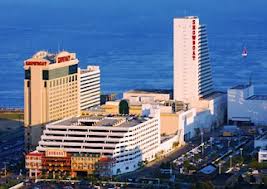 vacant land is said to be popular with the sand-volleyball crowd but it looks like they’ll have to take their ball and go elsewhere. By taking gambling out of the confines of the Showboat proper, Blatstein sidesteps a deed restriction imposed by Caesars when it sold the casino-hotel. Asked why he wanted to build another casino, Blatstein took a jab at the Boardwalk’s aging facilities. “The world has changed. The older-style casinos are no longer en vogue,” a point he could readily have backed up with recent earnings reports.
Blatstein’s target audience is–take a wild guess–Millennials. He’s going to introduce e-sports, for one thing. Bus-bound daytrippers 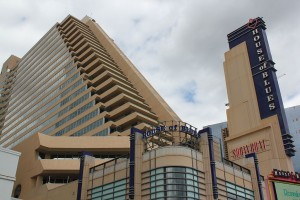 won’t find themselves welcomed: Blatstein is ripping out the bus terminal in favor of a “family entertainment center” (whatever that is). He brushed off concerns about market saturation by saying, “It’s not about the number of casinos. It’s about variety.” Again, the numbers would seem to back him up. Casino construction would take 14 months. By that time we should know if Bally’s Atlantic City has been sold or merely closed, opening up a wider field for Blatstein.

First off, I like the Showboat. It was a well capitalized and profitable property before Caesars closed it. In order for Bart to attract “Millennials”; however, he would have to do much more than tack a casino box onto the place. The decor is fine, but it would not attract a Millennial crowd. Showboat did a nice job of offing a product to a more aging crowd. Bart is going to have to do a whole lot more in order to turn the Boat into another direction!