
It’s time for Caesars Entertainment‘s quarterly earnings call and, by way of a preview, JP Morgan analyst Daniel Politzer took a relatively dim view of selling the company as a cure for whatever ails it. “While we understand activists’ rationale for circling CZR  (outgoing CEO, underperforming stock, stable cash flow, real estate optionality, to name a few), we do not necessarily see any obvious/easy fix, given (1) a shortage of buyers to create a competitive bidding situation, (2) CZR’s size/scale is a competitive advantage and the hub/spoke model make it difficult to divest/separate assets, and (3) monetizing LV Strip real estate to raise capital has its drawbacks (i.e., effectively adds long-term, high cost capitalized lease debt),” he wrote. He did cite a “relatively strong” 4Q18 as a rationale for slightly raising his cash-flow forecast ($568 million), while noting that his figure remained lower than Wall Street‘s consensus. He expected today’s call to provide some insight into the seemingly never-ending search to replace Mark Frissora and maybe touch upon the maneuverings of Carl Icahn and Tilman Fertitta to put the company in play.
Politzer opined that Caesars’ Las Vegas Strip properties had “strong fundamentals on both the gaming and lodging side” but in Atlantic City gaming revenue “was mitigated by ongoing competition.” (And will continue to be, we add.) As for the activist investors who are the heffalump in the middle of the room, Politzer doesn’t believe 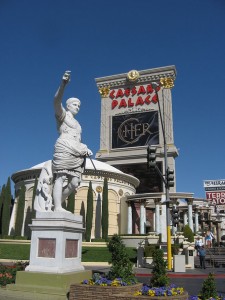 selling is the answer, saying that “capital structure and leverage remain overhangs, and
we do not see an easy fix.” He elaborated, “Divesting assets to raise capital may not be accretive, as casinos are typically more profitable under the CZR umbrella (55m+ Caesars Rewards program and LV Strip centric hub/spoke system) and thus a sale would likely come at a lower value than ascribed to CZR.” Referring to Icahn, Fertitta and a buy offer from Eldorado Resorts, he wrote, “we still do not see an obvious suitor that could//would take on CZR’s entire portfolio of assets (9 LV Strip assets, 22 regional assets, plus a handful of management contracts and casinos in the UK/South Africa). The assets could be split up among a mix of operators, though we believe CZR assets are likely more valuable as a whole.”
Identifying MGM Resorts International as the “most obvious” buyer, Frissora referenced “massive” synergies and a “regional footprint would provide a greater network from which MGM could draw customers.” However, MGM’s huge Strip presence would present “a regulatory hurdle.” Also, MGM has been pretty clear about  its own growth priorities, which do not seem to include Caesars. Wynn Resorts would make an odd fit and “also has its fair share of organic growth opportunities.” For a good balance sheet, one can’t beat Las Vegas Sands, Politzer says, but domestic growth is not one of the company’s priorities — this is the firm, after all, that is drawing down its stateside presence. Eldorado does make a logical partner “as the company has transacted with Icahn (e.g. Tropicana Entertainment acquisition), has an impressive track record of generating acquisition-related synergies, and would likely benefit from a presence on the LV Strip. However, the amount of regulatory approvals, asset divestitures, and the company likely becoming 100% full OpCo make for a difficult setup.”
Private equity is mentioned (and Oaktree Capital already holds a 1.5% stake in CZR) “though that didn’t work out so well in the past.” Touché. Fertitta might be unable to  swing the necessary leverage. “We could envision a scenario where Icahn and Tilman team up and Tilman is installed as CEO, but this would depend on capital structure and potential for a capital infusion.” This entire situation seems to bespeak an outbreak of amnesia on Wall Street. Caesars was in bankruptcy not so long ago from an LBO that went bust. As disinclined as we are to bet against Carl Icahn, this whole scenario reminds us of the saying that those who do not learn from history are doomed to repeat it.
* Horse racing, having been selected for extinction by the free market, continues to feed at the public trough. New Jersey Gov. Phil Murphy (D) just signed off on a $20 million/year subsidy for Garden State racing purses for the next five years. As The Press 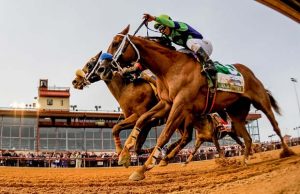 of Atlantic City reports, “The return of state support is good news for tracks that have struggled to compete with rivals in adjacent states that offer casino gambling as well.” The only potential stumbling block to five years of clear track for the horsey set would be if the state budget becomes so straitened that racing subsidies have to be sacrificed. In a fiscally responsive move, then-Gov. Chris Christie (R) had ended racing subsidies in 2011. Said Murphy, “Our state has a long and proud history of horse racing, and we must recapture our competitive edge in the industry. With this funding, New Jersey can continue to offer one of the most exciting horse racing experiences in the nation, while also providing a boost to an industry that is integral to our economy.”

In 2007 Las Vegas had 39.2 million visitors who spent $42 billion dollars and in 2017 Las Vegas had 42.2 million visitors who spent $54 billion dollars. Nice write up explaining the Caesars situation. Erno Rubik invented the Rubik’s Cube in 1974 so maybe he has a solution to this quagmire.
[…] for Icahn, the 800-pound gorilla in any discussion of Caesars, Politzer repeated his previous views, adding that there was “a shortage of buyers to create a competitive bidding situation.” Has […]