

Today’s guest-blogger contribution comes from Dr. Augie Grant, holder of the J. Rion McKissick Professorship of Journalism at the University of South Carolina‘s School of Journalism & Mass Communications. Prof. Grant was in Las Vegas for the opening of The Cosmopolitan and took advantage of the opportunity to compare it to next-door neighbor CityCenter. With Yr. Humble Blogger just back from two days in sickbay, S&G warmly appreciates the good professor’s timely contribution.
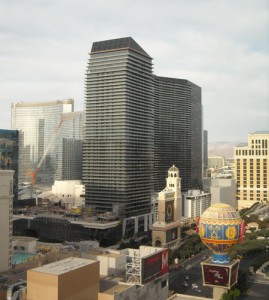 You can tell a lot about a neighborhood by looking at the front of the houses. If the houses have porches and are close to the street, you can bet that you’ll see people stopping by or saying “hi” as they pass by. But if the houses have walls and are set well back from the street, that’s a clear sign that company is usually not welcome—except by invitation, of course.
The Cosmopolitan resort and CityCenter represent this dichotomy on a grand scale. The Cosmopolitan is right on the street, with doors open to welcome anyone who wanders by. But CityCenter, especially its Aria centerpiece, is like a mansion, set well back from the Strip, with imposing concrete barriers that provide a not-too-subtle hint to visitors that this is not a place you simply drop by to say “hi.
It’s ironic to find such a set of barriers built into a set of buildings that are on one of the most famous pedestrian streets in the world. Even worse, the design of CityCenter deliberately inhibits pedestrian traffic. You can’t even walk past the property without having to detour a fair distance into the property to climb a bridge over the access roads—twice! (Side note: If you need to walk past CityCenter on that side of the street, the easiest path is to get to the second level and walk through the Crystals mall. It’s not too far out of the way.)
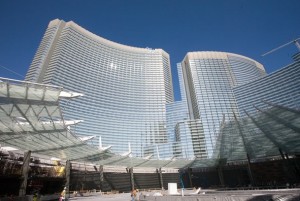 Pedestrian bridges are nothing new on the Strip — they’ve been helping the traffic flow at major intersections for more than a decade. But the maze of pedestrian access past CityCenter can definitely make a person feel less than welcome there. The problem is exacerbated by the lack of crosswalks across Las Vegas Boulevard the entire length of CityCenter. Not only were no crosswalks built when the streets were redesigned for CityCenter but a fence was put down the middle of Strip, providing a no-nonsense barrier that effectively keeps the casual customer out … or does it keep the CityCenter guest in?
Contrast the enclave that is CityCenter with the open access to the Cosmopolitan. Take the porch metaphor to an extreme — there is may be no better porches in Las Vegas than the fourth-floor patio that sits right on the Strip and the tiered balconies on every floor that rise above it.
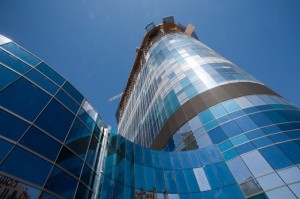 So I’m left to wonder: Did MGM Resorts International design CityCenter as an enclave, to keep the right people in and all others out? Was that an unfortunate accident of the architectural requirements for the “urban complex” that is CityCenter? If it was an accident, MGM has a ready facility that can address the problem — the first two floors of the now-vacant Harmon stump (left) could be outfitted as a casino, with access at both the street and pedestrian bridge levels that could welcome visitors from almost any direction. But it won’t happen—it’s probably less trouble to wrap signs around the building and keep it empty, providing yet another barrier between the Strip and CityCenter.
And the Cosmopolitan will stand beside it, with open doors and one of the best front porches in the world. I’m not qualified to compare the architecture of the two developments, but I know which one has made me feel welcome during my last two visits to Las Vegas. I’ll take a porch over a wall any day. — Augie Grant, USC

[…] This post was mentioned on Twitter by Angelo Georgiou, David McKee. David McKee said: New entry; Cosmo: Walls & Porches, by Prof. Augie Grant, U of S. Carolina (Go Gamecocks!) https://www.lasvegasadvisor.com/stiffs-and-georges/?p=5496 […]
Nice take. I happen to agree with you 100% on that one. Use the Harmon (at least the first few floors anyway) to lure people in! I had thought City Center was going to be a bit more like Related’s originally proposed Las Ramblas project with street level retail, restaurants etc that would lure people into Aria, Vdara etc. I was surprised when the main driveway to the place was just that..a driveway!
I’m going to repeat something I said on Twitter because Cosmopolitan requires me to re-address it, and maybe Dr. Grant will see it as well:
If you wish to understand why CityCenter is arranged in the way that it is, look no further than the process of it’s development: While demolishing the Boardwalk, MGM simultaneously built a multi-level parking garage for Bellagio employees whose surface parking was displaced by the project. The area next accessible to the public was a new Monte Carlo garage that also houses cars for CityCenter employees, and when you finally add the lot for ARIA self park and valet, you now have three above-ground garages.
On Twitter, I called for off-site parking for Strip hotels, which was met with a lukewarm reaction from people who know. The general response was that it would be too hard to keep employees from simply parking in customer lots. But due to necessity Cosmopolitan has a “co-stars parking” surface lot along Harmon west of the freeway overpass (behind the hotel and CC). It’s nowhere near as convenient as employee parking at Monte Carlo or maybe even Excalibur, but that underground garage (very expensive per space compared to above ground, thanks to the hardiness of the Vegas soil and water tables), is freed up for paying customers.
CityCenter might not be a dense urban project of Manhattan magnitudes, and simply another sprawling “can’t get there from here” megaplex that takes half the day for the average casual visitor to walk around. But it couldn’t be that project even if it wanted to be one, for even if it’s customers were high-rise sophisticates the employees would still be Las Vegans.
I love how CC and Cosmo offer me a break from the overly ornate luxury hotels and the themed older hotels, but CC probably also is a microcosm of all my problems with LV as a whole. Whether or not LV is a badly designed city or not depends on whether you view a city designed exclusively for car drivers to be a bad design by default or not. With it’s wide roads that rarely curve around bends, LV is an efficient city for driving, but a pedestrian’s nightmare. With so many valet opportunities, garages, and a road sneaking through it, CC sort of has some of the same characteristics.
Heck, one my strongest props for Aria is that Harmon oval, which is a great place to be dropped off or picked up by friends and family who do carry a license. Getting in and out of it is, for my drivers, not uncomfortable. But the space comes with a loss.
So basically, I’ll just sum it up by saying that like all other Vegas hotels CC is a toy version of some real object that works somewhere else, albeit maybe an imitation of something less tangible than the Eiffel Tower. It is still The Las Vegas Version of something that Las Vegas simply isn’t, and as such the impression is only skin deep. The Strip never get a truly intimate Manhattan style setting, whether you prefer the crazyness of Times Square or the stateliness of Wall Street, until we can do something to reduce the amount of vehicles that need to access it every hour.
I think MGM Resorts International had so much land to build on (around 66 acres) and an unlimited budget that they wanted to build a multifaceted project with many buildings and they came up with City Center.
American Gaming Guru: I remember seeing a rendering of Las Ramblas and I thought it looked pretty cool. That was one of the many projects that were announced back in the boom years (2004 to 2007) and never built.
I felt out of touch at City Center. Aria didn’t thrill me. I look forward to my next LV visit and check out Cosmo.
One would have thought the disaster that is Alladin would never happen again… When City Center was being constructed I always thought what is now Chrystals was going to be “the casino”. I told my family nobody was stupid enough to build a casino away from Las Vegas Blvd after the Alladin fiasco. Guess I was wrong…
When I visited City Center, it looked to me like the set of a dystopian science fiction movie — part Logan’s Run, part Silent Running, and part Zardosz. I don’t know what the architects were smoking when they designed it.
Interesting that when CC was finally finished, there were fights between the bigwigs of MGM of just who was to be credited with its design (thinking the world would smile). However, now that the glitz has dimmed, what stands is Aria too far from the Strip, too large to fill its rooms or sell its condos, and an atmosphere that is too formal and cold. There seems to be little desire for people to stay around and drink or party. Want just a lite beer? Just saunter up to any of their many empty bars and order one for $7.50. Not too inviting.
Then there’s the Mandarin Oriental (we won’t even mention to possible racial slur in its name), but has there ever been such a fiasco for people to get into the joint? Just try finding any door to walk into from the Strip! The valet entrance is such that any pedestrian can not only be intimadated but run over by an approaching car. I never did make it inside.
Finally, the Cosmo (the tardy offspring) is nice enough. We’ve become so spoiled when it comes to these “elite” properties that we now take for granted the beautiful interiors with the marble floors and crystal ensconsed center bars. To become truly “ohh and awed” by any property is now become almost impossible (unless you get a kick out of the display of hundreds of antique sewing machines–someone spent a lot of time on Ebay).
How in the world Las Vegas needs ANOTHER premium mall is completely a mystery to most. The millions spent on the “art” around the Crystals is simply another puzzle to me, Swirling water spouts and twisted metal is so underwhelming, all one can do shake your head and know that somewhere are the creaters of these enigmatic art displays laughing it up as they look over their bank accounts.
This isn’t to say there is nothing noteworthy here. Pretty much everywhere I went the staff was cordial and downright nice. When I was getting my slot card from the Cosmo, I asked the clerk is she was having a happy new year, and her response was simple: I thank God I have a job.
Bravo!