

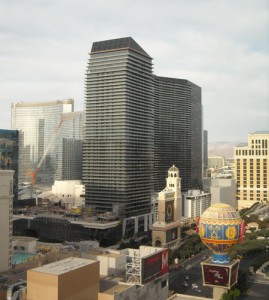
 It seems like David G. Schwartz is everywhere today. Las Vegas’ resident casino expert has not one but two stories out on The Cosmopolitan. From what he writes, Cosmo execs have convinced themselves they’ve reinvented the casino. It hinges upon something known as “the curious class,” a demographically indefinable mass of people who don’t come to Vegas. (If they don’t, how curious can they be?) The Curious Class member “defines herself in terms of wanting something new and different, but it has to be meaningful and relevant,” quoth Cosmo Chief Strategy Officer Sherry Harris. “The new luxury is less about status and more about purpose. It’s defined as seeking experience over services, and it requires emotional connection that is worth returning to.”
The casino industry is an odd duck, at least to the extent that it creates no tangible product. “Experiences” are what it’s already in the business of selling. As for the rest of The Cosmo’s spiel, it doesn’t sound like they’re going anywhere Steve Wynn hasn’t been already — and many years sooner. However, a separate Schwartz chat with CEO John Unwin suggests that the thinking at the top is more clear-headed. Unwin talks more in terms of continuing the progress Vegas has already made — and of the huge challenge posed by opening a casino whose brand equity is zippo, nada, squadoosh … although a deep portfolio of hospitality-industry experience will help and a marketing alliance with Marriott will assist even more. As his Twitter feed makes clear, Unwin travels in rarefied air that you or I do not inhabit. The $4 Billion Question is whether the other Unwins of the world — and that “curious class” — will flock to what promises to be CityCenter on a slightly smaller scale and with finer attention to detail.
Horse 1, Barn 0. Now that Sen. Harry Reid‘s belated attempt to push legalization of Internet poker through Congress has collapsed (although Old Sixty Votes’ spokesman now says it’s all a big, self-inflicted misunderstanding and reports of the bill’s death are exaggerated), intra-state ‘Net-betting may soon be on the table. This scenario was predicted at Global Gaming Expo and looks like it’s happening even faster than expected. Michael A. Brown, a member of the District of Columbia‘s city council, has proposed Internet poker and fantasy-sports wagering as a new source of revenue. Nevada Gov.-elect Brian Sandoval, who has budgetary woes of his own to solve, so severe that even the late Gov. Kenny Guinn might have called in sick, just so happened to let it be known that he supports Internet poker, too.
(Meanwhile, CityLife columnist Hugh Jackson provides a helpful reminder that liberals can play the we-hate-gambling tune with just as much vituperation as religious conservatives.)
 Silver State casinos biennially take umbrage (and rightly so) at the notion of a lottery but — with at least three major gaming companies poised to exploit the Internet-poker market — Sandoval just might have an ace up his sleeve. Meanwhile, Gov. Jim Gibbons (left) continues to be a class(less) act, sulking in his mansion and refusing to meet with his successor — though he did manage to cavort about The Venetian this week in “casual Friday” attire, making obtuse remarks about water usage. (Henry Brean, in The Newspaper That Must Not Be Cited, had a piquant account of the gubernatorial goings-on at Sheldon’s Place.) What are we gonna do for laughs when Midnight Jim is gone?
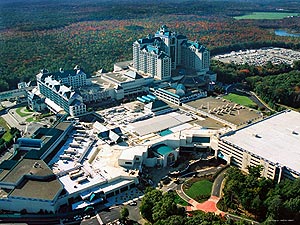 Wall Street’s tribal predicament. Or is that the other way ’round? Casino-owning tribes and the banking industry have each other over a barrel. Wall Street can’t foreclose on sovereign tribal nations and tribes would find it difficult to declare Chapter 11. Which means creditors could be left holding the bag big-time if a Foxwoods Resort Casino (left) were to default. By the same token, if tribes stiff their underwriters, they’ll be right back to supplicating Malaysian tycoons for loans at usurious interest rates, just like the old days.
Solutions to this crisis range from profit-sharing agreements to that oldie but goodie, writing off 33%-70% of one’s debt and hoping the new notes get redeemed. Or maybe some cash upfront in return for a lower interest rate on the (extended-maturity) back end of the deal. Wall Street has a short memory when it comes to bad investments — witness Donald Trump‘s serial casino bankruptcies — but it will probably make an exception for tribal casinos. It took a long time for The Street to develop any appetite for tribal gaming, so “Once burned, twice shy” definitely applies if Native American casinos start defaulting.

[…] This post was mentioned on Twitter by David McKee, Mysteriously Unnamed. Mysteriously Unnamed said: Cosmpolitan LV: The curious case of "the curious class" (plus Net bets redux, tribes vs. Wall Street). https://www.lasvegasadvisor.com/stiffs-and-georges/?p=5313 […]
From the pictures I have seen on various websites I really like The Cosmopolitan. It will also be extremely easy to get into Cosmo because it looks like it’s practically right on the Strip. Mr. Unwin learned a lot from Ian Schrager and the design looks pretty cool. Good luck Cosmo.
John Unwin can be credited with at least two important design changes. It was on his watch that the casino was extended to the LV Strip sidewalk, in acknowledgment of tourists’ preferences (Jim Murren, take note).
He also jettisoned the “stacked,” multi-floor casino design that Ian Bruce Eichner had envisioned. That sort of design goes over in Macao, where space is at a premium but Vegas visitors don’t seem to cotton to it — although whenever I have to traverse the MGM Grand casino floor I sure wish they would.
The Captcha phrase for today is “doctor novemen.” As in: “Doctor Novemen realized with dismay that her patient suffered from an advanced case of Ballas-Hough Syndrome.”