

Pinballing between projects, I’ll try to carom off the “blogging” bumper for a moment here …
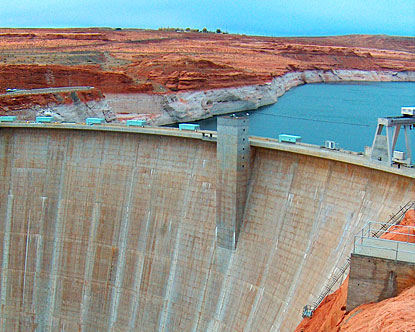 1,075. That’s the magic number of feet below which Lake Mead cannot drop lest Hoover Dam should become inoperable — plunging Clark County into darkness — and kicking off an emergency backup plan. The latter consists of robbing Peter to pay Paul: Drain more water from Lake Powell to replenish Lake Mead. Unfortunately, the primary alternatives are more of the same. Southern Nevada Water Authority generalissima Pat Mulroy — the closest thing to an absolute dictator in Nevada — is having her minions dig another “straw” into Lake Mead, to suck water out from below the 1,000-foot mark. (Believe me, if the lake level hits 1,000 feet, we’ll be in such deep manure that continuing to suck out Lake Mead becomes irrelevant.) Another scheme, even dearer to Mulroy’s heart, is to sap that aquifers that sit beneath ranches in northern Nevada and Utah.
The crowning irony of all this is that Nevada’s economic collapse may have been a blessing in disguise. Had the condo bubble not burst and taken the resort boom down with it, the unsustainable growth of Las Vegas would be on that much faster a collision course with the dwindling reality that is Lake Mead.
How to survive? Since the sustainability crisis out here can be deferred but not delayed indefinitely (at least not if Mother Nature continues on her present path), that’d be a good topic for the fine minds at Smithsonian magazine. Instead, they have commissioned a tiresome compendium of clichés by slumming Pulitzer Prize winner J.R. Moehringer. The latter, an avowed recluse, seems to have ventured out into Vegas during his stay here only long enough to make the most superficial observations. Some of the assertions he makes I find frankly incredible, fodder for an intelligentsia [sic] that will lap up the silliest Sin City fable as gospel truth. This is hit-and-run garbage any tyro writer could have cranked out.
The distant year 2004. It’s always rather amusing and disconcerting to read articles that denote Vegas’ wipeout by noting that gambling revenues are at levels not seen since — gasp! — 2004. What makes it funny is that ’04 was one of those banner years for the casino industry, spawning so much optimism that MGM Mirage and Harrah’s would turn the Strip into a duopoly by devouring most of their rivals. The Golden Nugget buyout would be but the first (and most successful) of a series of big investment plays, as conglomerates and developers tried to get in on the burgeoning Vegas economy. And when some companies ran out of things to buy, they purchased themselves. Of course, none of this would have possible without taking the city hostage to a mountain range of debt … which is a huge part of the reason why a full glass six years ago looks like so much like an empty one in 2010.
It’s no use being impatient with Mr. & Mrs. America for not spending the way they did a few years back. Who doesn’t hold their money a little closer these days and write every check with a frisson of apprehension? Given the absence of demand for new development, of any stripe, the swift implosion of the construction industry is expected to hobble Vegas’ economy for years to come. Still, the architects of the disaster remain shameless. Mouthpiece for hire Billy Vassiliadis tells the New York Times, “There needs to be some real, thoughtful, deliberate effort to rebuild an economy here. It isn’t going to happen by itself.” (There’s one for the No Shit, Sherlock File.)
Mind you, when “thoughtful, deliberate effort” was really needed, a few years back, Billy V. was among the cheerleaders for “party on, dudes” mentality, the same one that gave us such mythology as “Growth pays for itself” and “Gambling is recession-proof … uh, make that recession-resistant … oh wait, forget I said anything.” If we’d listened less to the professional optimists like Vassiliadis back then, maybe we’d not be in such a pickle now. But it’s nice to see that Billy’s capacity for shamelessness is the one thing in Vegas that’s 110% recession-proof.
On a happier note, the long-delayed Neon Museum, just uphill from Cashman Field, is starting to take shape. The former La Concha Motel lobby is in position to serve as a visitor center and the titular shoe from the Silver Slipper has been mounted out front. Other major pieces of neon (including the old Stardust sign) are in staging areas nearby. One hopes that the recent withdrawal of state support won’t seriously crimp the progress of this attraction, which has been so many years in the making.
Suncoast’s new marketing slogan? Heard last night in an elevator lobby: “It smells like sherry and old people.”

What is the water level today?
I love flying over Lake Mead and every time I do so the lake looks a few feet lower.
I remember reading the Skyscraper Page Vegas Forum back in 2005 through 2007 and real estate agents would promote certain condominium units they were selling. City Center, Palms Place, Trump, Panorama, Sky, etc. The Manhattanization of Las Vegas was imminent and then……?? We know how that ended. Some of these agents had the morals of the infamous huckster and shell game master Mr. Haney from Green Acres.
Hopefully 2010 will be better than 2009. In 2009 36.3 million tourists visited Las Vegas. In 2009 $35.2 billion was the amount of money spent in Las Vegas; $6.9 billion of it went to gambling. Shows, hotels rooms, restaurants, nightclubs and shops accounted for the rest.
You pretty much called it on that 2004 thing. Although that was a time when the companies were simply building add-on towers instead of whole new hotels (unless you were Steve Wynn), they had a lot more money for buying each other out.
You may or may not like the new White House Chief of Staff, but you can probably identify with him. He is a cat fan who is obsessed with his Maine Coons: http://gawker.com/5653467/rahm-emanuels-replacement-is-obsessed-with-cats
I’m confused:
Is the Neon Museum in the same place as the Neon Boneyard?
I know they are the same, but is the Neon Museum just a formal name for the informally named Boneyard?
The “boneyard” was a lot where the signs were stored, willy-nilly.” It is being gradually superseded by the museum proper. To further confuse matters, the “museum” was for a while defined as a series of old neon signs that were repurposed as street decoration (a souvenir of the Landmark sits across from the Convention Center), a tradition that will hopefully continue, as there seems to be far more historic neon that the Museum and its surrounding park — around the corner from the Mormon Fort — will be able to contain.