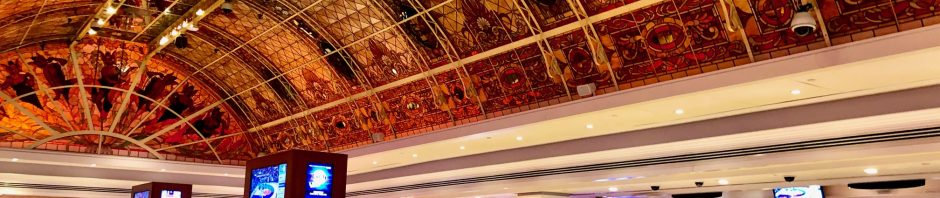

- GLPI-owned Casino Queen is the only GLPI property to be delinquent on its rent. It will be made whole by new owner DraftKings by December 31.
- “GLPI continues to evaluate inquiries for the Tropicana Las Vegas and is being patient as it waits for Las Vegas to return to some semblance of normalcy [sic].” Given the meager results generated by the recent Skyvue auction, will GLPI be able to recover its (discounted) $307.5 million price tag on the Trop?
- If—as probably will happen—Caesars sells Tropicana Evansville, GLPI wants to hang onto the underlying real estate.
- Caesars’ riverboat in Greenville, Mississippi, may be for sale.
- CEO Tom Reeg is welshing on a commitment to Louisiana regulators to revamp ancient Belle of Baton Rouge and is looking to sell Caesars’ stake in it. Neat trick: Promise capex improvements to get approval of your merger, then go back on your word.

MGM Resorts International held its first investor call with Bill Hornbuckle as permanent CEO and was able to report positive cash flow at all Las Vegas Strip resorts except Mandalay Bay (despite cost cuts). “The properties have benefited from pent-up demand (particularly at the high-end/Bellagio) following reopening, but there has been some deceleration in July,” reports JP Morgan analyst Joseph Greff. Midweek occupancy is described as “a challenge.” The company is leaning more heavily on Mlife to generate casino customers (30% of the mix instead of the usual 20%) and while occupancy has slipped, those who are renting rooms are spending 25% more than usual. “The short, one-week booking window in Las Vegas remains a challenge, and while bookings have been fairly steady, cancellations related to COVID-19 flare ups have made forecasting nearly impossible … and a lot of Mirage customers have shown willingness to stay at MGM’s other properties.”
Convention “leakage” is seeing into the first quarter of next year. The rest of 2021 looks better and convention planners tend to re-book rather than cancel outright. Most employees are still working part-time, with only 40% of the force full-time equivalents. Hornbuckle is sticking with MGM 2020 and it must be awfully easy to save money when you’re running a quasi-skeletal operation. On a not-unrelated note, management is leery of comps and promotions for the time being. It is expecting a stronger result from its regional properties, where 70% of the revenue is gaming-derived, compared to 30% for Las Vegas (where so many amenities are still dark or going that way … adieu, Sage.) Overseas, MGM is experiencing 90% occupancy at its non-gaming hotel in China and is “optimistic” that Beijing will finally reinstate the (crucial) individual visa scheme … in September, but in time for Golden Week in Macao. (This all presumes no resurgence of Covid-19, in which case the government has promised to re-close the casinos.) Overall, we can see why management was upbeat.
Speaking of Macao, Deutsche Bank analyst Carlo Santarelli projects a long—but ultimately successful—return to normality. Gaming revenues this year, he forecasts, will be 85% off the pace and 68% down next year. But casinos come roaring back in 2022, up 150%, leveling off in 2023 with a 9% increase. Pass the word.
“I sold Skyvue and all I got was this lousy T-shirt.” That’s what Colliers International should be saying. After fielding 271 expressions of interest, the bottom fell out of the Strip property, most of which sold to Wayne Perry for less than $4/acre. Worse still, he bought it with a “credit bid.” Which is to say he pledged $75 million that Howard Bulloch owes him against the acreage. It’s not Monopoly money but it’s close. Our best guess is that Perry will sit on the land until the Vegas economy improves, then flip it to someone with some real diñero. Expect Bulloch’s two lonely pillars and mascot Tiny the Tumbleweed to remain in residence for the foreseeable future.
Ownership of two Strip mainstays, Il Mulino and California Pizza Kitchen, filed Chapter 11. Il Mulino’s umbrella corporation is $36 million in debt and was in danger of having its restaurants seized. California Pizza Kitchen was even deeper in the hole—$400 million—having defaulted on rent payments during the Coronavirus pandemic.
Jottings: In Oklahoma, a big loss for Gov. Kevin Stitt (R). A federal district court has ruled that tribal gaming compacts rolled over last January 1, just as the tribes have been saying all along … Indecision is afoot in Japan. Now Sheldon Adelson may withdraw his withdrawal from the bidding, while MGM is having second thoughts about the ROI in Osaka, which we never thought would justify a $10 billion investment … The Massachusetts Lege has ash canned sports betting for the moment. As Boston Red Sox fans are already saying, Wait ’til next year … Rep. Joe Kennedy (D), scrounging up votes in his bid to unseat Sen. Ed Markey (D), has introduced legislation to reinstate the Mashpee Wampanoag reservation. It may be a slam-dunk in the House of Representatives but such bills have always stalled in the U.S. Senate, where the Grim Reaper awaits … Pre-approved lines of credit straight from slot machines or table games? It’s a problem-gambling advocate’s worst nightmare. Listen and decide for yourself.

The lack of conventions for the remainder of this year and into early
next year is going to hurt Las Vegas. Hopefully the large conventions can come back soon but until there is a vaccine everything is kind of at a stand still. This year just sucks and I would assume at least 15% of the restaurants in the USA will not come back and close forever.
The one business because of social distancing that has done well is drive-in movie theaters and several “pop up” drive-ins have opened up around Chicago. Its possible that other large cities have these “pop up” drive-ins also. Across the Strip from Mandalay Bay Bulloch’s lonely pillars and some of the vacant land south and west of the twin pillars would be an interesting location for a Strip drive-in movie theater.