

It’s 25 years ago this month that casino gambling came to Baton Rouge. The mood, however, is far from celebratory as the city’s riverboats remain mired in a two-year slump, thanks to the Baton Rouge smoking ban. Some also blame a lack of capex  maintenance at the three casinos, as well as stronger competition from Mississippi, which has—unlike Louisiana—sports betting. Ironically, the downward slalom began just as Baton Rouge were at their apogee: $309 million at the end of fiscal year 2017. By the end of FY2019 that number had dwindled to $235.5 million. Not chicken feed but a lot less than the good old days.
Not surprisingly, the casino that has defended its market share the best is also the newest: L’Auberge Baton Rouge, down 16%, compared to 21.5% less at Hollywood Belle and 48% at Belle of Baton Rouge. The latter is faulted for being too far from parking and both it and Hollywood are on the same barges which arrived 25 years ago. L’Auberge’s 1.4 million FY2019 visitors are more than its two competitors combined.
Also, while there’s a fair amount of new development along Mississippi’s Gulf Coast, there’s nothing happening in Louisiana, where taxes are considerably higher: 26% vs. 11.5% and where comps are taxed. “Louisiana has not kept regulations current in the face of changing demographics and changing competition,” concluded Spectrum Gaming‘s Matt Roob. Another problem is that two of the three Baton Rouge operators—Penn National Gaming and Eldorado Resorts—lack an economic initiative to be competitive there.
“Those operators can make more money by encouraging good customers to gamble in Mississippi [where their casino investments are considerably larger], where they get a bigger cut of the money that is lost and don’t have to pay taxes on a free hotel room,” writes reporter Timothy Boone. Penn and Gaming & Leisure Properties have also spent a combined $3.4 million on capex maintenance last year, putting them near the bottom for the state. Casino staffing has also plummeted over the last several years.
Unlike most major cities in Louisiana, to say nothing of Lake Charles, casinos in Baton Rouge are overwhelming dependent on locals, for whom the novelty of gaming has worn off (and 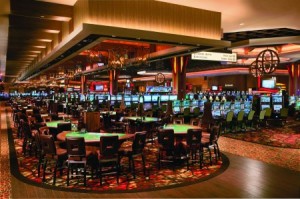 where there aren’t the additional amenities to draw visitation). Diversification of appeal might be possible if casinos accept the Lege’s 2018 invitation to move their facilities on shore. (Pinnacle Entertainment promised lavish amenities at L’Auberge that included a golf course, spa and 400 homes; Pinnacle never followed through and Penn has axed the concept.)
Whether operators have the willingness to make that investment remains to be seen. A similar initiative in Illinois several years ago found no takers. Only Belle General Manager Jim Rigot is openly in favor of moving onshore but Eldorado, which is barely making peanuts at the casino, is wishy-washy about it. For Penn, it makes no sense because L’Auberge is only 12 years old.
In lieu of new amenities, L’Auberge has focused on new table games and slots, as well as an open-air slot deck for smokers. Belle of Baton Rouge is the only casino not to make a concession to smokers. Explained Rigot, “We’re saving our powder if we go land-based.” (A big ‘if,’ as the casino is ripe for spinoff by Eldorado.) “Most folks feel like there will be an adjustment for the smoking ban,” says Louisiana Gaming Control Board Chairman Ronnie Jones. Yes, but we’ve been waiting for it a long time now.
* Sports betting hit a speed bump in Washington, D.C., where a Superior Court judge has enjoined it, due to a  complaint that Intralot‘s contract with the District is a protected monopoly. Intralot is out (at least temporarily) the $30 million it was to have been paid yesterday to incept sports-betting operations in D.C. Council member David Grosso has already faulted the Intralot deal as “A rush to tax the poor, a rush to skirt procurement rules, and rush to retain a company that was recently downgraded by Moody’s to a ‘B3’ status, which is a speculative grade and considered a high credit risk.” We await further developments with bated breath.
* Another casino came to Arkansas last Monday with the debut of the temporary version of Saracen Casino. It’s pretty basic: 300 slots and a bar. However, it should build up some nice cash flow while the 80,000-square foot permanent casino (and 300-room hotel) are built with an eye to a December 2020 debut.
* Congratulations to Gaming Hall of Fame inductees Elaine Hodgson of Incredible Technologies, Ernie Moody of Action Gaming and developer Stanley Mallin. Hodgson founded Incredible in a basement in 1985 and moved into the slot-machine domain in 2007. Moody is the inventor of Triple Play Poker and many other popular games besides, which you can find resident on 20,000 machines nationwide. Mallin was Jay Sarno‘s partner in Caesars Palace and Circus Circus. S&G salutes all of the honorees. They’ve earned it.
