


“It’s kind of fun to do the impossible,” said Walt Disney. For the leadership of DraftKings, “the impossible” would include finding a path to near-term profitability. DKNG reported 3Q22 numbers late last week and J.P. Morgan analyst Joseph Greff called the projected, year-end negative return on investment “worse than expected.” And it gets more adverse next year, when DraftKings is expected to return [sic] $110 million more negative ROI than Wall Street anticipated. “This is disappointing as this outlook follows recent 3Q22 earnings commentary from DKNG’s OSB/Digital competitors … who have talked up an accelerated path to profitability and suggests that DKNG is lagging peers on a path to positive EBITDA generation.” Oh sure, DraftKings might produce a positive ROI … in 14 months or maybe break even in 2024. But the company continues to get less bang for its buck, in terms of revenue and market share than (privately held) rival Fan Duel.
Among other contributing factors to the disappointing cash-flow news was that DraftKings has been slower than its competitors to trim promotions and operating expenses. At least stock-pickers could console themselves with the news that in the third quarter DraftKings didn’t lose as much net revenue ($502 million received) and ROI ($254 million lost) as expected. Monthly unique players grew 19% and their spend ($100 on average) was a 113% increase. Even so, Greff yanked his year-end price target down from $17/share to $12. It looks like next quarter’s revenues will be $805 million, well short of Wall Street targets, and negative ROI will be $108 million, way more than the Greffs of the world were anticipating. Negative ROI next year will be between $475 million-$575 million, even with contributions from Puerto Rico, Ohio, Maryland and Massachusetts. If you can wait until 2025, Greff projects positive ROI of $372 million, as revenues cross the $4 billion threshold.

“Eventful” was Deutsche Bank analyst Carlo Santarelli‘s diplomatic characterization of the earnings [sic] call, citing as one of the problems facing DraftKings, “the realization that even high hold has its drawbacks, as operators feel the need to re-stimulate their customers with incremental promotions.” To be fair, he also blamed “an overall skittish equity market, in which any material news, good or bad, creates outsized volatility.” Noting that DraftKings bosses made 3Q22 look nicer by shoving some expenses into 4Q22, Credit Suisse analyst Ben Chaiken called the numbers “better than expected” and “an attractive opportunity,” setting a decidedly optimistic $48/share price target on the stock (especially if you like throwing your money down a black hole).
Chaiken called the 27% plunge in DraftKings’ stock price “an overreaction” and “an arbitrarily tough bar … Further, we don’t think earnings/call shed light on anything incrementally negative either.” He clarified, “We think the largest portion of mis-modeling was around external marketing, which is the expense correlated with new state launches. Street was expecting this cost to be down in ’23 vs ’22, which is hard when there are four new state launches.” He predicts positive ROI of $589 million … in 2026.
Arguably even more upbeat was Truist Securities analyst Barry Jonas: “We still see a real path for investors to become more constructive given DKNG should be a [long-term] winner in the space, though we continue to favor operators at or closer to profitability.” Taking note of an $8 million expenditure to launch in Kansas, Jonas stressed revenues that “were higher than anticipated given favorable sports outcomes.” (Maybe not so much next quarter: See “Jottings”) He added that DraftKings was #1 in handle, a metric that Santarelli would be quick to dismiss, especially as it’s not flowing through to the bottom line. “In addition, mgmt noted a more rational promo environment compared to last football season which DKNG expects to continue moving forward.” Jonas, whose price target on the stock held at $15, wrapped up by noting that DraftKings expects to be profitable in 10 states next year. We’ll be pleasantly surprised when that happens.
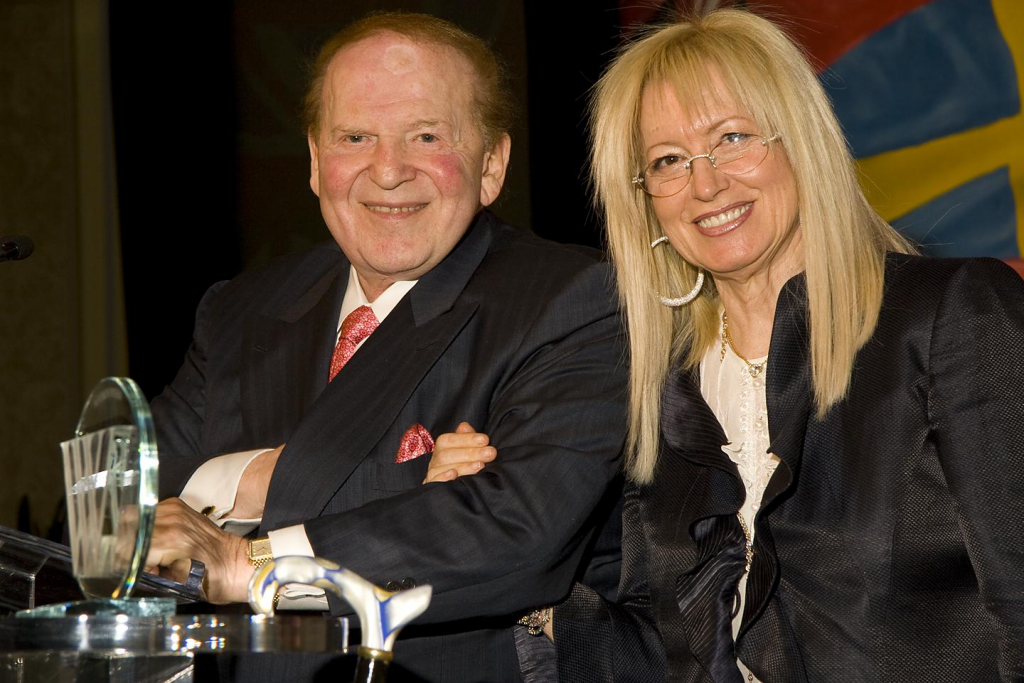
Big Gaming is “running to the right” this year and it’s not just the usual suspects in the C-Suites. According to Casino.org, “Even among casino floor workers, Republicans received about $1.50 for every $1 donated to Democrats … (The average casino worker’s political donation was $15.)” It’s not a good day for Democrats when they’re losing the rank and file. As for the plutocracy, it was fairly predictable in its financial behavior. For instance, if Rep. Marjorie Taylor Greene (R) makes good on her threat to cut off all aid to Ukraine, we can thank Dr. Miriam Adelson (above), who dug deep and donated $10 million to the Congressional Leadership Fund. The Fertitta Brothers, despite their previously announced support for Nevada Gov. Steve Sisolak (D), gave almost $2.5 million to various and sundry GOP candidates.
Circus Circus owner Phil Ruffin chipped in $750,000, two-thirds of that going to one of Donald Trump‘s PACs. Island View Casino owner Joel Carter Sr. gave $315,000 that included $120K to the Trump-Graham Majority Fund. The only “blue” donor of note was former MGM Resorts International CEO Jim Murren, who funded various Democratic campaigns to the tune of $87,000. Hedging his bets was DraftKings general counsel Stanton Dodge, who gave $71,500 to GOP campaigns and $67,500 to Dems. The industry’s earliest and bluest big wager, an outlier on New York State Gov. Kathy Hochul (D) looks like it is going to pay winnings, as Hochul is currently polling at 51%, staving off a last-minute charge by Lee Zeldin (R). Gaming CEOs will have much egg on their faces should Zeldin win. The only sure losers in Big Gaming are everybody who donated to California‘s Proposition 27, widely reviled by prospective voters.
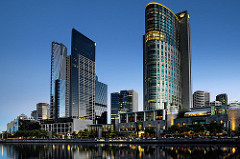
Troubles for outlaw Crown Resorts continue: Australian regulators slapped the company with a record $77 million penalty, the maximum allowed. Most of the fines were levied for lax (basically nonexistent) responsible-gambling policies, the rest for allowing slot players to use plastic sticks to keep spin buttons perpetually depressed, enabling one punter to play multiple machines simultaneously. “For a long time, Crown had promoted itself as having the world’s best approach to problem gambling. Nothing could be further from the truth,” said Fran Thorn, chairwoman of the Victorian Gambling & Casino Control Commission. Additional fines may be coming. Unfortunately, the burden of paying the penalty falls upon new-broom ownership Blackstone Group, which vowed, “We are genuinely remorseful for the failings of the past, and we are committed to becoming a world leader in the delivery of safe and responsible gaming and entertainment.”

Federal regulators say they are “not satisfied” with the results to date of an investigation into the politically juiced approval of Two Kings Casino in North Carolina. (Neither are we.) While Rep. Jim Clyburn‘s brother and ex-South Carolina Gov. Nikki Haley‘s husband will probably get off scot-free (it’s a bipartisan scandal), the Catawba Tribe may not be so lucky. Non-tribal Kings Mountain Sky Boat Partners not only held “management authority” over the casino but a ground lease under it, neither of which were approved by federal authorities. The Catawba face a possible fine and even the temporary closure of Two Kings, even though Congress passed a bill last December greasing the wheels for permanent-casino construction. This whole affair increasingly stinks.
Jottings: Luck was with problem gambler John “Mattress Mack” McIngvale, who collected $72.5 million when the Houston Astros won the World Series. Among those feeling the hurt will be Barstool Sports (there goes the hoped-for 4Q profit), BetMGM and Caesars Sportsbook, although maybe they can get some of it back if and when McIngvale doubles down on the Houston Texans to win the Super Bowl … Speaking of football, what are the odds on the underachieving Las Vegas Raiders right now? The Silver & Black snatched defeat from the jaws victory yet again, giving up 17 unanswered points (of an eventual 24) to the cellar-dwelling Jacksonville Jaguars … Elections have consequences and that’s nowhere more true than Brazil where newly elected Luiz Inacio Lula da Silva, while not a gambling supporter, says he will respect congressional wishes if legislators pass gaming-enabling legislation. This is a breath of fresh air after years of opposition from outgoing Jair Bolsonaro … The disconnect between the U.S. gaming economy and the larger U.S. economy continues to widen. Caesars CEO Tom Reeg told investors he was unable to “point you to anything in our business, in or out of Vegas, that shows any slowdown in the consumer. So we feel very good” … A Macao regulator has come to embattled junket boss Alvin Chau‘s aid. She testified that she never saw any evidence that Chau’s former company, Suncity, took illegal bets … A UFC fight under investigation for “suspicious betting“? Say not so! Kudos to Las Vegas sports books that blew the whistle on this.
Quote of the Day: “If your dreams do not scare you, they are not big enough.”—Ellen Johnson Sirleaf

[…] Source link […]
David, you might address this on 8 November, but what do you make of MGM National Harbor (Maryland) casino win in October 2022 doubling compared to October 2021?
Brian, thank you for reading and stay tuned for today’s S&G.