

100% devoid of Nevada-related content! Leaving aside a local advisory question in Richmond, California, there are four races to watch. Voters in Maine have blown hot and cold on casinos in their state. Next month they’ll weigh in on whether to put a Class III casino in Oxford County, taxed at 46% (slots) and 16% (tables). Black Bear Entertainment‘s $165 million casino proposal is running narrowly ahead in the polls and, if successful, would create a wedge whereby Penn National Gaming could demand table games at its Bangor racino. If opponents make heavy ad buys at the last minute, this may go south, but a “yes” vote will increase the pressure on New Hampshire, whose Legislature is at loggerheads over whether to permit casinos.
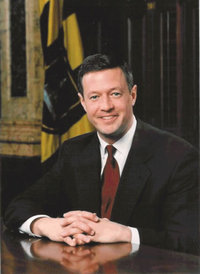 Penn is making mischief in Maryland, spending as much as $2 million to tip a referendum in Anne Arundel County against rival Cordish Gaming. With the de facto support of Gov. Martin O’Malley (left), Penn is scheming to wrest the Anne Arundel slot concession from Cordish by dint of persuading voters to revoke Cordish’s zoning permit. The endgame is to get the slot license for Laurel Park. However, Penn is limited to one slot license in Maryland, so it will either have to talk a sweetheart amendment through the Lege or close its brand-new Perryville casino in order to get a racino deal. Arundel Mills, Cordish’s site, is roughly equidistant from Perryville and Penn’s Charles Town, West Virginia casino — a pair of properties that are expected to generate 20% of Penn’s net revenue in two years’ time. Realpolitik-minded observers who argue that Penn’s real agenda is to protect its existing interests elsewhere would appear to have a point.
In Cape Girardeau, Missouri, voters seem likely to pass enabling legislation to allow gambling in their fair city. This is, obviously, a sine qua non of Isle of Capri Casino‘s efforts to obtain the 13th and final Missouri license. Rivals Ameristar Casinos and Pinnacle Entertainment have reason to root for Isle, since its project would be further from their casinos than any of the three other proposals before the state. If the burghers of Cape G. vote this down, it’s bad for Isle “given we see the project as a distinct growth driver for the company,” writes Wells Fargo gaming analyst Carlo Santarelli. He estimates that the $125 million casino, if built, would engender $125 million a year in net revenue (on a $149 million gross) and cash flow of $25 million (a 20% ROI).
At 1,400 slots and 25 tables, Santarelli “would be hard-pressed to call [Isle’s proposal] the favorite in this race.” But with Ameristar deriving 41% of its cash flow from Missouri and Pinnacle 28%, both companies have many rea$on$ to want Isle to prevail over projects that would encroach on the St. Louis or Kansas City markets.
Finally, Oregon could have its first private-sector casino … if, for starters, voters approve the Oregon Job Growth & Communities Fund Act. That’s a fancy name for putting a 3.500-slot, 15-table casino at Multnomah Kennel Club, outside Portland, taxed at 25%. The state constitution would also have to be amended, which may be a moot point as polling shows Oregonians 2-to-1 against Measure 75. You might say that dog won’t hunt.

The lead story on NBC National News with Brian Williams on Thursday was that Karl Rove (Bush’s buddy) has helped raise over $250 million dollars for Republican candidates through special interest groups. One would assume most of the money would go to negative campaign ads against the Democrats (especially Harry Reid).