
At least one woman was treated with respect yesterday on Capitol Hill and that was the American Gaming Association‘s Sara Slane. We reviewed her prepared testimony yesterday. “Because of the active, robust state and regulatory tribal gaming oversight, gaming is one of the most strictly regulated industries in America. Right now, over 4,000 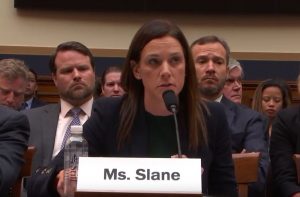 gaming regulators with budgets that exceed $1.3 billion dollars oversee the gaming industry,” testified Slane. “Just as Congress has refrained from regulating lotteries, slot machines, table games and other gambling products, it should leave sports betting oversight to the states and tribes that are closest to the market,” she told the House committee. She got backup from Nevada Gaming Control Board Chairwoman Becky Harris, who said,“States do a great job in every area including sports betting and we’ve just begun to see the roll out in other states. Nevada has a comprehensive regulatory structure that has been refined over decades, and we have a lot of integrity in our process.” Nor is the AGA an outlier on the idea that the federal government ought to butt out of regulating sports betting. “Part of the magic of America is the fifty states’ function as the laboratories of democracy,” writes Citizens Against Government Waste. Sen. Charles Schumer (D) “and others fail to recognize is that their proposed regulations will only make it more attractive for consumers stay on the black market, preserving criminal activity and increasing the risk of corruption in sports,” says the Competitive Enterprise Institute.
“Those fifty laboratories are the very essence of public policy innovation, and shutting them down again with federalism violating federal law is no more than big government mandating liberty fighting action,” opined the American Legislative Exchange Council. Americans for Tax Reform called Murphy v. NCAA “a great victory for federalism, the mechanism that limits the size and scope of government by requiring 50 states to compete to provide the best and lowest cost government.” “The choice to  legalize sports wagering is an important policy question and must be left to each state to decide. It is important to remember that while most states have only been granted the authority to legalize sports betting recently, state lotteries, slot machines, and gaming commissions have been operating for decades,” noted the National Conference of State Legislatures.
Law enforcement got into the act, with the Major County Sheriffs of America giving its two cents. So did the National Fraternal Order of Police, along with the American Conservative Union (I don’t think Rep. James Sensenbrenner [R] was anticipating a kick in the pants from that quarter) and Consumer Action for a Strong Economy. Given the array of opposition, it’s clear that federal regulation of sports betting is going to go over like a lead balloon and is a cinch for a Super Bowl-sized legal challenge.
* Despite an 18% increase in convention attendance, visitation to the Las Vegas Strip was flat last month, with room revenue 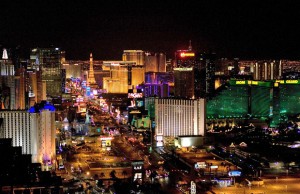 also stagnant and daily rates up 2% to $124/night, with 89.5% occupancy. Just think how much worse it might have been without the 32,00 attendees of the Orgill Fall Dealer Market Conference and the 17,500 ones of the Black Hat Conference, both rotated to August from July this year. Even with all those conventioneers, midweek occupancy slipped 2%. California drive-in traffic also fell, down 3%.
* One year after the Mandalay Bay Massacre, victims and their families reflect upon the aftermath. When you read their heartbreaking testimonies remember that these are the sort of people that MGM Resorts International is trying to sue.
