
Having once more proven itself constitutionally incapable (pun intended) of passing gaming legislation during the normal course of doing business, the Florida Lege is now talking ‘special session,’ which seems like what it would take to get anything done, if ever. Few lawmakers seem certain that anything will come to pass, however. 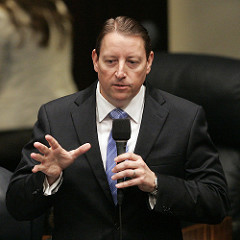 Said state Rep. Jared Moskowitz (D), “Before anybody gets too excited or upset on the issue of gaming, I would remind them that for the past five years we have not been able to do anything on this subject.” Agreed incoming state Senate Majority Leader Bill Galvano (R, right), “There is no agreement; only some discussions.” Considering that addressing the myriad pressing issues involving gaming (decoupling, additional racinos, the elusive Seminole Tribe compact) is nothing new, state Sen. Audrey Gibson (D) laid the problem at the feet of the Legislature’s leadership.
“This was not a sudden development, or a last-minute problem we needed to confront,” Gibson fumed. “This should have been resolved before we adjourned.” However, that wouldn’t be the Florida way, which is to put off until tomorrow whatever you don’t want to do today — or ever. Particularly ominous for the Sunshine State is the March 30 expiration of a provision deal between the state and the Seminoles which saw the latter continue to make payments to the state. Having lapsed, a $400 million chasm opens in the budget. “It’s my understanding that nobody with the Legislature has talked to the tribe,” said tribal counsel Barry Richard.
Not helping is former Lt. Governor Jeff Kottkamp, now a lobbyist for dog tracks, who tweeted that the Lege should do nothing. “Calling a  special session to expand gambling in an election year is a really bad idea – especially when there is a gambling amendment on the ballot in November. Let the voters decide!”, he chirped. Moskowitz was less giddy about the risks of punting the gaming ball into the autumn. “The additional dollars and tax revenues it brings into the system could be used for things like education, health care for the poor, opioid addiction, etc., etc., etc. We could increase the per-pupil spending on education from the money on gaming,” he said. Given that Gov. Rick Scott (R) is no friend of the poor, Moskowitz’s point is well taken.
* Elsewhere in Dixie, riverboat casinos in Mississippi continue on a 12-year decline. Last month they took in $73 million, a 5% dip. That was sufficient to more than negate a gain on the Gulf Coast from $95 million to $97 million, year over year.
* MGM Resorts International, like a fortuitous surfer, caught a wave in Macao. Newly opened MGM Cotai was among the beneficiaries of a  22% increase in March revenues. Morgan Stanley Asia analysts credited the enclave’s surge partly to “a full month contribution from MGM Cotai’s 1,000 rooms and 150 odd mass tables.” In the first quarter of 2018, gross gaming revenue in Macao is at its highest level since 2015. (A 23% surge in Mainland customers didn’t hurt.) Elsewhere in Asia, three Nomura Securities analysts have issued a report that suggests casino legalization in Japan will be pushed into early 2019. It may be the Land of the Rising Sun but the casino powers find themselves chasing the sunset of the Shinzo Abe government’s troubled legislation.
* MGM’s hiring program in Springfield, Massachusetts, may become a template for other major gaming companies pushing into new jurisdictions. The company has been talking up job opportunities  everywhere from local churches to to senior centers. Reports the Boston Globe, “They pored over layoff data from the state, including from a Springfield hospital and a nearby Sam’s Club that had recently closed, to pursue workers who might be good fits.” Most of the casino jobs appear to be filled but MGM still needs retail, hotel and restaurant workers. Last Monday it posted 1,000 job openings, mainly in F&B. A largely similar process is being undergone at Wynn Boston Harbor, although its opening is farther off — and imperiled by Steve Wynn‘s sexual shenanigans. At $40,000, the median income of an MGM Springfield worker will be $4K higher than the average for the city overall.
There are critics. “What I worry about is the large number of people who will be in low-wage jobs that really won’t go anywhere,” fretted the University of Massachusetts Amherst‘s Tom Juravich. “This is not like bringing Amazon to town,” he adds. No, but it’s a big improvement on the Springfield status quo. Even with over 6.5% unemployment in Springfield, MGM has had difficulty finding dealers.
 “Math anxiety and mandatory background checks could also be roadblocks,” reports the Globe, adding that only those who get hired have their $400 dealer tuition reimbursed. (Methinks it should be the other way around, to soften the blow for the also-rans.) MGM even found a former Atlantic City dealer among the faculty of Springfield’s public schools. Even 800-odd employees in non-sensitive positions were hired despite their criminal records, thanks to an exemption from the Massachusetts Gaming Commission. Whether one is discussing the city of Springfield itself or the casino’s employees, the narrative is definitely a set of variations on the theme of second chances.
* Just look at that picture of DraftKings CEO Jason Robins. Don’t you want to smash a cream pie into his smug mug? Robins has reason to gloat, as his company is dropping all pretense of not being a sports-betting outfit and, pending a Supreme Court ruling, “has naturally had  discussions with potential land-based casino partners, as required under [New Jersey‘s] online gaming regulations.” To some, DraftKings’ trawling for terrestrial casino bases of operation is only logical. “By setting up partnerships now, DraftKings may be in a position to make money even in those states that would otherwise make it difficult for the online operator to directly participate in the action,” reports Forbes.
“Rumor has it that the daily fantasy sports leader is aggressively shopping for sports betting partnerships in the New Jersey market, positioning itself as a one-stop solution for land-based operators looking for a way to offer sports betting in the casino and online,” wrote analyst Chris Grove, prophetically. “Of course, the question of what technology DraftKings would bring to the table is an open one – it has no sports betting tech that we’re aware of – and leads to another rumor that’s been floating around as of late: that the company is close to a deal with a major B2B provider to provide DraftKings with an in-house sports betting platform,” Grove adds. You have to hand it to the DFS boys: There’s not much they can’t figure a means from which to profit.
