
One of the few CEOs to grace JP Morgan‘s hotel-and-leisure forum was Penn National Gaming‘s Tim Wilmot. He reported that the “regional consumer remains solid and trends are largely consistent with that  seen 2018.” Furthermore, Penn is “seeing good growth at the high-end (VIP is solid, single-digit growth), better unrated play, as well as growth in the low-end/retail segment.” The Pinnacle Entertainment assimilation is a work in progress: Half of the projected $100 million in synergies have been realized to date. Penn execs said all the surprises have good ones, such as the strength of Pinnacle’s loyalty program, 2 million members strong. There were few, if any, deferred-maintenance issues in the Pinnacle portfolio, although Penn has had to reinvest some in slot machines.
Penn finds itself caught between looking for acquisitions that “move the needle” while also deleveraging from its recent feeding frenzy. The Tropicana Las Vegas came up, with some capex being put into the casino, food and beverage, back of the house—pretty much everywhere, although Penn indicated the Trop wasn’t a top priority, just the subject of “modest changes.” (Phase II of renovation is back on the radar screen, though.) In Pennsylvania, the company said the 35% sports-betting tax is “not ideal” but expects 15% ROI from its two satellite casinos, once they get built. Penn brass expects that, while given pause by reinterpretation of the Federal Wire Act, states will eventually go ahead with legalizing sports betting and that 25-30 will have it by 2025.
* Another CEO who dropped by was Boyd Gaming‘s Keith Smith, who reported good news: “Management has seen a continuation of the  relatively strong environment for the gaming consumer, with fairly attractive fundamentals across the entirety of its portfolio and both the rated and unrated segments doing well. The Midwest segment is at the healthiest level that BYD has seen in some time, and metrics in Nevada remain solid— management has not seen any signs of overheating nor trends suggesting any slowdown is on the come.” Boyd said it was “not overly concerned with higher labor costs, though noted it can be difficult to find qualified employees.”
Smith that although the company had a number of irons in the fire presently that it didn’t rule out additional M&A activity, providing the deal was significant. Taking a contrarian stance, Boyd “views REIT financing as generally expensive and essentially a form of equity financing.” It prefers to own its casinos in addition to operating them. While Boyd is focused on deleveraging, a merger or acquisition that pays its own way would be looked upon favorably.
* “Management views the current backdrop of low unemployment, rising wages, low gas prices, etc. as providing a stable setup for the  regional gaming consumer.” That, in essence, was what Eldorado Resorts CEO Tom Reeg had to say. The company is coming off a month in which its primary market, Reno, had snowfall on 24 of 28 days. Reeg said it “was clear that it has not been active in the M&A space since Tropicana [Entertainment] and sees a very strong standalone path.” So much for the Caesars Entertainment takeover, I guess. Additional acquisitions would have to 1) improve asset performance, 2) increase cash flow, 3) grow the ERI stock price. Then they would “have a look.” Talk about circumspection.
Integration of Tropicana and Grand Victoria was said to be proceeding well. One fly in the ointment was that both had bought business by heavy promotional activity, but Eldorado says it’s not sweating the comps … yet. Eldorado has set an ambitious goal for itself at Grand Victoria, growing the cash flow from $36 million/year to $60 million.
* Churchill Downs CEO Bill Carstanje and CFO Marcia Dall also presented commentary, which was mostly devoted to the Kentucky Derby and its prospects, which include some outreach to Japan for race 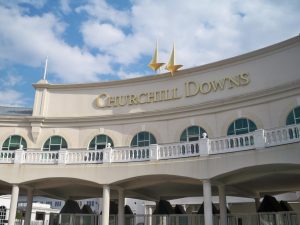 horses. “Longer term, CHDN looks to increase the international appeal of the Derby and will continue to further segment its customer base in a manner that optimizes EBITDA (as opposed to attendance).” In other words, fewer and richer customers, not more of the Great Unwashed. While noncommittal on ‘historical racing’ at the Twin Spires, Churchill Downs is gong-ho about adding a 1,000-room hotel.
After noting that its northern casinos had been adversely affected by weather, Carstanje and Dall were dismissive of going the REIT route, telling analysts “While the OpCo/PropCo model is right for some, CHDN has thus far grown through owning properties and does not generally view REIT financing as particularly compelling as a source of funds.” In Illinois, they are hopeful the Lege will pass something that allows Arlington Park to be monetized as a racino, while Derby City in Louisville “continues to ramp nicely” from historical racing and has exceeded expectations.
Isn’t it nice to end on a positive note?
