

Genting Group evidently hasn’t given up on its casino aspirations in south Florida. The company is teaming with BYD Motors of China to propose a monorail 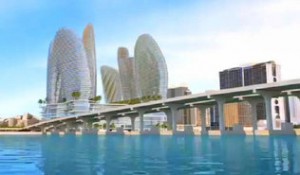 between downtown Miami and Miami Beach. Genting owns waterfront real estate in Miami it has been unable to monetize, mostly because the idea of casino megaresorts never gained traction in the Sunshine State. (Las Vegas Sands took a run at it, then just plain gave up.) Two cronies of Miami-Dade Mayor Carlos Gimenez round out the group making the unsolicited monorail pitch. (If the track can really deliver tourists to the beach, it would make more sense than, say, its nowhere-to-nowhere Las Vegas counterpart.)
Details of the proposal are shielded from public scrutiny until internal reviews are finished, so we may be waiting a while. Despite the Gimenez connection, it’s no cinch that Hizzoner will approve: He’s already backed a $243 million system of rapid transit buses as more cost-efficient than putting $1.3 billion in an extension of a rail line into Florida City. Also, there’s the infrastructure challenge of spanning Biscayne Bay with a rail line, nor is Miami Beach on board with the idea … yet anyway. Miami Herald sources say Genting would offset part of the cost and sweeten the pot by donating some of its real estate to house a transit terminal–delivering customers right to its doorstep.
BYD Motors is big into the manufacture of electric cars, so one hopes it can translate that tech expertise into delivering something more state of the art than what the Herald describes as the “pokey sightseeing option at Zoo  Miami.” While construction costs are estimated at $1 billion, it would be no cheaper to extend the Metromover in the same direction, so that’s a point for Genting/BYD. The monorail, moreover, could transport over three times as many passengers, for technical reasons. Genting will have to compete for public funds with British Ascendal Group, which is pushing rapid-transit buses. Considering that Genting has been running silent, running deep on its Florida aspirations for the last several years, it’s good to see them surfacing with a new vehicle for their casino dreams. It would be a shame if Resorts World Miami ended up as merely a pipe dream.
* Tacitly admitting that sports betting per se will never make it through the California Lege, two lawmakers are trying to get their colleagues to put the question directly to the people instead. State Sen. Bill Dodd (R) and Assemblyman Adam Gray (D, pictured) are the prime movers of the bill, which aims  to put the sports-betting question on the 2020 election ballot. It’s a way of getting around the inevitable clash of card rooms and Native American tribes, each wanting a piece of the action and not wanting to share it with the other. “By legalizing sports wagering, we can avoid some of the problems associated with an underground market, such as fraud and tax evasion, while investing in problem gambling education,” argues Dodd, whose words fell on deaf ears at tribal association CNIGA. The Pechanga Band of Luiseño Indians was slightly more receptive. Said Chairman Mark Macarro, “Pechanga looks forward to engaging in the debate to determine the best path forward.”
Getting the public on board, which only requires a majority, will be easier than persuading the Lege, in which a two-thirds majority is necessary. Internet poker has been stalled in Sacramento longer than we care to remember, so we’re not getting our hopes up for sports betting, even if California could be the biggest market in the land. Perhaps to make his bill all things to all lawmakers, Dodd is being purposely vague where the revenue-sharing dollars would go. As the International Center for Gaming Regulation‘s Jennifer Roberts said with massive understatement, “I don’t see these issues being easily resolved.”
* Caesars Entertainment is test-flying a new policy at The Linq. Seems that if you’re playing and qualify for a free drink it can only be a well drink. Anything that smacks of premium liquor brings with it an upcharge. (It’s the ripple of a much larger data-mining wave being seen in the casino industry.) We’ve said it before and we’ll say it again … Caesars Entertainment: Where the customer almost matters.
* The 50th anniversary edition of the World Series of Poker at The Rio (which only looks 50 years old) has inspired retrospectives like this one. The 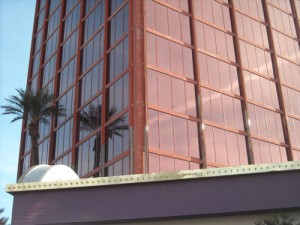 WSOP seems to have made a healthy recovery from the Justice Department crackdown on Internet gambling that scared away contestants in 2007. Addition of the TV hole-card camera has also done wonders for the event’s popularity. As veteran player T.J. Cloutier observes, “When you watched it on TV, it was like watching paint dry. Now, you could actually watch the tournament and know what was going on.” To say nothing of the pleasure of second-guessing the players.
* Possibly feeling political pressure, both Sociedade de Jogos de Macau and Wynn Macau are issuing summer bonuses to staff members. SJM went first and Wynn followed within hours of the announcement. Now we shall see if the four other concessionaires follow suit. We expect they will.
Keeping with the Joneses in other ways, Macanese casinos are rolling out facial-recognition technology. They’re stressing that it’s purely for security purposes, having been embarrassed by a Bloomberg report that stated biometrics would be used to snoop on players’ habits, the better to cater to them and induce them to play longer, not to mention keeping tabs on VIPs. The casinos find themselves caught between the rock of being pressured by City Hall to deploy biometrics and the hard place of having to prove they won’t be employed to untoward ends.
* Is it too soon to say ‘kiddie casino’? Cambodian casino developer NagaCorp is ogling the Huis Ten Bosch theme park near Nagasaki for potential casino-megaresort conversion. Said NagaCorp advisor Adam Steinberg, “the concentration of the population is attractive to us as well … in terms of the number of people per square kilometer. It is fairly concentrated when compared to some other prefectures.” Whether amusement-park casinos amuse the central government is a very good question.
