

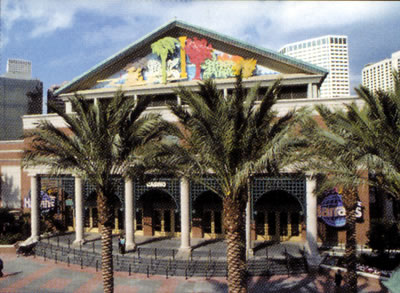
September gaming revenues in Louisiana were expected to be diminished by Hurricane Ida and they certainly were, down 23% on a same-store basis. New Orleans had the worst time of it (-48%), Baton Rouge the easiest (-5%). All comparisons are to 2019 numbers. In the Crescent City, Harrah’s New Orleans had a terrible month, grossing only $8 million (-66%) and almost as low as second-place Boomtown New Orleans (just under $8 million, -22%). Fair Grounds racino barely registered with $2 million (-47%), falling behind Amelia Belle ($3 million, -25.5%), while Boyd Gaming‘s other area property, Treasure Chest, grossed $6 million, down 39%. Lake Charles casinos didn’t suffer so spectacularly but they weren’t turning cartwheels either. L’Auberge du Lac took top honors for the month, off only—and amazingly—5% with a gross of $26.5 million, comfortably ahead of Golden Nugget‘s $22.5 million (-23.5%). Dover Downs brought in $12 million, a 21% decline.
In relatively undamaged Baton Rouge, L’Auberge Baton Rouge was flat at $13 million, while Belle of Baton Rouge plunged 39.5% to $1.4 million. In between was Hollywood Baton Rouge, dipping 3% to $4.5 million. Shreveport/Bossier City saw the inception of Shreveport’s smoking ban and it was pretty catastrophic for Sam’s Town, plummeting 48.5% to $3.5 million. One other eye-grabbing stat was a 38% dive at Horseshoe Bossier City ($11 million), balanced by a 12% surge at new area fave Margaritaville ($16.5 million). Eldorado Shreveport slipped 13% to $8 million, Boomtown Bossier stumbled 11.5% to $4 million and Louisiana Downs nodded 4.4% to $4 million. Although the market was down 22%, once Horseshoe and Sam’s Town are backed out it doesn’t look particularly dire.
Falling somewhere between preemptively preventing backlash and belatedly closing the barn door, the NFL has pledged $6 million toward promoting responsible gambling. Teaming with the National Council on Problem Gambling, the league is seeking to incept “a responsible betting initiative aimed at getting fans to set limits on their wagers, understand the risks of betting and know where to get help if things get out of hand.” The league is motivated by a 36% increase in bettors, to 45 million expected this season. Or, as league Chief Strategy & Growth Officer Christopher Halpin puts it, “Sports betting is supposed to be fun … We also recognize that responsible-betting programs across the country are under resourced, especially as legalization spreads nationwide.”

Adds Keith Whyte, executive director of NCPG, while prevalence rates for disordered gamblers are usually around 2%, among newbie bettors it’s 5%. “The NFL has set an example for the other professional sports leagues who also need to realize their obligation to address the downside of sports betting as much as they embrace the upside.” Next up for Whyte are the NBA, MLB and WTA. The NFL, meanwhile, will work with its official sports betting partners to disseminate responsible-gambling messages. The slogan? “Stick to your game plan. Always bet responsibly.” Or, as Halpin put it, “For the casual bettor, now is a once-in-a-lifetime opportunity to teach them what responsible betting looks like: mindfulness, setting betting budgets, knowing your operator, knowing how parlays and other kinds of bets work. We intend to get this right.”
Meanwhile, how much is Jamie Foxx worth to BetMGM? Not much, according to a YouGov survey that found only 10% of gaming consumers were influenced by celebrity endorsements. Only financial services (9%) performed worse. The U.S. is, admittedly, ahead (12%) of the global average, while the United Kingdom leads with 14%. Celebrity pitchmen fall flattest in Hong Kong and Singapore (5% each). What’s worse, the demographic that trusts celebrities most is graying Baby Boomers, while the young ‘uns aren’t impressed much of all (18-34 year-olds: 6.5%). Understates YouGov, “Clearly, an attitudinal difference among global consumers that is related to age is evident when it comes to public figures endorsing gambling brands.”
Although it has the most architecturally striking presentation, Full House Resorts hasn’t won the Terre Haute casino license yet. It made its case to a smattering of spectators yesterday. American Place, as the $250 million proposal would be called, would offer 1,000 slots, 50 table games, 100 hotel rooms and a greenhouse-styled restaurant. While it’s being built, Full House would run a temporary casino out of a local mall. There’s a grass-roots movement to bring a poker room to Terre Haute and Chief Development Officer Alex Stolyar said the company would study the issue seriously. Stolyar was also pressured to share comps with local businesses and said that was Full House’s practice in other markets.
Quote of the Day: “We question whether some of the criticism is fueled by the jealously of traditional white interests who aren’t running this show, and therefore may not personally benefit from the casino as they would have with the proposed Coliseum project.”—the Richmond Free Press, endorsing the Black-owned Urban One casino, opposed by Sen. Tim Kaine (D) among others.

Betting on an NFL football game is an act of faith that supports an institution that refuses to be transparent about it’s own officiating, I will stick to just being a fan, betting money on a game where there is holding on every single play but it only gets called a few times is just a silly way to burn Benjamin’s… Last week the Rams punter on a 4th and 15 perfectly executed a fake punt and threw for a first down, there was a “penalty”, the ref said “unsportsman like conduct, both teams, penalties offset, re-play the down”. Play took maybe 3 seconds, they never explained what the penalties were, who they were on, and where it happened. I guess we are supposed to just trust them, because we never got a clarification from the announcers or the league, I have sent them several emails they have ignored. It just amazes me that the NFL will simply let me consider the product they offer to be suspect on honesty and integrity, and I guarantee I am not the only fan who is asking legit questions about what looks sketchy as all heck. Screw you NFL if you won’t admit your mistakes or explain yourself when your own officials make baffling calls, the more folks who bet means the more scrutiny on your entire operation. I quit betting on horse racing because I could not control any of the action, and i don’t bet on NFL games because I can’t control or even trust it anymore…
Did Dover Downs move from Delaware to Louisiana?
Good catch. It’s Delta Downs. I was having a senior moment.
For decades the NFL has sold itself through attendance, television, and merchandise, this shift to promoting gambling is a self-own that down the line will erode their merchandise franchise. The next generations of NFL patrons are being groomed to bet on the games, I was groomed to support my team, I was not groomed on any speck of objectivity, the difference between a fan and a bettor is cavernous. If you want to win money betting the NFL, you have to look objectively at your own favorite teams, and the ones you hate. Too tall an order for the vast majority of us. Be careful NFL, you make bank on my life as a fan, I buy the shit, I wear it proudly. Now you want me to be neutral and wager on the games, or stupid and lose on my home team. Once you open this door, forget about closing it. Maybe you can perfectly thread the needle and push the cult aspect at the same time you push the bet the rent money aspect, but I certainly doubt it…