

“So much for a [gross gaming revenue] stabilization,” sighed analyst Joseph Greff in a J.P. Morgan investor note, after Illinois‘ casino revenues dropped 7% in November. Whenever you think the Land of Lincoln’s casinos have hit bottom, they sink lower still. The statewide gross of $105 million was the worst of the 2009-10 period, although at the present pace December will be worse still. A report from the state’s Commission on Government Forecasting & Accountability, prepared before the November numbers were released, already had Illinois’ casino economy at its lowest level in a decade. (Casinos were legalized in the state in 1990.)
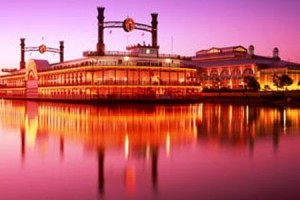 Bright spots were the land-based Jumer’s Casino Rock Island (+10%) and Boyd Gaming‘s Par-A-Dice riverboat (+1%). Hardest-hit was Penn National Gaming‘s Empress Joliet, posting a far-worse-than-expected 16% decline. Penn was down 10% statewide — not good news for a company with a lot of buns in the oven. As usual, the revenue leader ($22 million, -3%) was MGM Resorts International‘s Grand Victoria (left), which continues to widen its lead on runner-up Harrah’s Joliet.
Casinos in the St. Louis area (led by Pinnacle Entertainment‘s River City) continue to sap their Illinois competitors, with East St. Louis-berthed Casino Queen down 12% and Penn’s Alton Belle off by 8%. Incidentally, one of the Missouri casino projects that just got trumped by Isle of Capri Casinos was premised on siphoning $50 million a year from Alton Belle — two-thirds of the Belle‘s annual revenue. Not very likely.
Impervious to reality, lawmakers like Waukegan state Sen. Terry Link (D) pushed through a lame-duck bill that would create an insane level of gaming expansion: four more riverboats and racinos with 6,300 slots. The lower house must also consider the bill, which Gov. Pat Quinn has opposed … albeit not without some Obama-style wishy-washy-ness. (Is it something in the Illinois water?) Although the proposed law would ease the state’s usurious gaming tax rate (50% of revenues exceeding $200 million) it would also potentially triple the number of gambling positions in the state. The deleterious effects on existing casinos hardly need belaboring. Even Wall Street analysts oppose the measure, using phrases that rarely pass their lips, like “too much gaming.” Not content to have cooked the state’s golden goose, Illinois politicians seem hellbent on eating it for lunch, too.
Boyd Gaming is poised for a big comeback — or so says Wells Fargo gaming analyst Carlo Santarelli, who just raised earnings-per-share and cash-flow estimates for the company. He estimates Boyd’s net revenues will leap 31% this year, with 8% and 2% growth in the years following. After two years of getting hammered (-16% and 5% in 2009 and 2010) in the Las Vegas locals segment, Boyd will see a shallow climb in 2011-12, to the tune of 2.4%. Borgata is expected to touch bottom next year and see a slight uptick in 2012. On the downside, debt servicing goes way up next year and stays there, although long-term debt will continue to be retired, bringing Boyd closer to a 1:1 ratio between debt and equity. Despite Boyd’s conservative fiscal policies, Wall Street has been cool to this company, so Santarelli’s billet doux is noteworthy.

The state of Illinois already has plenty of casinos (I live in Chicago) but since the state is completely broke they want more casinos to increase the tax revenue. What the Chicago politicians really want is a casino located near Navy Pier in downtown Chicago.
Why any gaming operator does business in Illinois is beyond me. Jack Binion is probably still smiling for getting his license denied!
On another note, I have been and still am a big believer in Boyd. Wall Street has virtually never been excited about them which is one of the reasons why I have. They are essentially a family operated business that takes pride in the markets they operate in and are supposedly good to their employees. I can say that I have never had a bad experience at any of their properties. From Jokers Wild to Borgata. Their typical casinos my not be the sexiest ones on the block, but they sure are like the good girl next door!
[…] This post was mentioned on Twitter by 89835, David McKee. David McKee said: New entry: No end in sight for IL; Wall St. gives $BYD some love https://www.lasvegasadvisor.com/stiffs-and-georges/?p=5255 […]