
While its $170 million gross looked a lot better than Illinois‘ $104 million, Indiana saw its gamblers stay home in droves — 24% less foot traffic,  although those who showed up seemed to have spent 21%. In any event, gambling revenue tumbled 8%. Most the action was in the Chicagoland area, which produced (when blended with casinos on the Illinois side of the border) $147 million in revenue, also down 8%. Safe in Lawrenceburg, nearer the Kentucky market than thee, Penn National Gaming‘s riverboat made $14.5 million, up 6%. Other operators got hammered, including Pinnacle Entertainment (-12%), Caesars Entertainment (-18%) and Boyd Gaming (-16%). There’s no way to be certain, but all three are heavily invested in the northern tier, where Four Winds Casino could be inflicting depredations on their player base as customers try out the new kid on the block.
Belterra, which has never been the same since gambling came to Ohio, was down 21%, for a $7 million gross. Pinnacle’s Ameristar East Chicago dipped 8%, for a $17.5 million haul. Boyd’s Blue Chip grossed $11 million, below analyst expectations, as Caesars’ two Horseshoe-branded riverboats combined for a $44.5 million payday.
It was quite a different story across the border in Ohio, where casinos and racinos were up 1% combined ($147 million). The numbers might be bigger still had flooding not knocked Belterra Park, never a strong contender on the best of days, for a -35.5% loop and $4 million gross.  Having good months were Eldorado Resorts‘ Scioto Downs, up 10% ($14 million) and most of Dan Gilbert‘s trio of gambling houses, giving him reason to grin. Jack Cleveland ($16 million) was 1% off but Jack Cincinnati rose 3% ($17 million) and Jack Thistledown gained 9% on a $10 million gross. As for the Penn/GLPI quartet, Hollywood Columbus was flat at $18.5 million, Hollywood Toledo was up 1.5% to $16 million, Hollywood Dayton ascended 8% to $9 million and star performer Hollywood Mahoning Valley actually slipped 2%, to $9.5 million. Hard Rock Rocksino‘s domination of the Buckeye State was more pronounced last month, as it posted a nice, round $20 million, a 3% gain. If the competition isn’t studying the way things are done at Hard Rock they should be.
Boyd took a meeting with JP Morgan analyst Joseph Greff, who reported that “regional trends in the 1Q have been consistent with the 4Q, with customer spend/visitation healthy notwithstanding properties that have been hit by adverse weather.” Boyd expressed contentment with the Las  Vegas market, predicting single digit growth and expressing relief for a lack of promotional warfare. Management conceded, vis-a-vis Blue Chip, that Four Winds had a superior location, although they think its impact will be felt more in midweek business. Greff wrote that Boyd “has not yet seen much impact at Blue Chip, but Four Winds has not fully embarked on its marketing plan and given the property does not pay taxes, it may be able to reinvest/be more promotional than Blue Chip.” Management is also described as trying to achieve a “healthy tension” between deleveraging the company, making new acquisitions and paying dividends. Barring new purchase opportunities there seems to be nothing on the horizon to disrupt that balance.
Preceding Boyd onto Greff’s dais, Station Casinos had nothing but good news, even if JP Morgan buried the lead. Thanks to having been unable to sell its Cactus Lane acreage, Station finds itself with 100 acres in relatively close proximity to Raiders Station. If Station sits on its land  bank long enough, liabilities could turn to opportunity. Greff implied that a stadium-era development might even push Durango Station and Reno even further onto the back burner. All Vegas economic indicators were described as positive, especially population and job growth, and wages. Customers are switching over to carded play in greater numbers and an International Game Technology slot-management system is having the bonus effect of increasing player spend and time on device, the slot-floor manager’s siren’s song.
Despite being very much a work in progress, Palace Station is said to be doing well, particularly its new poker room, as well as its refreshed casino floor. Over at the Palms, where two phases of renovation have grown to 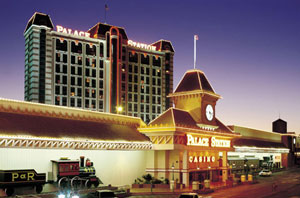 three, Phase I is on track for May completion and, since Phase II is concentrated upon hotel rooms, that means less disruption for casino players. With the slot inventory having been increased from 1,400 to 1,700, Station expects lower-than-average slot win of $175/unit/day but thinks it will be able to achieve room rates in the $200 neighborhood, running at 85% occupancy. Hoping for an eventual cash flow comparable to Red Rock Resort, Station is going back to George Maloof‘s formula of locals play midweek and heavy on tourists on the weekend, plus an escalated push for the Asian-American market.
Gaming & Leisure Properties was also in attendance and reported that, thanks to the IRS, there will probably be few new entrants to the REIT stakes (Greff did not elaborate on the “why”). GLPI’s Bill Clifford played a bit of kiss-and-tell, saying that “sellers that have approached GLPI have been genuinely interested in pursuing a deal versus just seeing what a REIT would offer.” He also let on that the REIT has been picking over “theme parks, ski resorts and TopGolf.” As for future gambling acquisitions, GLPI “remains more interested in the regional market over the LV Strip given the higher rent coverage needed on the Strip due to higher maintenance capex. The LV Locals market is more akin to regional gaming than it is to the Strip.”
Eldorado Resorts was not to be kept out of the JP Morgan forum and explained that its recent sales to Churchill Downs were part of a deleveraging strategy. But “it is reasonable to assume they’re looking  for/working on the next acquisition, and that with any transaction the company undertakes, it will look to reduce to the multiple by 3 – 6x via synergies/operating improvements.” Eldorado assumed the Pennsylvania market was maxed out, or soon would be, hence its exit — speeded by a 65% tax rate. (Eldorado still is burdened with a management contract at Lady Luck Nemacolin.) The company’s target, when shopping around, is to look for properties with 20% return on investment although, in a startling disclosure, it said its Reno purchases were returning 50%. Consumer demand in the Biggest Little City in the World was described as “solid.”
