

Heading into the weekend, Trump Entertainment Resorts continued its reorganization by sacking six top executives. They were preceded by Trump Plaza General Manager Jim Rigot, who wasn’t pushed but gave his notice a fortnight ago. One of the Trump Six, Trump Taj Mahal GM Rosalind Krause said she was quitting due to burn-out: “I worked weekends, I worked six days a week. My entire career has been working and sacrificing.”
However, people who quit don’t usually receive golden parachutes. Krause and Rigot are receiving a combined $1.8 million in walking-away dough, meaning that it’s going to cost Trump a lot of money in order to save money, especially with four other high-ranking executives still to be paid off. However, it’s a refreshing change to see a casino firm looking to trim fat at the top, rather than slashing line employees and maintenance budgets.
In the case of Krause, it’s a somewhat poignant departure, considering that she ascended from schlepping cocktails to overseeing an expansion of the Taj that reversed its fortunes. Good luck to Rigot and the Trump Six in their next endeavors.
Steal of a deal. New Resorts Atlantic City owner Dennis Gomes snagged the money-bleeding casino for the tidy little sum of $35 million. One’s eyebrow ascends a bit when Gomes says he’ll have the property turned around by the end of next year. However, Gomes shelled out only a fourth as much as Colony Capital did for Resorts back in ’01. Having gotten the place at a bargain price, Colony put another $100 million into expansion. So far, so good.
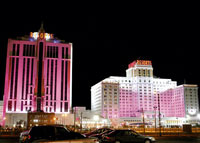 Having done this, did Colony try to recoup its investment right quick? No, Colony CEO Tom Barrack, the Mr. Magoo of the casino industry, went and borrowed another $360 million against the place, a backbreaking debt load that was Resorts’ undoing. Hundreds of millions of dollars down the toilet later (including operating in the red ever since since early 2008), Barrack’s folly has become Gomes’ windfall.
It’s hard not to root for Gomes, in light of his management style. Many casino companies have lost touch with their workforce. Therefore, any guy who says, “I like talking to the maids and the guys who clean the floors. The doormen, those are my friends. They’re the people I relate to best, because I come from a poor background,” is off on the right foot.
Several Atlantic City casinos aren’t pulling their weight right now but the sad truth is, if you prune the sickliest casinos from the market, that’s thousands of jobs lost and never to return, barring the completion of new projects like Revel. However, both Gomes and son Aaron Gomes seem rather deeply in denial about the growing encroachment of Pennsylvania and other nearby gambling-friendly states. “They can’t duplicate what we have here in these little slot houses they’re building. The way we look at it, this is like Mecca,” says Gomes pere. “This is still the second-biggest gambling market in the U.S. When the economy gets back, people will come back in droves.” Seems we’ve heard that before.
Brace yourself, Atlantic City! Fewer than three weeks remain until $385 million SugarHouse Casino goes live in Philadelphia, on Sept. 23. A three-day ‘shakedown cruise’ for invited players will precede the grand opening, as SugarHouse management gets any and all bugs out of its system, with the proceeds going to charity. It took Philly a long time to get into the game but the burning question seems to be not how SugarHouse will perform per se but how heavy a blow it will deal to the Boardwalk.
Note that, in terms of urban renewal, SugarHouse developer Neil Bluhm accomplished what the City of Philadelphia could not. It’s also disingenuous for the Philadelphia Inquirer to hold Bluhm responsible for the $800 million pricetag of his struggling Rivers City in Pittsburgh. Bluhm was tapped to rescue that project after Don Barden blew $700 million-plus on it with no end in sight and simply ran out of moolah. There wasn’t much Bluhm could do to perfume that pig. Three-quarters of a billion dollars is a casino investment no Pennsylvania city has been able to support, so Rivers Casino is a an expensive “teaching moment.”
Another casino executive who gets it is Dennis Gomes’ sometime adversary, Tropicana Entertainment CEO Scott Butera. Known best, if at all, as the turnaround specialist who works behind the scenes, Butera takes center stage in a Las Vegas Sun interview. He takes some hard shots at predecessor Columbia Sussex, with whom he was suspected (by me, anyway) of being chummier than he actually was. Anyway, he sounds well and truly fed up with William J. Yung III‘s malign neglect of his (former) casino portfolio — which included trying to provoke a strike at the Tropicana Las Vegas. (It’s a measure of how much ColSux botched Gomes’ legacy at the Tropicana Atlantic City that the latter’s popular The Quarter was nearly sold for a fraction of its cost, simply to scare up some quick cash.)
The latter is no longer under Butera’s remit but during his brief tenure at its helm, he was swift to ink a pact with the Culinary Union, bringing peace to a very troubled casino. Like Gomes, Butera’s a CEO who’s got his priorities in order and who offers considerable food for thought in a brief but trenchant colloquy.
Congratulations are in order to the operators of Boot Hill Casino, in Dodge City. The first (and so far only) of Kansas‘ state-owned casinos is doing boffo biz, on pace to take in $40 million in Year One. Cheers!

Good luck to Gomes and Co at Resorts. It would be a great thing for the city if they could make a good run with the place. Its those dam operating losses (regardless of debt payments) that they are going to have to contend with. Sugar House is not going to help, but it does look like a decorated warehouse! I hope Gomes can convince Philly gamblers the same.
As for the Taj, Krause has done a good job over there keeping the place relevant and must I say actually a good place to be again. SCORES will make it even better!