

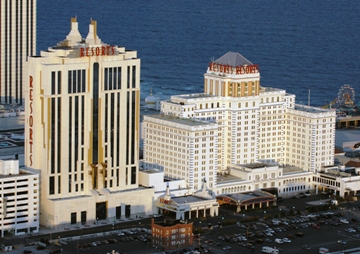
 It still looks like Resorts Atlantic City is the casino most likely to close in that market, on pace to lose nearly $22 million this year. That’s the monumental challenge facing prospective new owner Dennis Gomes. In unadjusted dollars, the casino’s revenue has fallen 60% since 1978. Throw in the fact that it’s the oldest operational casino on the Boardwalk and you’ve got your work cut out for you. UNLV technomage David G. Schwartz has some practical ideas for reversing the decline, particularly with regard to staving off Pennsylvania competition.
Consultant-at-large and former Resorts exec Steve Norton says Gomes should reposition Resorts A.C. toward the convention market. Other than a comparative dearth of rooms (942, small by Vegas standards), it’s hard to see a problem with that, especially as there’s potential meeting space and, as Norton points out in re adding amenties, “I doubt they need all of the casino floor now.” (Norton, you’re the greatest!)
Atlantic City has been talking a good game about targeting conventions for as long as I can remember. However, it gets caught in the chicken-and-egg condundrum of “How do we draw conventions without a critical mass of hotel rooms? But why build more hotel rooms if we’re not drawing conventions.” And round and round the mulberry bush it goes. The burning question for Gomes is whether the bleeding at Resorts can be stanched quickly enough for the casino to stay open. The phrase “race against time” definitely applies.
As the saying goes, when you owe the bank $22,500, you’ve got a problem. When you owe it $225 million, the bank’s got a problem. Creditors for Colony Capital‘s Las Vegas Hilton have backed off and even given Colony CEO Tom Barrack a loan extension into 2012, even though he’s delinquent on his mortgage payments. Sweet! Bet you wish you could get those terms on your home loan. (Hey, Wall Street Journal, that was one lametastic headline, baby.)
Perhaps co-financiers Gramercy Capital and Goldman Sachs Group didn’t think the LVH would fetch 225 mil on the open market. Also, there’s an inherent conflict of interest that works in Barrack’s favor. Goldman Sachs holds a large minority interest — as well as veto power over capex spending — in the casino, through a subsidiary. The Nevada Gaming Commission winked at this arrangement when it was proposed and now we have the spectacle of Goldman essentially dickering with itself. Letting Goldman buy into the LVH was a canny — nay, brilliant — move on Barrack’s part: He’s effectively checkmated the firm from foreclosing upon its own asset.
Back in Atlantic City, in a potentially related move, bankers have quietly dropped their move to repossess Barrack’s Atlantic City Hilton. It will be interesting to see what sort of settlement this betokens.
Insecurity. One reason that Indian tribes have to go beyond Wall Street in search of capital is the inability of banks to collateralize tribal loans. (It’s sort of like trying to take out a mortgage on the Forbidden City in Peking. Good luck with that.) However, that’s not deterring Harrah’s Cherokee from its $633 million (!) megaresort expansion. It’s not like the casino is a bad risk: It may be 10% off its 2007 apex of gaming revenues but it’s in very, very good company in that regard. By the bye, the new rotunda that the Cherokee intend to build looks an awful lot like Mohegan Sun, doesn’t it?

I’ve never been to AC, but in looking for an alternative for the fall trip, I went through Harrahs system and took a look at some rates. This is all extremely circumstantial, but I noticed something during the look.
Harrahs and Showboat were the properties being comped for me, as a low level player and non-AC traveller, this was a first, as every other time I’ve ever viewed AC, I’ve only shown one or two potential comp nights at Caesars in AC.
Caesars shows up currently as sold out, based on my understanding, Harrahs is more of the flagship property in AC then Caesars, so I found it interesting that it was laying out that way, it definitely appeared to be Harrahs latest effort from their marketing tool to drive customers in the direction they want them to go for resorts and putting Harrahs as their highest occupancy property right now.
Again, all guess work on my part, but I thought I’d share, reminds me of Summer of ’09 when suddenly Caesars in Vegas was showing available for comp and all other properties were showing either minimum charges or sold out, it lasted only for a couple months, but it’s the only time I’ve ever seen Caesars comped at my level, from the straight reservation system.
I always thought Resorts biggest asset was its undeveloped land adjacent to the hotel. Build a new modern resort next door and use Resorts as over-flow. That’s what Sun did with Resorts Paradise Island and by all accounts appeared to work out well. Unfortunately Colony probably had no desire to try it and Gomes is stuck with an economy and competition that currently will not permit it.
Interesting news on the AC Hilton. Thanks
If AC multiple resorts go for the convention route, can multiple hotels market and book guests together if no one hotel has room for a large convention’s participants?
Do Vegas properties do that, formally or informally, if they’re close to each other? I think so, but I’m not sure. Comments?