

Station Casinos has an excellent record as an operator. Why then did it misjudge its attempt to compete with the Las Vegas Strip in its takeover (and makeover) of the Palms? And while it knows its onions with regard to 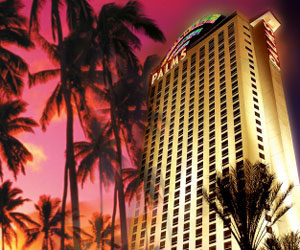 gambling, its experiments with high-end nightclubs have been less than auspicious. Anyone remember Cherry at Red Rock Resort? I thought not. Yesterday, Palms brass released a statement saying that the KAOS nightclub was closing “effective immediately. While Palms has experienced exceptional growth across the gaming and non-gaming segments of the business, the expense side of the business has been challenging to date, due in large part to the entertainment and fixed cost structure associated with KAOS.” Ergo, Station will “reassess the programming and use of the space,” which will be diverted to meetings and special events while the reassessment moves forward. (KTNV-TV confirmed the news, throwing in a copy of an internal Station memo, one that offered a soft landing for potentially terminated KAOS employees.)
“Chaos” was also one of the words J.P. Morgan analyst Joseph Greff used to describe Station’s third quarter. Much of the news was good. For instance, locals-derived cash flow was up 6% where Greff had expected 4.5%. Native American casino-management fees were up 12.5%. The cash-flow loss  associated with the Palms, however, was “much larger than anticipated”: $10 million vs. Greff’s anticipated $4 million. The company “noted that excluding its unprofitable KAOS day/nightclub and adjusting for hold, EBITDA would have been a positive $4m in the 3Q.” The write down on KAOS next quarter will be in the neighborhood of $16 million-$22 million. (That’s a pretty big neighborhood.) “Palms will still be positioned as a hybrid Las Vegas Locals/Strip patron focused resort, but without expensive entertainment talent that is unprofitable,” Greff wrote. Getting rid of expensive entertainers like Cardi B will cost Station $28 million in the form of a one-time charge.
Still, Greff expects better cash flow in the fourth quarter ($121 million vs. 3Q19’s $111 million), with locals revenue up 2.5%. Palms cash flow in 2020 will probably be a measly $18 million, less than that generated by Tropicana Las Vegas. Next year Station anticipates no taxes and has 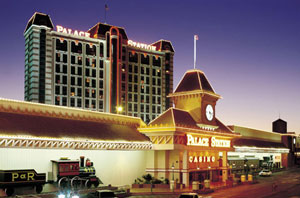 budgeted $100 million in capex improvements. (Say, whatever happened to that bowling alley at Palace Station?) Palms cash flow should improve to $25 million in 2021, even though Station will still be getting a poor return on its investment. Native American contracts will likely expire that year, so Station will have to scare up a new revenue stream. Says Greff, “we wouldn’t be surprised to see some sort of real estate monetization to further reduce leverage.” REITs, take heed!
Looking ahead, Greff sees a “relatively solid” locals market and “fewer drags” associated with the Palms. He adds that the hybrid Strip/locals property “has been a difficult chapter for shareholders, and, frankly, a costly investment … The property has seen strong top-line trends (albeit off a low base given construction there), with gaming revenues up 30% y/y. With Tim Ho Wan and 16 new gaming tables having recently opened, Phase III construction has now finished and [Station] should be able to better ramp the property and looks to go ‘beyond break even in Q1.’ On its call, management stated that ‘every segment of the property, excluding the club, is tracking to [Station’s] plan,’ and there has been a good pickup in forward bookings into 2020 and 2021.”
Bottom line: Except for the Palms sucking wind, everything is good at Station and there’s hope for the Palms yet, too.
* If Station wants to monetize its real estate, perhaps it should put a call to MGM Growth Properties. The REIT is one whose “properties are currently performing well,” according to Credit Suisse analyst Ben Combes. The company is “Continuing to evaluate accretive transactions  in the gaming and broader universe.” True, MGM Springfield is “still slower than expected” but the “Bellagio transaction highlights both additional competition for assets, but also the underlying value in gaming real estate being realized by a broader group.” Added Greff, “the company remains focused on accretive transactions— it would be “unlikely [for MGP to] do some sort of stretch deal that hampers the income statement.” It was also disclosed that there had been six potential buyers in the running for Bellagio. Do tell. Also, MGM Resorts International‘s half of CityCenter is already on the block, in addition to MGM Grand. As we’ve said before, everything must go.
As long as we’re talking about acquisitions, how about an MGP play for the Trop? It would give MGP and MGM all four of the corners at Tropicana Avenue and the Strip. Hey Jim Murren, don’t tell us you haven’t thought about it.
* Still no word on the fate of Proposition DD in Colorado. As of the latest report, it had eked out a 1% lead but all sources seem to agree that it’s just too close to call. The ambivalence of Colorado voters toward sports betting is bound to cause some head-scratching in the industry.
