
Boyd Gaming warned us that Deep South results would be weak, following two hurricanes, and they didn’t exaggerate. Flood-affected Louisiana casino receipts 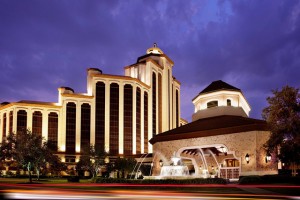 plummeted 11% in September. Boyd casinos got the worst of it, down 10.5%. New Orleans was flat but Lake Charles took a bashing, plunging 18%. Baton Rouge‘s mere 3.5% decline looks like a triumph. Golden Nugget slid 23.5% to $21 million, as L’Auberge du Lac squeaked past with $22 million, down 10%. Isle Grand Palais shed 15% ($7 million gross) and Delta Downs was 21% off the pace with $12 million. L’Auberge Baton Rouge actually gained 5%, clocking in with $12 million, while Casino Rouge dropped 9% to $4 million. That was far better than Belle of Baton Rouge, a sorry $2 million and 29% freefall.
Land-based casinos bested riverboats in New Orleans, with Harrah’s New Orleans grossing $24 million (+3%) and Fair Grounds racino snaring $3.5 million (+6%). Amelia Belle was flat ($3.5 million), Boomtown New Orleans grossed $9 million (+2.5%) and Treasure Chest garnered 3% less ($8 million). Up in Shreveport/Bossier City, overachiever Margaritaville fell 15.5% but still came within a hundred grand of Horseshoe Bossier City ($12 million, -23%), the traditional market leader. Eldorado Shreveport tumbled 18% to $8 million and Boomtown Bossier slid 8.5% to $4 million. Sam’s Town fell 11.5% to $5 million while Harrah’s Louisiana Downs was flat at $3.5 million. Better luck next month, everybody, and stay dry.
* Third-quarter results are in for Las Vegas Sands and they’re fairly good. Occupancy held steady on the Las Vegas Strip at 94.5%, with room rates averaging $236, up 4%. Slot handle was up 7% ($739 million) but table wagers 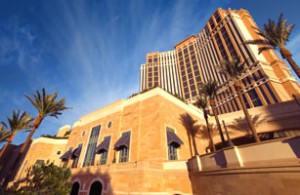 were down 7%, with $473 million being bet at Sheldon’s Place. Credit Suisse analyst Ben Combes called the results “mixed,” noting that the headline item was a beat of Singapore estimates, thanks to high hold percentages. “While Macau missed, the gain in mass share from last quarter is a positive. We remain Neutral on LVS in the near term, as macro and policy concerns in Macau drive limited visibility on revenue cadence, and license renewal uncertainty could inhibit some potential buyers. We’re positive on the long-term outlook, given leverage to growth in Chinese wealth, outbound travel, and consumption,” he added. Like many other analysts, he looks forward to an early 2020 turnaround.
Mass-market and premium-mass revenues were up 9% (lagging the overall market’s 18%) in Macao but VIP play got hammered, down 36%. Combes reported that the openings of The Londoner (formerly Sands Cotai Central) and Four Seasons have been pushed back but, once open, they will enable LVS to capture more mass-market custom. Unlike some, he doesn’t blithely assume concession renewal in 2020, predicting “competitive lobbying” for the six licenses.
J.P. Morgan analyst Joseph Greff saw the Macao results as “both good and mixed, with better than expected mass table [gross gaming revenue] performance,” up 9%. “In Las Vegas, hold adjusted [cash flow] was right in line 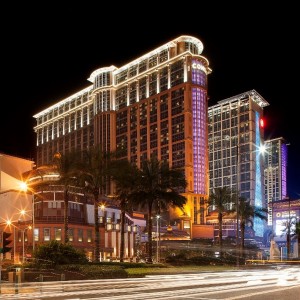 with solid growth in non-high-end table segments … Overall, there are some good and less-than-good things to pick at, but relative to low investor expectations amid China/trade/macro fears, the 3Q performance is probably good enough for the stock to stabilize near current levels.” In Japan, Sands “has to be in a strong position” for the Yokohama market, particularly given its successes in Macao and Singapore, plus a relatively un-leveraged balance sheet. (MGM Resorts International, take note.) Greff trimmed his estimates for 2020 just a hair, predicting Sands to make over $5.4 billion.
Sands will be spending $3.3 billion on its new hotel tower at Marina Bay Sands, plus $400 million on London Tower Suites and $450 million on Four Seasons  suites. (Still now word on whether the St. Regis will ever be finished.) “The Four Seasons should benefit from 300 suites that should drive premium mass and junket business while the Londoner will benefit from additional gaming space,” wrote Greff.
Sheldon Adelson‘s Las Vegas Review-Journal declares that the $4.2 billion Bellagio sale “may be” the most expensive real estate transaction in the history of the Strip. May be? Either it is or it isn’t. Make up your mind.
* Preventing money laundering is difficult so we might as well just give up. That’s the defeatist talk coming from one Ronald F. Pol, even as he acknowledges that AML  investigations are turning up money hand over fist. Evidently, rule-breakers like Crown Resorts are the standard by which everyone should be judged. Pol argues that AML efforts, which have seen American casinos step up to the plate, are “a waste of time, and some of it might be doing more harm than good.” His argument is predicated on the statistic that far more laundered money is getting through than is being interdicted. Once again, it’s hard so why try? Writes Pol, “The system isn’t designed to demonstrate its impact on crime. Jin Yuan Finance, for example, was fined because it breached anti-money laundering laws, not because there was necessarily laundering or any other crime.”
While faulting the present AML regime for being badly established, Pol offers nothing in its place … nothing but abject surrender to organized crime, that is. “Complicated laws, armies of regulators and costly compliance tasks give the comfort of activity and feeling of security, but they don’t make us safe from serious crime and terrorism. To resolve it, we must frankly confront the reality of its failure,” Pol concludes. If he’d been regulating casinos back in the Eighties, Lefty Rosenthal would never have made it into the Black Book, would he?
* One of the longest-shot casino bids in Illinois history is a step away from becoming reality. Williamson County approved a $180 million casino project for Walker’s Bluff Winery, sending the proposal onto the Illinois Gaming Board for approval, which could take as long as a year (as we are constantly being reminded). The county approval is a tribute to the persistence of winery owners Cynde Bunch and David Bunch, who have been pursuing this dream for years.
* Hey, Big Gaming: 32% of consumers surveyed say they feel properly rewarded for loyalty when fees are waived. So how about rescinding some resort fees? You may be surprised at the effect it has.
