

Citing an obvious saturation (already) in the Massachusetts market and the possibility of a tribal casino in Taunton or on Martha’s Vineyard, the Massachusetts Gaming Commission punted the award of the state’s final  casino license into the indefinite future. In the words of the Boston Globe, “regulators were in no rush to add more variables to the equation.” As Commissioner Enrique Zuniga put it, “I currently feel no sense of urgency. We have not seen the levels that the applicants themselves predicted, because they did predict certain revenues from year one, and they’re not currently seeing those revenues.” The MGC may authorize a re-study of the issue, although it’s not clear whether that will change anything—although it might justify lowering the capital commitment of investors who want to bring more gaming to southeastern Massachusetts.
This is yet another setback in Neil Bluhm‘s quest to bring a $677 million casino to Brockton (shown). A competing proposal for a racino in Wareham would  require amendment of the casino-enabling legislation. That’s not as improbable as it sounds: Lawmakers are looking at the law with an eye to bringing table games to Plainridge Park, among other things. However, Taunton/Brockton-representing state Sen. Marc Pacheco (D) cautioned the MGC against authorizing a Region C casino, lest investors find themselves with “having a Native American casino opening up next door.” Meanwhile, a bill that would give the Mashpee Wampanoag a path to a Taunton casino is stalled in the U.S. Senate and faces the certainty of a Donald Trump veto, The Donald having already Tweeted his opposition.
The Bay State may be nascent in the casino industry but its Asian-American community already has a gambling problem. A new study recommends, among other things, gambling-counseling services “tailored to the community,” as well as further study of the Vietnamese- and Cambodian-American populations.
* Singapore‘s government evidently doesn’t feel it’s done enough to discourage gambling by its constituents: It’s raising casino entry fees by 50%, making for a very expensive night on the town. (It’s already not cheap, costing $1,467 for an annual pass.) Some gaming 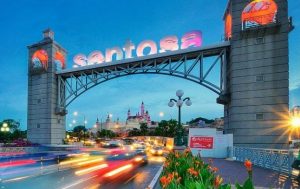 analysts think this bodes ill for Marina Bay Sands and Resorts World Sentosa. “With such a steep hike, we gather that some will not renew their annual passes when they expire, exerting downside pressure on mass-market gross gaming revenue,” said Samuel Yin Shao Yang. Already, Sands has seen a slight dimming of slot handle. Explained Yin, “the mass market segment, in our view, is more important that the VIP one as its earnings before interest, taxation, depreciation and amortisation margin is approximately 60 percent or 2 time to 3 times that of VIP.” As for the government, its stated intent is to minimize “the social impact of problem gambling.”
Jottings: Ladbrokes Coral got off easy after being caught paying $1.2 million in hush money to the victims of scammer Tony Parente. It must 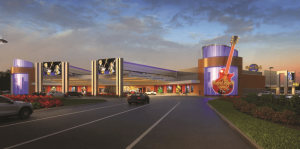 be nice to be able to buy your way out of trouble … Hard Rock Gary (shown) is a ‘go’ after Hard Rock International‘s compliance committee determined that there was nothing untoward about the way in which Spectacle Entertainment acquired the land … Dan Gilbert made a good deal on his remaining Ohio properties, selling Jack Thistledown and Jack Cleveland (which never lived up to its potential) to Vici Properties for $843 million. Gilbert will pay $66 million a year to continue operating the duo for 15 years. The deal continues Caesars Entertainment‘s problematic relationship with Ohio having been in, out and now in again … Harrah’s Resort in Atlantic City having been offloaded to Vici, Eldorado Resorts may feel relieved of the obligation to sell another asset, especially with Bally’s Wild Wild West performing well these days. The remaining Caesars/Gilbert joint venture, woebegone Horseshoe Baltimore, is optioned to Vici, as are Caesars’ two Indiana racinos.
