

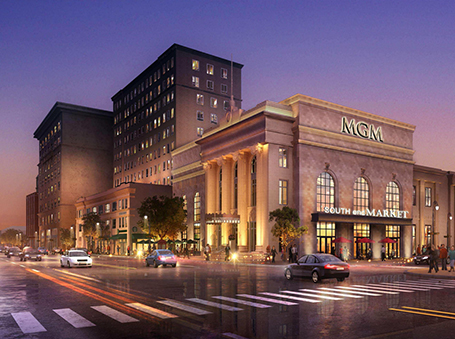
Gambling revenues nudged upward a bit in Massachusetts, rising 2% from a year earlier. April’s numbers had Encore Boston Harbor far in the lead with $64 million but flat year/year. MGM Springfield (shown) had quite a good month, up 5% to $24 million, while Plainridge Park did almost as well, rising 4% to $13.5 million. Sports betting was lucrative, bringing home $60 million on $579 million in handle. Favorite son DraftKings scored a much-needed win with $29 million in revenue, followed by FanDuel‘s $22 million. (The two had been deadlocked last month.) WynnBet tumbled below the Mendoza Line, while Barstool Sports slumped to $2 million after a strong-ish start and BetMGM fell way back to $5 million, more indications that revenue was flowing DraftKings’ way. Caesars Sportsbook held its ground with $2 million.

Indiana‘s gambling winnings fell 8% last month to hit $211 million. The sky isn’t plummeting, however. To put this in context, Hoosier State gambling is back where it was in 2019, a very good year for casinos. So the ‘new normal,’ if that’s what this is, looks a helluva lot like the old normal. Hard Rock Northern Indiana continues to run rampant, grossing $39 million (+3%) and putting a hurt on Horseshoe Hammond to the tune of -19%, although Horseshoe H. still netted an impressive $26 million. Other northern-tier competitors fared relatively better, with Blue Chip down 6.5% to $12 million and Ameristar East Chicago stumbling 9.5% to $17 million.
Horseshoe Indianapolis ceded 4.5% but was still good for second place statewide with $26.5 million. Sister property Harrah’s Hoosier Park plunged 17% to $17 million. Also taking hard shots were Hollywood Lawrenceburg, sliding 15% to $13 million, and French Lick Resort, licked -10% to $6.5 million. Caesars Southern Indiana dipped only 2% to $22 million, while Belterra Resort fell 8.5% to $8 million. Bally’s Evansville was good for $15 million (-7%) and Rising Star grossed $3.5 million (-9%). If you’ve not been keeping score at home, only Hard Rock was revenue-positive for the month. Sports betting operators brought home $29.5 million, primarily to FanDuel ($12 million) and DraftKings ($9 million). Other operators of consequence were Caesars Sportsbook ($2 million) and BetMGM ($3 million). The inconsequential ones were Barstool Sports, PointsBet, BetRivers, uniBet and WynnBet, none of whom cracked the $1 million threshold and some of whom didn’t even come close.
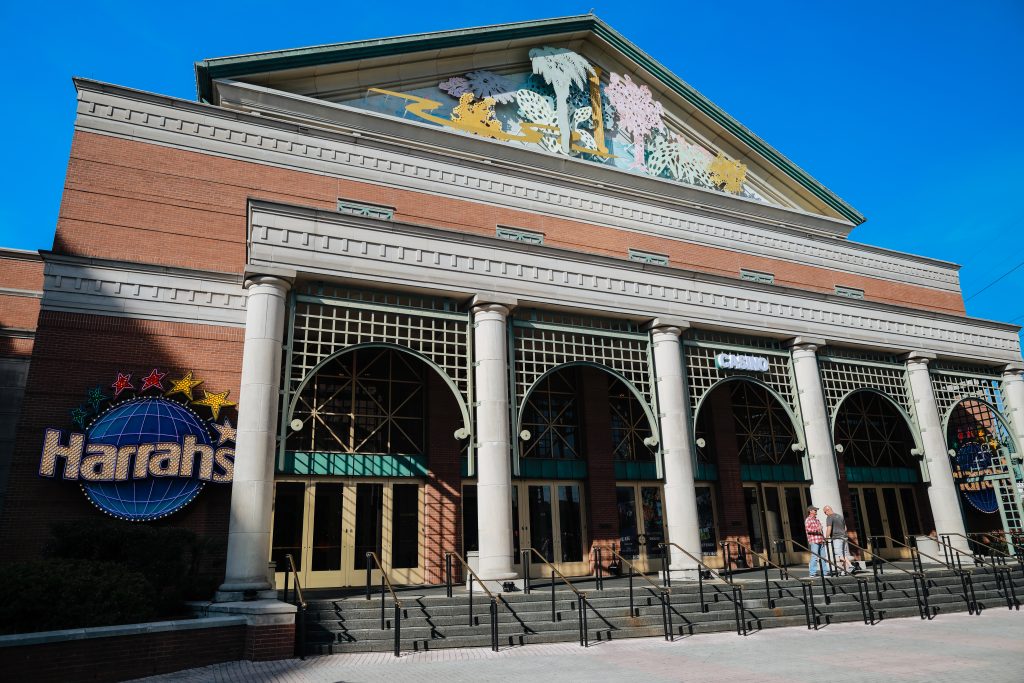
Louisiana is just plain snake-bitten these days and would have fallen 12% in April if it weren’t for Horseshoe Lake Charles. As it was, the Pelican State was down 8% on an unadjusted basis, grossing $201 million. Visitors came less (-3%) and spent much less (-6%). Inflationary pressures? It’s as good an explanation as we can think of. Compared to Massachusetts’ quick start in sports betting, it still fails to flourish along the bayous. Operators only won $23.5 million on anemic handle of $211 million. At least they’re not throwing good money after bad, curbing promotional outlays to just over $1 million.
Conversion of Harrah’s New Orleans into a Caesars-branded property is taking forever and may account for the 21% plunge to $21 million. Similarly afflicted was Treasure Chest, screaming -24% to $7 million. But how to explain an 18% declivity at Boomtown New Orleans ($10 million)? By contrast, Fair Grounds racino can be said to have done well, ceding only 3.5% to make $3.5 million. Outlying Amelia Belle sank 17% to $3 million and Evangeline Downs was 7.5% down to $6.5 million. In Lake Charles, Horseshoe’s $9 million was largely cannibalized from the competition, as L’Auberge du Lac led the area with $27 million but shed 8%. Likewise Golden Nugget dipped a concerning 15% but was still good for $26 million. Delta Downs absorbed an 8% hit but made $15 million.

Baton Rouge was plenty predictable, with L’Auberge Baton Rouge (above) way out front with $16 million, only a 2% slippage. Hollywood Baton Rouge tumbled 14% to $4.5 million, while Belle of Baton Rouge eked out $1 million for a 19% dropoff. In Shreveport/Bossier City, leader Margaritaville fell 9.5% but still banked $18 million. Next best was Horseshoe Bossier, whose $12 million represented a 21.5% freefall. Also hit hard was Sam’s Town Shreveport (-18%, $3 million), although local politicians are trying to ride to the rescue by—Bleah!—bringing back smoking. Boomtown Bossier took a -14% whack to reach $4.5 million and Bally’s Shreveport was the lone casino in the state to gain revenue, up 12% to $9 million. Louisiana Downs slipped 8% for $3.5 million.
Why doesn’t that uncaring Merrick Garland just snap his fingers and stamp out offshore, illegal gambling sites? Why indeed? For those like Bill Miller of the American Gaming Association, who have stopped just short of calling for military intervention to shut down black-market competitors who have the impertinence to be overseas, Richard Schuetz has a hard dosage of reality. For starters, the State Department would be the correct repository for AGA grievances, since we are dealing with corporate citizens of sovereign nations (unless you believe in gunboat diplomacy when it comes to gambling). As Schuetz writes, “I can assure you that the State Department will be interested to know that U.S. special interest groups desire to close businesses in foreign countries, so leaving its officials out of the loop would not be in the signer’s interest.”
There’s also the nasty aspect of meddling in the internal business affairs of another country. The U.S. government “will not sacrifice a good relationship with a country over a betting shop, plain and simple,” especially if no lives are at stake. (No, Miller’s bruised ego doesn’t count.) Incidentally, the petitioners who are barracking Garland seem to have no idea how he—or Secretary of State Anthony Blinken—would make these baneful, international sites just up and go away, let alone deal with the economic fallout that came with getting their wish. Miller needs to book some Zoom time with Schuetz … or read the monthly gaming-legislation updates in Casino Life magazine (which we edit) to learn the niceties and intricacies of gambling law beyond our borders. The AGA’s outlook is, for the moment, as parochial as its name.
Evidently having some free time on its hands, the Culinary Union has launched FertittaJetWatch.org, to dramatize the free-spending C-Suite habits of the Fertitta Brothers. The last time we looked (which was several years back, we admit), CEO Frank Fertitta III was the most grossly overpaid CEO in gaming relative to the magnitude of his company. The Fertittas’ stratospheric attitude of themselves translates into some high-altitude jitterbugging, as in 307 jet flights per year, according to Culinary stats. (This is the same company that poor-mouths workers when they try to unionize, God forbid them.) If Station wants to live up to its “solid citizen” reputation, perhaps the corporate jet shouldn’t have zipping off the Great Britain last September 11. Station has no casinos in the United Kingdom to the best of our knowledge and is unlikely ever to have any. Quo vadis, Frank III?
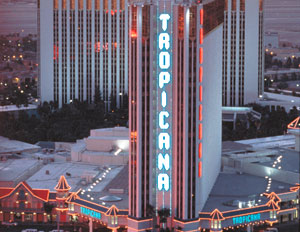
Jottings: As though it weren’t manifestly clear that Bally’s Corp. Chairman Soo Kim isn’t in full possession of his marbles, he’s literally giving away nine acres of Tropicana Las Vegas land to the Oakland Athletics. (Not that the land is Soo’s to give.) That’s $180 million worth of release estate gone “Poof!” … Don’t read too much into sky-is-falling tales of showbiz on the Las Vegas Strip. The mortality rate of shows (especially those that star Criss F. Angel) seems pretty normal … Score one for former buffet workers at Resorts New York City, whom Genting Group sacked without notice in 2014. An appeals court has ruled that Genting violated the federal WARN Act and thereby rescued a struggling class-action lawsuit against the operator. Should Genting be juiced into a New York City license when it behaves like that?
