
Poor MGM Springfield. It’s not even finished and MGM Resorts International is already off on a snipe hunt in Connecticut. Like Steve Wynn many years ago, it is proposing a casino for Bridgeport. MGM says it is prepared to invest $675 million in  the project and pay annual host-community fees of $8 million. CEO Jim Murren must be really scared of that tribal satellite casino in East Windsor, even though it won’t be open before he starts doing business in Springfield. MGM’s promising 7,000 jobs for the depressed Bridgeport area and $50 million to the state in exchange for a license. It’s even commissioned a design for the casino-hotel. Desperate much?
Getting a bit carried away, Murren promised, “This project can help to turn the economic tide of this state. We just need the political commitment to make it happen.” That’s a pretty heavy burden of expectations for a casino, even an MGM one. On the one hand, he can point to the dramatic effect of MGM National Harbor in expanding Maryland‘s casino market. On the other, to what extent is a Bridgeport casino going to merely 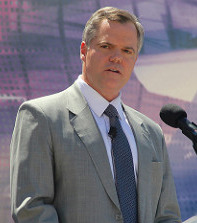 cannibalize play that would normally go to Foxwoods Resort Casino and Mohegan Sun? The tribes understandably scoffed, with spokesman Andrew Doba saying, “Simply put, authorization of this facility would violate the existing compacts between the two tribes and the state, which would immediately end the slot payments that currently sends the state hundreds of million a year in much need revenue.” That’s hitting Gov. Dannel Malloy (D) where it hurts. As it is, Malloy’s office played party pooper, issuing a statement that “It is important to note that gaming is not currently authorized in Bridgeport under current law.”
The proposed casino wouldn’t be a behemoth on the Mohegan Sun scale. It would have 160 table games, 2,000 slot machines and 300 hotel rooms. In short, it’d be more a resort for day-trippers than vacationers. At least we know that MGM’s flirtation with Bridgeport was more than a diversion and the company really does have it bad for the southern Connecticut market.
In other MGM news, it rolled out a new ad campaign, “Welcome to the Show” last Sunday night. In it, the company proclaims itself to be in the “Holy Sh*t business.” Don’t be fooled by the roaring lion, however. The big cats got evicted years ago.
* Battle lines are being drawn up in York County, Maine, over a controversial racino referendum. As noted previously in this space, the ballot question is cleverly worded so that sleazy casino speculator Shawn Scott and only he can benefit. Scott is promising to invest $175 million in the casino, generate 2,100 jobs and increase the tax base by nearly $50 million a year. Scott,  however, hasn’t much of a track record as a casino operator and is unlikely to pass the smell test with Maine regulators, so this could be the preliminary to a big real-estate flip. I wouldn’t bet against Gaming & Leisure Properties or Caesars Entertainment swooping in with purchase offers should the initiative pass. That’s Scott’s modus operandi, according to one Maine newspaper: “Buy a struggling facility, push to add gambling through the citizen initiative process and then leave town after regulators start digging into his past.”
(Typical Scott chicanery: “The phone number listed on the committee’s registration form to the Maine Ethics Commission is invalid. It belongs to a woman named Gladys, who said she had no idea who Shawn or Lisa Scott were.”)
The board of selectmen in the town of York, meanwhile, are likely to vote “no” if asked to host a casino. Said Town Manager Stephen Burns, “Setting this up for only one entity is pretty  ludicrous, and I think it’s a pretty safe bet we are going to be opposed to this again, but we are going to have to wait and see.” Other cities in the area are more equivocal, even though Scott and sister Lisa Scott remain under multiple investigations. As state Rep. Louis Luchini (D, left) says of the Scotts, “This ballot question committee has been so fraudulent from beginning to end. They have shown a blatant disregard for Maine laws and, frankly, should know better.”
* Major casino companies are, by and large, ignoring the e-sports phenomenon. Thankfully, the boffins at the University of Nevada-Las Vegas are not. Quietly, it began offering a course in e-sports, along with a workshop devoted to same. “It fits the International Gaming Institute’s model of innovation to support the gaming industry, while touching on something in popular culture that exploded,” Hospitality Lab Director Robert Rippee told the Las Vegas Sun. Unlike casino executives, “The students had a good grasp of … how the industry is developing,” said Millennial Esports CEO Alex Igelman. The overall goal of the lab is to develop ways to mesh e-sports into the traditional casino matrix.
That includes things like addressing the gender gap in e-sports, currently dominating by pimply fanboys. “I’d like to hear from some of the women in the class and the guys as well, to see what they feel about the gender issues. Because I’d like to learn from that and see if I could implement that in my business here,” Igelman told the Sun. Since UNLV is grooming the next generation of casino executives, there’s hope for getting the industry out from behind the e-sports curve yet.
