
“Vital in terms of the process of concession renewal,” is how MGM China CEO Grant Bowie described new, $3.4 billion MGM Cotai. The megaresort opened a year behind schedule but MGM undoubtedly hopes Macao authorities overlook that an focus instead on the glittering new resort and its amenities (which include a rich collection of fine art, curated by co-owner Pansy Ho). Bowie acknowledged as much, saying, “The concession renewal will not be determined by how successful we are at running casinos, but by how successful we are at diversifying and allowing Macao to become more than just a gaming town.” (It’s a gaming town, incidentally, where casino revenue rose 6% last month.) With three resident shows, and the world’s largest indoor LED screen and indoor garden, MGM Cotai doesn’t stint on the extras. MGM Resort International CEO Jim Murren has even talked of exporting Lady Gaga to the 10-configuaration showroom, along with other MGM headliners. (But really, Jim, isn’t Cher pretty played out?) E-sports tourneys have also been mooted for the space and MGM is even making a play against Sands China for the convention trade.
Like MGM Grand Paradise on the peninsula, MGM Cotai had to contend with a small footprint, which may have more than a little to do with the resort’s striking verticality. While MGM has two years now in which to make its case for concession renewal, that’s an eternity compared to Sociedade de Jogos de Macau, which will be lucky to finish much before 2020 and has, reputedly, the worst site on the Cotai Strip. What would happen to the dozens of SJM-run casinos around Macao if the unthinkable happenedand it was stripped of its concession. (SJM has not made a strong case for diversification.) As for the high cost of MGM Cotai — more worrisome perhaps to investors than  government officials — Bowie makes a convincing argument: “We increase the probability and continue to improve our belief that we are deserving of an extension by the actions we carry out, so having to invest this amount of money is part of the process of demonstrating our commitment to Macao. Clearly when you’ve invested $3 billion, the money can’t leave Macao. That’s a big indication from us at MGM and all of our shareholders that we are committed to Macao for the long term, we are innovating, we are responding to the strategic requirements.” As a comfort to Wall Street, he added, “We spent a lot of money on this property and our expectation is that we will meet our shareholders’ expectations in terms of our return on that investment … I’m not going to give any forecasts at this time but we’re very comfortable that this is a good investment, that it will return to our shareholders and will return to Macao itself.”
Bowie even compliments the local authorities on playing their concession-renewal cards so close to the vest, saying “makes all of us work harder.” Despite the frequent construction delays, MGM still was unable to avoid a soft opening, with only 500 hotel room on line. 890 rooms and 27 high-roller villas remain to be finished and junket operations won’t kick in until the summer. VIPs also got but a limited allocation of the casino’s 177 table games: 12. For these reasons, some stock analysts 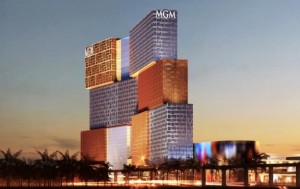 skeptical. A Morgan Stanley one wrote that MGM would gain speed “slower than that of peers due to the late opening of casino/VIP tables and a lower number of tables being allocated.”
A Sanford C. Bernstein boffin opined that it would take 18 months for business to ramp up, adding, “While the property brings some new elements to Macau and MGM’s food and beverage offering has greatly improved, the casino layout, in our view, is not ideal and suffers from the property’s long, narrow footprint. That being said, it is likely the property gets a better share of walk-ins than Wynn Palace as it is better located, but the high-end business will not be as impressive.” Making the ‘pro’ case, Union Gaming Group‘s Grant Govertsen penned that “No other company’s Cotai project will have as meaningful a market share impact as MGM Cotai, given how much leverage the company will have in terms of the increase in number of hotel rooms and the increase in gaming supply. The ramp of MGM Cotai is therefore likely to be as quick, if not quicker, than the peer group.” May the best concessionaire win.
On another MGM battlefront, Connecticut, on the eve of demolition work in East Windsor, the Lege might take back the satellite casino it gift-wrapped for Mohegan Sun and Foxwoods Resort Casino, and open the process for bidding. A bill has been introduced in the Public Safety & Security Committee that would “repeal the authority of MMCT 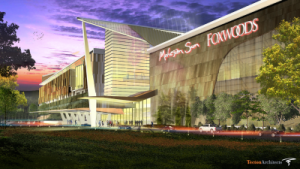 Venture, LLC,” the Foxwoods-Mohegan joint venture. The winning bidder would have to build a $500 million casino, pay $50 million for a license and put up a refundable $5 application fee.
For lack of a civic permit, MMCT has had to postpone demolition of the cineplex on which its casino would be built. Still, the joint venture is undaunted, with spokesman Andrew Doba warning balefully, “Make no mistake about it, this bill is going to cost thousands of people their jobs and the state hundreds of millions in revenue.” At present, MGM Springfield is a cinch to beat East Windsor to the finish line. “I think it’s going to take them at least 20 months to build it,” opined East Windsor First Selectman Robert Maynard. Still, it’s a good deal for the city if the casino is built, as MMCT is obligated to pay $5 million in property taxes and $3 million in service fees annually. We continue to be suspicious of MGM’s sudden ardor for Bridgeport, not only because it’s a late addition to its business plan but it materialized only when the threat from East Windsor became real — and now may become unreal. What if the bill passes, MGM wins the bidding war and then sits on the license? Has anyone considered that scenario?
* Like the dog that caught the car, Greenwood Gaming has no strategy for its new mini-casino in Pennsylvania. More to the point, it doesn’t even have a site. (A prerequisite for building a casino, wouldn’tcha think?) Considering that Greenwood was one of the  opponents of the mini-casino plan, this cart-before-the-hourse revelation shouldn’t come as a complete surprise. As one newspaper put it, the disclosure “means everybody in the 30-mile circle that Greenwood has bought development rights to can be: A) nervous; or B) excited, depending upon how you feel about adding ‘casino town’ to the way your town is identified.”
* In other Keystone State news, Pennsylvania casinos won’t be able to offer online play within their physical boundaries. It’s all somewhat confusing but is explained thusly: “the premise that a land-based casino would fire most of its workforce and replace its slot machines and table games with tablets and computer screens because the tax rate is lower is absurd.” Also, at a 59% levy, it remains to be seen how many Pennsylvania casinos apply for the right to offer low-margin Internet play.
