

MGM Resorts International stepped in it — at least momentarily — when it elected to sue victims of the Mandalay Bay Massacre in federal court. The Twitterverse briefly arose in #BoycottMGM outrage, but it died down by day’s end and MGM  stock price was unruffled. The company did, however, obliquely acknowledge that ‘MGM sues victims’ makes a bad headline and tried t0 explain its hair-splitting legal strategy: “We have filed what is known as an action for declaratory relief. All we are doing, in effect, is asking for a change in venue from state to federal court. We are not asking for money or attorney’s fees. We only want to resolve these cases quickly, fairly and efficiently.” (And in MGM’s favor, of course. Hence the forum-shopping in the Ninth Circuit.)
By filing the suit, MGM placed itself in a no-win PR situation, as crisis-management expert Eric Rose elucidated. “They couldn’t explain the lawsuit in a sound bite, and therefore they are suffering the consequences with bad headlines. It makes it look like they are going after the victims. It is going to hurt their brand.”
Las Vegas Review-Journal reporter Todd Prince delved into the pages of MGM’s legal filing and found some damaging verbiage. “If defendants were injured by Paddock’s assault, as they  allege, they were inevitably injured both because Paddock fired from his window and because they remained in the line of fire at the concert,” the lawsuit reads. Yup. MGM went there. It blamed the victims. Gosh darn them, why did they have to remain in the line of fire, creating all these lawsuits for MGM? For the short term, MGM will look Too Big To Care. However, other than the lingering stigma at Mandalay Bay itself, we don’t expect the backlash to generate much more than a blip in the 3Q18 filing. MGM’s seen worse. Don’t forget this is the company that came within hours of a CityCenter bankruptcy.
MGM’s defense hinges on the Support Anti-Terrorism by Fostering Effective Technologies Act. The company’s event-security subcontractor was certified by the Department of Homeland Security, pursuant to the Safety Act. However, since the FBI has been disinclined to classify shooter Stephen Paddock as a terrorist, there could be a flaw in MGM’s reasoning. According to one news report, “The request is both a 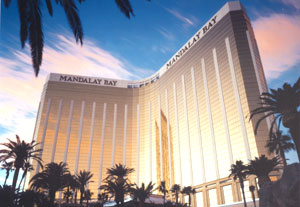 way of streamlining the more than 2,000 individuals who have brought lawsuits or threatened to bring lawsuits against MGM, and also an attempt to prove to a judge that it followed the letter of the law and shouldn’t be held responsible.”
Victims’ attorney Robert Eglet retorted, “This is the first time that we’re aware of that anyone has raised the Safety Act and tried to basically get out of responsibility for their negligence by trying to use the Safety Act.” One news report opines that “While this ‘lawsuit’ by MGM will be perceived as an aggressive, offensive maneuver, it’s the opposite. It’s really a request to determine the extent of MGM’s proposed defense.” Contractor Contemporary Services Corp. probably needn’t worry about being pushed under the bus, given its DHS certification.
Adds LVA publisher Anthony Curtis, “MGM is technically ‘suing’ the defendants, but not in the familiar ‘personal injury’ sense. That is, MGM is not accusing the victims of carelessly causing MGM harm, nor are they demanding money from the bereaved. This case will not culminate in emotional testimony from shooting victims before a jury. It’s likely that this case will be decided by a judge, with little or no testimony required at all.” We can see where that would gratify MGM — and engender resentment among the victims.
In better MGM news, the opening of MGM Springfield has been moved forward a month, set for August 18. Friedmutter Group‘s design work sounds exciting: “The reimagined architecture will include whimsical design elements with tributes to local denizens Dr. Seuss and Emily Dickinson, among others … The company will restore the United Electric lobby with its terrazzo floors, marbled walls and stained-glass dome.” The future of Springfield is going to owe a great deal to its past. It will be $960 million well spent.
* Marc Lasry, venture capitalist and “george” Democratic Party donor, has kept a low profile since being run out of Atlantic City by Carl Icahn. But he’s back in the news again, buying Navajo Generating Station and the coal mine that sustains its noxious fumes. Lasry’s modus operandi is to purchase “distressed assets.” Anybody who’s been the owner of Trump Entertainment Resorts is definitely an expert on what constitutes a distressed asset.
* The University of Nevada-Las Vegas‘ Fertitta Football Complex has run into — surprise, surprise — cost overruns. The school is going to use the complex as is an figure out how to finish it later. Will Lorenzo Fertitta and family pony up the $5 million shortfall? They’re not talking.
* Dan Gilbert never got around to building that permanent casino in downtown Cleveland. But he built himself a nice corporate headquarters in Detroit. It’s good to know he’s got his priorities in order.

“MGM Resorts has decided to stop talking and start doing, in an attempt to streamline the settlement process. Our desire is to provide structure, clarity and certainty for all involved in a compassionate manner and a reasonable time frame.”
I’m a 60 year old, high school graduate (who is drinking beer) MGM stockholder. And I’m wondering howcum I can dream up and type that sound bite in five minutes?