

Our post yesterday about “robot” bartenders coming to MGM Resorts International properties on the Las Vegas Strip struck a nerve in the lion’s den. Understandably concerned with the mental image of customers expecting to get their drinks from a Cylon, MGM had a list of talking points it wanted to share with S&G readers. First of all, you can put thoughts of Tipsy Robot out of your mind. The technology MGM has in mind is probably something like what’s demonstrated below, although an MGM source said the company hadn’t settled upon the hardware yet.
MGM also said that …
-
- Technology will be deployed at back of house casino service bars (excluding Signature and Vdara).
- Automated Beverage Systems are beverage stations that automatically measure and mix beverages with accurate pour sizes at the touch of a button.
- Customers would not see or interact with the automated beverage system. (No self-service booze, in other words.)
- Not affecting front of house, customer-facing bars.
- With this technology, employees can easily and quickly self-serve a guest’s order, reducing wait time and expediting the service process.
- No jobs have been eliminated.
- The timeline to implementation is six months.
- The new Culinary Union contract offers retraining/other roles within the casino.
- Again, no “robots.”
The question that remains begged is why a company that took home $2 billion in profits last year feels the urgency to trim a $300 million hangnail over the next two years. Yesterday we suggested greed as the moving factor. Today we offer another motivation: fear. Fear that corporate raiders will decide that MGM spends too much and has too low of a stock price, and accordingly pillage the company. MGM trades at $26.28, a far cry from Caesars Entertainment‘s $8.45/share but nobody is safe these days, not even MGM corporate brass.
* Both MGM and Caesars have to be concerned with the pressure that can be exerted upon them by speculative Canyon Capital Advisors. It holds 19,366,568 shares of MGM and 42,569,860 of Caesars. Regarding the latter, Canyon states, “Canyon’s view is that the shareholder value would be best served and enhanced by an open sale process that will be presented to shareholders for a vote thereon.” Throw in Carl Icahn and his junta on the Caesars board and the company finds itself between Scylla and Charybdis. The question of a Caesars sale/breakup is no longer one of “if” but “when.”
* Nickel-and-diming of customers is spreading to the bargain joints. El Cortez is appending resort fees to comped room nights and M Resort has apparently been doing the same. Global Gaming Business‘ Jeff Hwang had some memorable thoughts on the demise of the Las 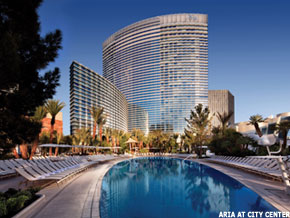 Vegas bargain premise, which make worthwhile reading. Noting the demise of at least seven bargain Strip properties and their replacement with four- and five-star hotels, Hwang writes, “the problem is not so much that Strip hotel ADRs have been on the rise—this is what you expect to happen when you replace the Boardwalk with Aria—but rather that there is an increasingly disproportionate lack of low-end hotel casino supply on the Strip. This in turn has led to the probability that we are unwittingly pricing out the more populous, lower end of the Las Vegas visitor market and stunting visitor growth outright.” Wise words.

[…] about this seemed to freak people out. They are planning on adding new automated drink systems. The Stiffs & Georges blog shared this video of the kind of machine MGM Resorts might […]