
Tribal Winds. That’s what Mohegan Sun and Foxwoods Resort Casino are going to call their joint venture in East Windsor, Connecticut. The duo has already spent $14 million on the $300 million project. Both of the tribes involved are not concealing their ire at  the Department of the Interior for not signing off on the project, which is pending approval by the state Lege, or at MGM Resorts International, which they feel has laid a heavy thumb on the scales of justice. “Heavy lobbying by MGM in the last 48 hours prior to those approvals is what halted it,” says Mohegan Tribal Nation Chairman Kevin Brown. (Compact changes with Mohegans have been approved, those with the Mashantucket Pequots not.) This has prompted area lawmakers to push for a state-level workaround. The quickest path would be to amend the 2017 law allowing Tribal Winds by removing its mandate for federal approval. Former Interior secretary Ryan Zinke faces scrutiny over the possibility that he may have lied to investigators when asked about Tribal Winds. In the meantime, state lawmakers are tempted to revisited the Nutmeg State’s tribal compacts, swayed by MGM’s promise of billions in investment, should a casino concession in Bridgeport be approved. MGM’s pitch has lost some of its persuasiveness as competition from MGM Springfield has been less than feared. The latter is also badly lagging its gaming-revenue projections, having only accrued $101.5 million of its Year One revenue target of $412 million. Tribal Winds is projected to garner $75 million annually for the state. “They’re talking about thousands of jobs and certainly more revenue for the state, so we are pleased about that and glad we are being talked about,” said East Windsor First Selectman Bob Maynard.
Solons were bracing themselves for a 25% drop in Connecticut casino revenue, but only a 9% slippage has materialized. Foxwoods and Mohegan Sun, meanwhile, have missed their start date by several months and, not having submitted an application to build, will lose one more, at least. A local lawsuit has been filed, challenging the project. In the 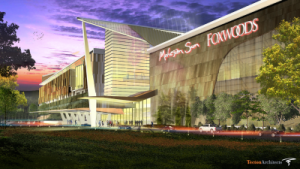 meantime, Mashantucket Pequot Tribal Council Chairman Rodney Butler is telling lawmakers that litigation from MGM — “our friends from the north” — is inevitable, lest the Lege open upon competitive bidding from fear of the lion’s wrath. MGM was not shy about repeating its sales pitch through the media. The tribes also got little comfort from Bridgeport state Sen. Dennis Bailey, who said, “I don’t know if that will still stand. We are looking at those things to make sure that whatever was done in the past is transparent and open and creates the progress that we want.” State Rep. Joe Verrengia described the tribal/MGM situation as a stalemate under which gaming expansion could not proceed. Gov. Ned Lamont has also characterized himself as being open to the MGM pitch. The minimal impact of MGM Springfield is dulling the urgency of the East Windsor issue, too. The tribes’ best ally for the moment is state Sen. Cathy Osten, who is carrying the ball for amendment of the 2017 legislation. At present, it looks like she’s got a tough row to hoe.
* Chances of a recession next year stand at 40%. That’s among the takeaways from the latest American Leisure Industry Summit. Other opinions aired included “There are a lot of antiquated products in the market today.” We hope casino companies with risky-dink resorts get that memo.
* For the first time since 2004, all Nevada casino markets saw revenue increases last year. The Silver State generated $11.9 billion in gambling revenue. That’s 3% better than  2017 and 65% driven by slot machines. The all-time high-water mark is 2007’s $12.8 billion. That’s just before the tide went out, leaving the industry high and dry for several years. “We are only 7.2 percent below the peak right now. That’s the closest we’ve been since the recession,” said the Nevada Gaming Control Board‘s Michael Lawton. That reliable barometer of fiscal health, Wendover, was up 6.5% (to $201 million). The Las Vegas Strip was relatively quiet, rising only 2% but sports books had a record take — $5 billion of handle, of which the house kept $301 million. Customers were also spending more freely, as the near-record numbers were achieved in a year that saw flat visitation levels.
* Macao got 2019 off to a downward start, off 5%. This was not unexpected, given the 14% growth levels seen last year — 36% in January of last year. “We are encouraged by the January results and view the market as being more robust than it gets credit for, especially given the [earlier] timing of Chinese New Year this year,” said Union Gaming Group analyst Grant Govertsen. Although the holiday falls on Feb. 5, it is credited with creating some anticipatory play in Macao. The numbers were also taken to mean that the effects of the smoking ban in Macanese casinos have been less deleterious than anticipated. Single-digit growth is forecast for February.
