
There’s no question that upstate New York‘s new casinos drank their own bathwater when making their case to the state. Two of them are now squealing like stuck pigs, demanding that the Lege lower their tax rates. 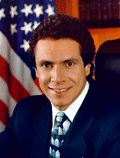 Never mind that the casinos agreed to those tax rates, nor that lawmakers — seeing less tax revenue than they’d been promised — are hardly going to assent to a still-lower amount. The casinos were supposed to be the golden goose for the Empire State’s school system. Their failure to lay eggs leaves yolk on the face of Gov. Andrew Cuomo (D) and gives challenger (and public-school activist) Cynthia Nixon a stick with which to beat him.
Cuomo had no truck with tax cuts for Del Lago Resort & Casino or Rivers Casino, the two supplicants. Said he, “The upstate gaming casinos are private concerns. They bid, they made an investment and some of them will say they’re not doing as well as they hoped or would have expected, but they’re private concerns, and I don’t  want to get into the business of bailing out private concerns.” It’s amazing how quickly Del Lago and Rivers went from whistling past the graveyard to asking for a handout. The numbers tell the story. Del Lago’s fantasy projection: $263 million in Year One. Reality: $163 million. Rivers’ fantasy: $222 million. Reality: $142 million. Lesson? Don’t go into a high-tax jurisdiction unless you’re really prepared to pay the piper. Also: Make your plans around the worst-case scenario, not the blue-sky one some consultant has dreamt up. (Word on early foot traffic at Resorts World Catskills suggests it will be Disappointment #4.)
Interestingly, the Lege did not legalize Internet gambling to make up the casino shortfall. Despite support in the state Senate the bill died in the Assembly. Gary Pretlow (D) has some explaining to do.
* Speaking of lackluster numbers, Horseshoe Baltimore is getting creative in its efforts to improve business. It is buying up adjacent land with an eye toward creating an ‘entertainment district.’ This will appeal to 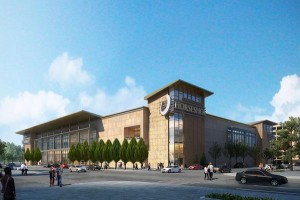 those patrons and would-be customers who find Horseshoe’s neighborhood a little dicey for their taste. As gaming analyst Alan Woinski puts it, “It’s tough to attract customers with a city that has issues like Baltimore does.” Adds a customer, “I never set foot outside of Horseshoe, not even to the gas station next door.” (So much for positive economic vibes radiating out from the casino.) At least the Horseshoe area has seen a decline in violent crime.
Horseshoe has been doing this on the QT, probably to avoid an inflationary effect on the real estate it’s eyeing. According to the Washington Post, “The goal, ultimately, is to establish a sports and 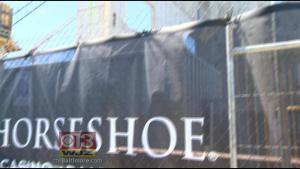 entertainment district that connects the casino through the football stadium and baseball park to the Inner Harbor.” The acquisitions include two parking lots, a warehouse and an office building, all of which has cost over $8 million. (The cost of keeping up MGM National Harbor, whose advent has seen Horseshoe’s table games take a 22% percent fall.) As a lawmaker put it, Horseshoe is “still a silo” and redevelopment of its area can’t come too soon.
* The Nevada Gaming Control Board put some teeth in regulatory language that bars casinos from serving patrons “who are visibly impaired by alcohol or any other drug.” Just imagine if that disciplinary  provision had been around when Caesars Entertainment was cleaning up off an inebriated Terrence K. Watanabe. The NGCB also relaxed a rule on sports-bet payouts, allowing them to be rolled into new wagers, among other things. Sports books are also now charged with monitoring suspicious activity, particularly bets placed by coaches and athletes. (See how legalized sports betting makes it easier to keep games on the square?) The NGCB also loosened the number of drug that may be in a racehorse’s system during a meet. Ah, the excitement of the Sport of Kings.
* It’s nothing to do with gambling but this has to be the story of the week. Why should Alabama accept what New York and New Jersey won’t keep?

The projections w/ the NY casinos has been a joke from the beginning. You knew it, I knew it, the most experienced American-based companies (for the most part) knew it.