

Now that all four casinos and seven racinos are open, Ohio posted a spectacular year/year increase of 36% in gambling revenue. However, 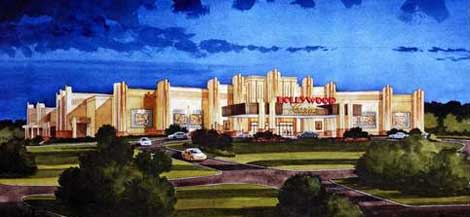 success came at a price, in terms of an 8% decline in same-store revenue, indicative of a saturated market. For instance, Penn National Gaming‘s Hollywood Toledo was up 3% year/year but slot revenue was down $21 per slot per day from August. Table play, however, (which racinos can’t offer) was up from $1,127/table/day in August to $1,234 in September.
Penn’s two, new, Hollywood-branded racinos came out of the gate with a vengeance. Hollywood Dayton averaged a win/slot/day of $207 — more than double the projection of Deutsche Bank‘s Carlo Santarelli — while, in two weeks, Hollywood Austintown averaged a mind-blowing $499 slot/day. By contrast, Pinnacle Entertainment‘s Belterra Park continued to disappoint, averaging $102.
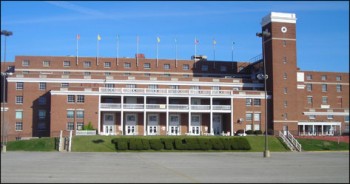 Both Caesars Entertainment casino properties, their novelty having worn off, suffered as the racinos prospered. Horseshoe Cleveland was 13% off last year’s pace and Horseshoe Cincinnati plunged 18%. Its Thistledown Racetrack (above) also had a bad month, falling 19% and easily outgrossed by Hard Rock International‘s Hard Rock Rocksino — geez, that name sounds like something from The Flintstones. (Why are players ditching Caesars’ properties and almost no one else’s?) Eldorado Resorts‘ Scioto Downs enjoyed a 7% increase.
There are clearly a lot of discretionary dollars sloshing around Ohio but are there enough for everybody?
* With the rap of a gavel, Revel became the property of Brookfield Asset Management — though not without some last-minute drama queenery from losing bidder Glenn Straub. Confronted with Revel ownership’s 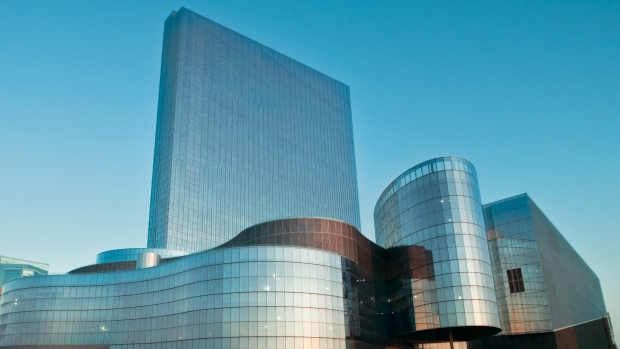 demand for a midnight counteroffer, Straub outdid ‘the dog ate my homework‘: “I got a life or death medical situation,” he told the court.” I didn’t leave [Palm Beach] with my pills. I have to take them two days a week. I’m not going to give you my medical history, but it’s a life or death medical situation.”
Straub’s narrative of shifting deadlines didn’t impress Bankruptcy Court Judge Gloria Burns, who told the combatants, “The sale was properly conducted and was fair. I haven’t heard one [other] party suggest that we 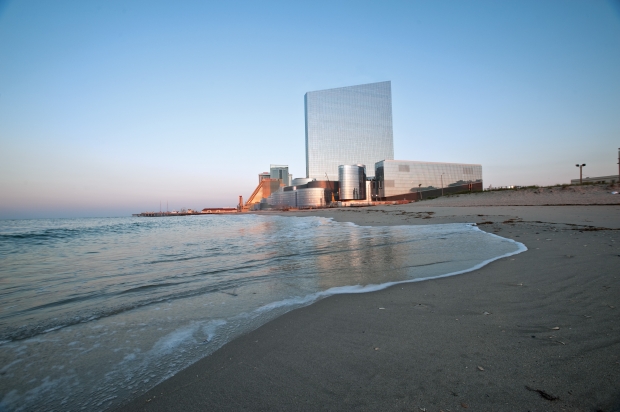 should go back and have bidding again. You have to prove to me there was some kind of collusion or fraud … and I haven’t heard that today.”
As for Straub’s pill crisis, Brookfield attorney John Cunningham said, “The rambling comments you just heard were what was in the minds of the debtors and consulting parties.” Having implied that Straub is mentally unstable, Cunningham piled on by calling him “nothing more than a disgruntled losing bidder who made a number of allegations that are clearly false.”
Those darts include a charge that unsecured creditors threatened to cause Straub to lose both his $3 million breakup fee and a $10 million. He also claimed he was promised access to all rival bids. As we’ve seen from several of his recent comments, Straub doesn’t really have it together, so it’s no wonder these dogs didn’t hunt.
