

Despite having an extra weekend day, Louisiana casinos saw revenue fall 7% in July. (JP Morgan analyst Joseph Greff blames flooding for the waterlogged numbers.) Pinnacle Entertainment did the best among major operators, up 4%, while Caesars Entertainment went into the toilet, down 29%, led by a catastrophic 38% plunge at Harrah’s New Orleans ($22.5 million). I don’t think we can blame the smoking ban, a smoke-free Fair Grounds racino was only 4% off its feed ($3 million). Across the river, where you smoke, Boyd Gaming‘s Treasure Chest was up 3% ($9 million) but Pinnacle’s Boomtown New Orleans dipped 5%, still good enough for a $10 million gross. Outlying Boyd properties suffered, with Amelia Belle down 8% ($4 million) and Evangeline Downs slipping 6.5%, to $7 million.
Lake Charles revenues — $85.5 million — almost doubled those in New Orleans. No surprise, L’Auberge du Lac was out front with $34 million and a 7% increase, followed by Continue reading
 like Sands, or as the state constitution puts it, “all taxes shall be uniform, upon the same class of subjects.” On the other side of the issue are elected officials like Bethlehem Mayor Robert Donchez, who says $10 million a year translates into 100 police officers and the “host fee is significantly important to our budget.” Added state Sen. Pat Browne, anticipating a court defeat, “I don’t know exactly how we’d go about it, but given that this fee has been established for a decade, we’re not just going to let this money be stripped from municipalities that rely on it.” However, given the Legislature’s hopeless performance on gaming-related issues last session, is it going to be able to get its act together and find a way to prop up civic budgets?
 Management and Texas Pacific Group. This bit of shadow puppetry is apparently intended to get at the goodies before junior bondholders can sue for relief (which they are enjoined from doing before the end of the month). In the meantime, Caesars has a new offer on the table, contingent upon converting CEOC into a REIT. Reports Global Gaming Business, “senior bondholders, who are owed about $6.35 billion, would get all the stock in the property company, $2 billion in cash, almost $1.9 billion in new debt and nearly 16 percent of the equity of the parent company. Creditors who hold $5.35 billion in bank loans would get $3.2 billion in cash, $2.2 billion in new debt and 5 percent of the parent.” So even if Caesars is prevalent in negotiations, it’s going to have to live with
 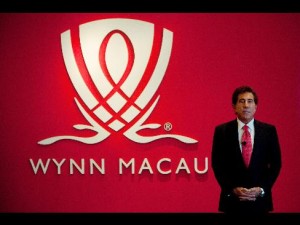 Instead, they’re suing Wynn Macau, saying “as a gaming concessionaire, [it] should be held responsible for Dore’s conduct on the basis that Wynn Resorts Macau is responsible for the supervision of Dore’s activities at Wynn Macau that resulted in the purported losses,” according to the company itself. It added that “the plaintiffs of the lawsuits allege that Dore failed to honour withdrawal of funds requests that allegedly has resulted in certain losses for these individuals.” Wynn holds that the lawsuit is without merit. (Big surprise, no?)
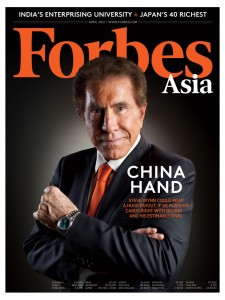 the rate of growth was unprecedented and historic and in many cases not just extraordinary but outrageous.” Careful, Steve, you’re starting to sound like a member of the Chinese government. Calling current market conditions “wonderful” — Macao’s current $29 billion/year output is anything but shabby, after all — Wynn described the present casino business as “representing more normal patterns of human behavior, and that applies as well financially.” I’m not quite sure I believe Wynn when he says he’s too busy to keep tabs on policy in Beijing: “The policies of the central government are only tangentially important to us because we’re in the middle of delivering a service. In the long run, the economy of China is going to affect all my customers and their ability to recreate [sic], but on a day-to-day basis it’s not part of our script, it’s far away from us compared with the demands of the moment.” Even if he’s sweating out such niceties as
 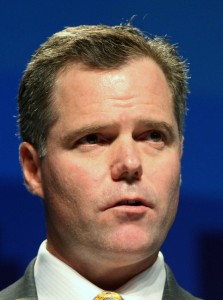 candidate works to create stability and certainty, qualities the market loves and rewards. The other operates erratically and unpredictably, qualities the market abhors and punishes.” — MGM Resorts International CEO Jim Murren, endorsing Hillary Clinton as we predicted, his
 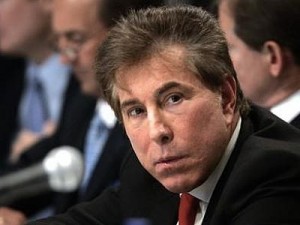 to grow the overall market; the ability of the operators to capture a disproportionate share of the market from their new openings; and the operators collective ability to defend their market share when competitors open new properties.” They were particularly skeptical of Wynn Palace, writing, “there is no conclusive evidence over Wynn Macau’s 10-year track record in Macau that shows the success of its properties in taking market share or driving incremental demand … Indeed, Wynn [Resorts] has been steadily losing market share since Wynn Macau opened in 2006. At its peak, Wynn Macau accounted for more than 17 percent of Macau’s total [gross gaming revenue]. Today it accounts for around 10 percent, or around half of the figure eight years ago.” (Steve Wynn has declined to predict what the megaresort’s break-even point or return on investment will be.) “That Wynn is able to shift 250 tables to Cotai is really telling in terms of how much demand has slackened over the past couple years,” added Union Gaming Group analyst Grant Govertsen. He thinks Wynn Palace can limp along with an emaciated table-game repertory for a year or two but that, starting in 2018, prospects get fairly dicey.
 increasing its hold on the property to 56%. In return, Ms. Ho will buy 4 million MGM shares from the late Kirk Kekorian‘s Trancinda Corp., giving her an almost 5% stake in MGM. Deutsche Bank analyst Carlo Santarelli spoke for many when he wrote, “we expect investors to be a bit confused by the rationale for this transaction. The transaction, while positive for MGM China … is a bit perplexing from MGM’s perspective. In our view, MGM Resorts is inexpensive and MGM China is trading at top of the range multiples, on our forecasts, with meaningful ambiguity in future results given the wave of new supply in a questionable top line recovery environment. While MGM Resorts benefits from Ms. Ho lightening the Tracinda overhang, it does so just modestly. Lastly, in a period in which we view domestic gaming fundamentals favorably, MGM is using its equity to
  “Truly, I think the brand is so powerful, that when other people would have maybe went under, I think that helped carry us because people are very loyal to the Binion brand. I think if we could survive the bad economy, we could survive anything.” — Binion’s Gambling Hall General Manager Tim Lager, reflecting on the resilience of the property,
  best ideas that property’s had in a long time. Storm’s “Month of Giving” campaign, in which the August marketing budget is rechanneled into charitable causes is getting noticed. It’s also getting
 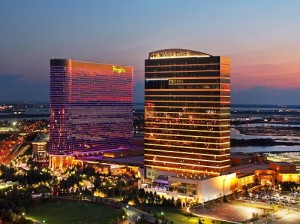 combined with a little good luck for the house, meant an 11.5% revenue uptick. Borgata grossed $81 million, a 12.5% gain, far overshooting Deutsche Bank‘s projection ($65 million). Table play was 10% higher and players lost big, with Borgata raking in 22% more than last year. Slot play was up 6% and the house had a winning edge, banking 8% more coin-in. (I’m telling ya, Boyd Gaming, you’re going to be sorry you sold your half of this piggy bank.) Borgata continues to hold the largest share of hotly contested Internet play, with the unlikely runner up being the Golden Nugget. With or without PokerStars, they’re still an also-ran at Resorts Digital, stuck firmly at the back of the pack.
 a pretty mingy allocation but is in line with Secretary for Economy & Finance Lionel Leong‘s goal of 3% table-game growth. Wynn said it was “satisfied” with the grant, as though it had any choice but to roll with the punches. The megaresort was designed with 400 tables in mind and Steve Wynn is camouflaging the shortfall by importing 250 tables from Wynn Macau. The Macanese government seems to be having a jolly good time making an example of Wynn (the CEO, not the company) after he blew his stack over governmental micromanagement of the casino industry, views that probably shouldn’t have been shared on an international conference call. We’ve come a full 180 degrees from the days when Wynn said his eponymous firm was “essentially a Chinese company” and threatened to move corporate headquarters to the People’s Republic of China. (Las Vegans practically lined up to help him move.)
 Trump’s running mate, though, is perfectly clear. While there is smoke with Trump, [Mike] Pence’s desire to usurp the states with a federal online poker prohibition is a raging inferno.” — Poker Players Alliance Executive Director John Pappas on
 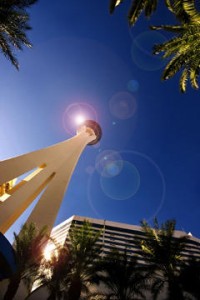 Better slot play, stronger restaurant business and greater hotel occupancy (which drove up rates) conspired to improve American Casino & Entertainment Properties‘ revenue and profitability in 2Q16. Net revenue — i.e., not profit — is on a 10-month upward roll, driven in part by a 3% increase in room rates and 4% higher slot winnings. ACEP, owner of the Stratosphere, bucked the Las Vegas trend of generating higher revenue through non-gaming amenities. With 5% fewer people visiting the sightseeing pod atop the tower and spending 8.5% less, a 10% in pod-derived revenue was the consequence. Business was flat for ACEP’s Arizona Charlie’s grind joints but the company was successful in inducing more people to stay at the Aquarius in Laughlin, where hotel revenues rose 8.5%, even though gambling winnings were only 2% up.
 for services and supplies. That’s almost half the construction budget for the Massachusetts megaresort. Essentially vowing to think globally and act locally, casino President Robert DeSalvio said, “Wynn [Resorts] is absolute in our commitment to keep as much spending as possible close to home during our nearly three-year construction phase, particularly with minority, women and veteran-owned vendors.” Meanwhile, despite federal litigation, the Mashpee Wampanoag are forging ahead with activity on Project First Light, planning to be the second Bay State casino to market, opening roughly a year from now.